Why can a Rolex cost exponentially more than a $50 watch when both tell time?
Why can Ferrari, Hermès, Apple, and Ryan Serhant create such strong demand, trust, and pricing power?
And what can tax and accounting firms learn from them?
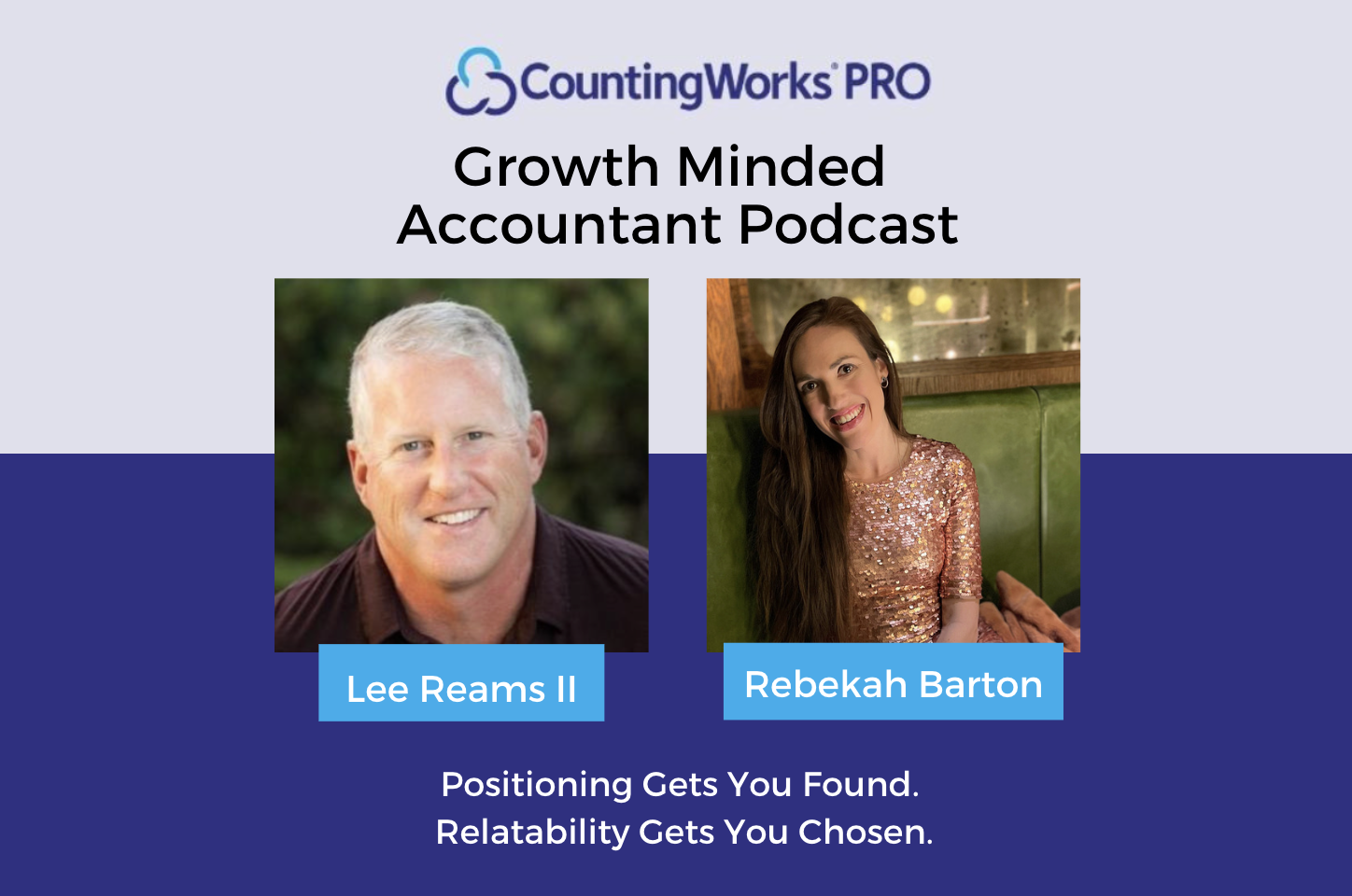
In this episode of The Growth Minded Accountant, Lee Reams II and Rebekah Barton unpack what premium brands understand about value that most accounting firms often overlook.
The big idea: clients don’t buy expertise the way accountants think they do.
Most prospects cannot evaluate technical ability before they hire a firm. Instead, they look for signals. Your positioning. Your reviews. Your website. Your content. Your visibility. Your client experience. The confidence you create before the first meeting ever happens.
In an AI-driven world where basic information is becoming abundant, trust is becoming more valuable. The firms that win will not necessarily be the cheapest firms or even the most technically credentialed firms. They will be the firms that become the obvious choice.
Lee and Rebekah break down how premium brands create value through trust, positioning, scarcity, visibility, simplicity, and experience — and why those same principles now matter more than ever for tax and accounting firms.
If you’re looking to position your firm more clearly, tell a stronger story, attract better-fit clients, and build a more premium brand, CountingWorks PRO can help.
Take our free firm assessment and discover where your firm stands across positioning, visibility, client experience, and AI readiness.
Start here: https://www.countingworkspro.com/
We know that everyone digests information differently. That’s why we’re now sharing the full transcript of each episode of The Growth Minded Accountant right here on the CountingWorks PRO blog. Whether you’re short on time, like to scan and highlight, or simply prefer reading over listening, you can catch up on every conversation at your own pace.
Each week, we cover topics that matter most to tax and accounting professionals—from AI and automation to marketing strategies, firm growth, and client relationships. Scroll down to read the full episode, or subscribe to the podcast to listen on the go.
Welcome to the Growth Minded Accountant podcast, where our experts share best practices for running your firm in the digital age. This podcast is brought to you by CountingWorks PRO.
Lee Reams: Hi, and welcome back to another episode of the Growth Minded Accountant podcast. Today we are going to talk about luxury brands. Yes, believe it or not, on the Growth Minded Accountant, we are getting into luxury brands and how this applies to tax and accounting firms.
Lee Reams: Brands like Rolex, Ferrari, Apple, Hermes, and even Ryan Serhant in the real estate industry have all done something that accounting firms can learn from. We are going to look at what those brands are doing, why it works, and how the same principles apply to firm growth.
Lee Reams: Before you think we have completely lost our minds and turned this into a luxury brand podcast, stay with me. I believe one of the biggest mistakes tax and accounting firms make is assuming premium pricing comes from being technically better.
Lee Reams: It does not. And if you are seeing more people in our profession talking about CAS pricing, value pricing, and why firms struggle to charge more, I will tell you what the problem often is: you have not positioned your firm as a premium brand, yet you are trying to sell premium services.
Lee Reams: Every year, we talk with firms that are frustrated because they are losing opportunities to competitors charging two or three times more than they are. Their reaction is usually, 'They are not better accountants than me. They are not better CPAs or EAs. They are not smarter. Their tax returns are not necessarily more accurate.'
Lee Reams: Often, they are right. The difference is usually not expertise. The difference is perception. The difference is positioning. The difference is trust. And more importantly, in the AI age, the difference is visibility.
Lee Reams: The brands we are talking about today have mastered the ability to become the obvious choice. The same principles they use are becoming more important than ever for accountants as AI continues to commoditize basic compliance work.
Lee Reams: Your clients now believe they have access to the same knowledge you have through ChatGPT, Claude, Gemini, and other AI tools. They may think, 'I am as smart as my accountant now.' The reality is that they are not, and AI tools are often wrong. But perception matters, and that is why this conversation is so important.
Lee Reams: To help unpack this, I am joined by our Chief Visibility Officer, Rebekah Barton. Welcome back, Rebekah.
Rebekah Barton: Hello. As much as I wish this were a shopping podcast, because that would be fun, this is really more of a human psychology podcast. I am very excited because this is one of my favorite topics.
Lee Reams: One of the brands we are going to talk about is Hermes. I still cannot pronounce it correctly, and my wife and daughter laugh at me for that. But we included at least one high-end fashion brand because I knew Rebekah would be into it.
Lee Reams: Let's start with the biggest misconception many accountants have: believing clients hire them because of technical expertise. Rebekah, why is that flawed thinking?
Rebekah Barton: We need to start with information asymmetry, which is a fancy way of saying that one person in a situation knows more than the other person. Accounting is a great example.
Rebekah Barton: You know tax law, tax regulations, and the tax code. Your client does not, at least not in the way you do. You understand planning opportunities. You understand how to help clients prepare throughout the year. Your client does not. That is why they need you.
Rebekah Barton: Clients do not always know what to do month over month to make April better for them. You understand compliance risk. They do not. Because of that imbalance, it is hard for clients to evaluate your expertise directly. They do not necessarily have the baseline knowledge to compare two accountants and determine which one is technically better.
Rebekah Barton: The same dynamic applies to attorneys, doctors, financial advisors, and other professionals with deep expertise in a specific area. Instead of evaluating you strictly by technical expertise, clients evaluate you through trust signals.
Rebekah Barton: Those trust signals include reviews, referrals, website quality, positioning, branding, aesthetics, consistency of content, and social proof. All of these factors come together and help people develop confidence in one brand over another.
Rebekah Barton: That is very different from evaluating your expertise. It is about evaluating the perception of your brand based on what you put into the world. That is the baseline for this entire conversation.
Lee Reams: That ties into how people evaluate doctors, tax attorneys, and other experts. I have examples from my own life. A few years ago, we were talking about restructuring our entity, and I needed a QSBS stock tax attorney. I asked for referrals from my Morgan Stanley advisor and from friends in private equity and finance.
Lee Reams: This was an important decision, and I did not want to make a mistake. There were many people with the expertise, but I needed to know who I could trust to do it correctly. That is similar to choosing a doctor for something serious. You are buying confidence in the expertise.
Lee Reams: When I researched the referrals, the same name kept appearing. The person recommended by my network was also the person I kept finding online. Everything I saw validated that this was the right choice. I was evaluating trust.
Lee Reams: That trust was built long before a consultation ever happened. By the time I reached out and engaged the attorney, their marketing, reputation, and referrals had already done the work. Many people could provide QSBS stock advisory services, but their marketing created the trust.
Lee Reams: This is one of the biggest misconceptions in the tax and accounting space. I hear firms say, 'I do not need marketing.' Then they wonder why they are floundering, why they are losing clients, why clients will not pay enough, and why they are not making enough money. The issue is that they have not built a premium brand or established trust.
Lee Reams: Let's start with Rolex. A Rolex tells time. So does a fifty-dollar watch. Yet one costs exponentially more.
Lee Reams: I recently stumbled across someone who restores watches. He restored a Rolex that survived the Palisades fire, and you could see what the watch looked like before he brought it back to life. Watching him rebuild it and seeing all the parts inside was incredible. But the question remains: what is Rolex actually selling?
Rebekah Barton: Rolex is selling the accumulated value of trust in a brand. We call that brand equity. It is the value a brand has created in itself over time. In Rolex's case, that value has been built over many decades.
Rebekah Barton: Brands like Mercedes-Benz and Ralph Lauren are also very good at this. Older legacy brands often establish themselves as premium through heritage, consistency, and repeated associations with quality.
Rebekah Barton: When people see a Rolex, they instantly associate it with quality, reliability, precision, success, and heritage. What is interesting is that consumers often assume these brands are high quality before they ever experience the product.
Rebekah Barton: Most Americans do not own a Rolex. But if asked to name the best watch brand, many would probably say Rolex or Tag Heuer because those are visible brands. Tag Heuer sponsors sporting events, PGA events, horse racing, and other environments where wealth and status are present. That visibility builds trust and community.
Rebekah Barton: When a brand has high brand equity, it becomes easier to attract new customers because people want to be part of the lifestyle they associate with that brand.
Lee Reams: Let's tie that back to accounting firms. What are some trust-building systems that a tax or accounting firm can use to start creating this same effect?
Rebekah Barton: Consistent educational content is key. People typically do not trust brands that only feel salesy. They want value. Educational content helps build trust in you as a tax professional before someone ever speaks with you.
Rebekah Barton: That can include Reels, blog posts, segmented newsletters, and content tailored to where clients are in life. All of those can build trust and create value before the consultation.
Rebekah Barton: Client testimonials are also huge. They allow prospects to put themselves in the shoes of people you have already helped. They show that your work has helped real people and that there is a baseline for what you can do.
Rebekah Barton: Speaking opportunities are also important, whether on podcasts, webinars, conferences, or in-person events. They establish authority, put your face in front of people, and help you build a personal relationship before you have ever met someone.
Rebekah Barton: Community involvement, thought leadership, and strategic partnerships with other local businesses can also help. Partnering with a financial advisor, estate planner, or another trusted professional can create high-quality referrals and build rapport before the first meeting.
Lee Reams: The goal is to create confidence before the consultation. The strongest firms are not selling trust; they are demonstrating trust through marketing and communication.
Lee Reams: If you spend most of your time trying to convince prospects during the consultation, your marketing is not doing its job. Ideally, by the time a prospect reaches out, they have already read your blogs, seen your social posts, checked your reviews, watched a video, or listened to a podcast. The consultation becomes a fit conversation, not a trust conversation.
Lee Reams: That is a completely different business model, and most accountants are not operating that way.
Lee Reams: Now let's talk about Ferrari. Ferrari may be one of the most misunderstood business models in the world. I did not fully understand the process of being allowed to buy a Ferrari until I learned more about the brand. Rebekah, what can Ferrari teach accounting firms about positioning?
Rebekah Barton: One of the foundational ideas in marketing is that value comes from differentiation. You cannot be like everyone else and still establish premium value. This directly applies to tax and accounting firms.
Rebekah Barton: You do not want to be lumped in with everyone else. You want to stand out. Ferrari does an exceptional job of this. They are not trying to be the car for everyone. They are trying to be the best car for a specific class of buyer.
Rebekah Barton: When you try to appeal to everyone, you become generic. When you become generic, you become comparable. When you become comparable, you compete on price. That is a trap for accounting firms, car brands, clothing retailers, and almost any industry where trust matters.
Rebekah Barton: If your website says, 'We serve individuals and businesses' or 'We offer tax and accounting services,' that is not helpful. Every competitor in your city, state, and across the country could say the same thing.
Rebekah Barton: Ferrari does not simply describe transportation. Ferrari describes identity. They describe who they are and who their ideal customer is. Accounting firms can do the same thing.
Rebekah Barton: For example: 'We help construction company owners build wealth.' 'We help dental practices increase profitability.' 'We help high-income families reduce tax surprises.' Those are statements the right audience can connect with.
Rebekah Barton: Specificity creates relevance. Relevance creates authority. Authority creates trust. What matters is not appealing to everyone. What matters is appealing to the right people.
Lee Reams: This is the basis for my 'cookie cutter is dead, narrative wins' campaign. Most firms are describing services instead of describing their ideal client and the outcome that client wants. That is a huge difference.
Lee Reams: Now let's talk about Hermes. Hermes is not marketing to me. I cannot even pronounce the name correctly, and I do not shop there. But they use scarcity to increase value. They make certain products difficult to get. There are limited editions, waitlists, and a process behind access. Rebekah, why is scarcity such a powerful behavioral strategy?
Rebekah Barton: Hermes does this very well. Everybody wants a Birkin, and hardly anyone can get one. There are resale markets, of course, but Hermes makes people want the product partly because it is difficult to obtain.
Rebekah Barton: Scarcity is extremely important in behavioral economics. Humans automatically assign higher value to things that are perceived as limited. That is why almost every brand has limited-edition products, limited runs, limited-time offers, or special releases.
Rebekah Barton: Even brands like Bath & Body Works do this with seasonal soap collections. It applies across price points. If something is perceived as limited, it draws attention and creates desire.
Rebekah Barton: We call this scarcity bias. If something is abundant, it feels common. If something is scarce or appears scarce, it feels more valuable.
Rebekah Barton: Most accounting firms accidentally communicate that their services are abundant. They say, 'We take anyone.' 'We serve everyone.' 'We work with individuals, businesses, and nonprofits.' That does not feel like an exclusive offering.
Rebekah Barton: Premium firms communicate selectivity. Not arrogance, but selectivity. They may have ideal client profiles on their websites. They may use an application process to determine whether a prospect aligns with their services. They may communicate capacity limits, such as only accepting a certain number of new clients each year. They may have waitlists during busy seasons.
Rebekah Barton: All of those elements communicate scarcity. They help position the firm as a provider of high-value services rather than a commodity provider.
Lee Reams: That is why certain retail stores have lines outside where people wait for permission to go inside and spend thousands of dollars. Taylor Swift also used scarcity extremely effectively with access windows, cardholder presales, and staged ticket availability. It can backfire if overplayed, but when used intentionally, scarcity increases value.
Lee Reams: One of the fastest ways to increase value is to stop trying to be everything to everyone. The goal is not necessarily fewer clients. The goal is better-fit clients. Your marketing should communicate who your ideal client is, what they look like, and which services you are best positioned to provide.
Lee Reams: Now I want to talk about a disrupting brand: Ryan Serhant and the Serhant brand in real estate. They are expanding quickly, and they represent a modern digital marketing style. What they sell is not just expertise. It is exposure, familiarity, and social connection.
Rebekah Barton: Serhant and his team leverage something in psychology and behavioral marketing called the mere exposure effect. The idea is that the more often people encounter something, the more they tend to trust it.
Rebekah Barton: Mere exposure makes something feel familiar. Familiarity makes people feel like they know it, and that can lead to trust. News anchors are a good example. People who watch the same news show every night feel like those anchors are coming into their living room. Game show hosts like Pat Sajak and Vanna White created similar familiarity for generations of viewers.
Rebekah Barton: Serhant's team does this online. They use social media, video, storytelling, captions, and education very consistently. They post daily and often multiple times a day. They use Instagram, TikTok, LinkedIn, and other platforms. They have a large digital footprint.
Rebekah Barton: I talk often about the importance of building a web footprint, not just having a website. Serhant's team does this very well. They are everywhere. No matter where you follow them, you receive consistent content that reinforces the brand.
Rebekah Barton: By the time someone contacts him or someone on his team for real estate help, they feel like they already know him. They have already developed trust through repeated exposure.
Rebekah Barton: Accounting is moving in this direction. Visibility is becoming a serious competitive advantage. That means firms need to be intentional about publishing content across multiple locations.
Lee Reams: What is interesting is that it is not just Ryan anymore. It is the Serhant brand. He represents it, but the trust extends to his team. That matters for accounting firms because we want firms to start thinking like media companies.
Lee Reams: You do not need millions of followers. You need focused, targeted followers. Trust starts before discovery. Serhant makes the brand feel approachable, fun, and like people you would want to work with. You are not thinking only about the transaction. You are thinking, 'I would like to work with this person or this firm.'
Lee Reams: The consultation is no longer where trust begins. It is where trust gets confirmed.
Lee Reams: Now let's move to Apple. Apple has created multiple categories, and even if we debate whether the brand has had challenges recently, it remains one of the best cash-flow companies in the world. Rebekah, what can we learn from Apple?
Rebekah Barton: Apple's greatest historical strength has been cognitive fluency. That means things that feel easier feel safer. Things that feel safer feel more valuable and more trustworthy.
Rebekah Barton: Apple removed friction in a way very few brands have. Everything feels intentional, simple, predictable, and clear. I have been in Apple stores all over the country and around the world, and the experience is consistent everywhere.
Rebekah Barton: Starbucks also does this well with global consistency. But Apple is the standard. You walk into an Apple store, you know what to expect. There is a Genius Bar. There are people in shirts who can help you. The process is simple enough that almost anyone can participate.
Rebekah Barton: AI tools are creating a similar expectation across industries. People open ChatGPT or Gemini and immediately receive an answer. There is no manual, no onboarding, and no complicated process. They type a question and get a response.
Rebekah Barton: That experience is retraining consumers, whether they realize it or not. Consumer psychology has changed dramatically in the last few years. People expect immediate explanations, immediate support, and simple experiences.
Rebekah Barton: Whether the answer is perfect is not always the point psychologically. The easier something feels, the more people trust it. That expectation for instant gratification has been established by AI and by consumer platforms.
Rebekah Barton: Accounting firms can apply this. Ask yourself: Is our website clear? Is it easy to make an appointment? Is onboarding simple? Is communication simple? Is document sharing simple? Is the client portal intuitive?
Rebekah Barton: You can audit these things yourself in thirty minutes by visiting your own website as if you were seeing it for the first time. You will probably identify small things that could be corrected. Every detail matters when it comes to removing friction.
Rebekah Barton: The more friction you remove, the more clarity you create. The more clarity you create, the more confidence people have in you.
Lee Reams: Most firms underestimate how much value is hidden inside client experience. At CountingWorks, we are positioning CountingWorks PRO as the client experience platform for modern, forward-thinking tax and accounting firms. That is an example of how positioning works.
Lee Reams: We are not simply a practice management software company, and we are not just a website product. We are focused on client experience for firms that believe in AI, better client experiences, and the value that comes from those improvements.
Lee Reams: Better client experience means higher-paying clients, more referrals, and stronger retention. Two firms can deliver identical tax advice, but the firm with the better experience often wins.
Lee Reams: Many firms spend most of their attention on the back end: how the team works, how internal processes function, and how the work gets done. Those are important, but the client relationship is the most important part of what you do.
Lee Reams: With disruptive technology like AI, the moat around your client relationship is the most important thing you can protect.
Lee Reams: Now let's talk about AI. Many accountants think AI will destroy pricing power. Rebekah, what are they missing?
Rebekah Barton: A lot of accountants and professionals in other industries misunderstand what is actually happening. AI is not just changing tax and accounting. It is changing clients.
Rebekah Barton: Every time a client opens ChatGPT, Gemini, Siri, or Claude, they are being trained to expect immediate answers, personalized explanations, and twenty-four-hour availability. If they wake up at two in the morning with a question, they can get an answer. There is almost no friction.
Rebekah Barton: Whether the answers are right or wrong has become secondary in many cases. From a psychological standpoint, clients are bringing those expectations into every professional relationship, including their relationship with their accountant.
Rebekah Barton: That is why branding matters. Visibility matters. Client experience matters. You have to build the same kind of trust people feel in an AI system, even though your advice is the advice that is actually correct and useful.
Rebekah Barton: You can take lessons from AI's frictionless process and apply them in a professional way: personalized information, custom tax plans, targeted newsletters, and content that speaks to specific segments of your audience.
Rebekah Barton: Economists have long observed that when a product becomes commoditized, differentiation shifts elsewhere. As information becomes abundant, judgment becomes more valuable. As expertise becomes easier to access through AI or the internet, relationships become more valuable.
Rebekah Barton: AI is not going to replace you if you build the right kind of client relationship. It will highlight how important it is to provide personal relationships and high-quality advisory experiences that meet the needs of modern consumers.
Rebekah Barton: The firms that thrive will not necessarily be the firms that appear smartest. They will be the firms clients trust the most. Information is abundant. Judgment is scarce. Judgment is what you provide.
Lee Reams: I see this happening in other spaces too. A dental hygienist now has to explain why something someone read online is not the whole story. College counselors have students saying, 'ChatGPT said I do not need to worry about this.' The human judgment is the scarce part.
Lee Reams: If you do not think this is already happening in accounting, it is. Many firms have already heard clients say, 'ChatGPT said to do this.' That can be frustrating, but it is also a signal. If you proactively reinforce trust and position your firm as the source of judgment, you win.
Lee Reams: Most accountants think AI is a technology problem. It is really creating an expectation problem. A client who gets an instant answer from ChatGPT at two in the morning does not suddenly stop needing professional advice, but they do start expecting faster communication, proactive guidance, personalized experiences, and better follow-up.
Lee Reams: Accountants are often known for poor follow-up. One-star reviews are usually not because the accountant is not technically good. They are often because the firm does not respond or does not set expectations for response time.
Lee Reams: AI and technology can supercharge you. They can help you become more responsive and reduce friction. Responses can be drafted for you, reviewed by you, and sent more efficiently. The bumps in the road that exist today do not have to exist in the future.
Lee Reams: Firms that recognize this shift will have a huge advantage. And the shift has already happened. This is not something coming later. It is already here.
Lee Reams: AI is not replacing relationships. In fact, we are already seeing pushback against AI. People value human relationships. But AI raises the bar for those relationships.
Lee Reams: The future belongs to firms that combine expertise with visibility, expertise with trust, and expertise with client experience. The winners will not be the cheapest firms. They will be the firms clients cannot imagine replacing.
Lee Reams: Let's recap the brands we discussed. Rolex represents trust. Ferrari represents positioning. Hermes represents scarcity. Ryan Serhant represents visibility. Apple represents simplicity.
Lee Reams: For the AI era, the word is differentiation. You need to be different. You have to set yourself apart.
Lee Reams: Premium pricing is not just a pricing strategy. It is the outcome of building trust. It is the outcome of positioning, visibility, specialization, and delivering experiences that people remember, trust, and refer.
Lee Reams: Most accountants think they are competing against other accountants. They are not. They are competing against expectations created by brands like Amazon, Apple, Netflix, and now AI platforms.
Lee Reams: Amazon created the expectation that everything arrives quickly. Apple created expectations around simplicity. Netflix created expectations around on-demand access and an enormous library. AI is now changing expectations in knowledge-based professions.
Lee Reams: The firms that reduce uncertainty the fastest will win. The firms that thrive over the next decade will not necessarily be the firms with the most credentials on the wall. They will be the firms that become the obvious choice.
Lee Reams: They will build trust before they are needed. They will be predictive and proactive instead of purely reactive. They will tell a better story. They will have a clear narrative and a real personality.
Lee Reams: It is not difficult to differentiate in this profession, which is why we are seeing so much traction with our Future Ready Firm assessments. We help firms identify where they are today, where they could be, and how they can tell a better story while creating a stronger client experience.
Lee Reams: The firms that stop selling tax returns like hot dogs and start delivering certainty and outcomes are going to win.
Lee Reams: Information is everywhere. Knowledge, misinformation, and bad information are everywhere. But trust is not everywhere.
Lee Reams: If you are interested in evaluating your own firm positioning, we are doing Future Ready Firm blueprints. Go to countingworkspro.com and click the assessment button. It takes just a few minutes to complete the questionnaire. Our team will review where you are, where you want to go, and what you are doing today. Then we will come back with a roadmap, including a sample narrative and brand story for what your firm could sound like.
Lee Reams: We want to keep helping tax and accounting firms thrive in the AI era. I hope this topic gave you useful, real-world examples of what you should be doing and why it matters. Many firms are not trained in marketing and do not fully understand positioning, so I hope this added clarity.
Lee Reams: Thank you for listening to the Growth Minded Accountant podcast. Summer is about to start here in Southern California, graduation season is happening, and it feels like summer is here. Thanks again for listening, and we will see you next time.
Q: If clients can’t evaluate my technical expertise, what are they actually using to choose an accounting firm?
A: Most prospects rely on trust signals long before they ever schedule a consultation. They look at reviews, referrals, website quality, content, social presence, and how clearly a firm communicates its value. The episode argues that these signals often have a bigger influence on buying decisions than credentials alone because clients don't have the expertise to compare accountants technically.
Q: Why do some accounting firms charge two or three times more than competitors offering similar services?
A: According to the episode, premium pricing is usually the result of stronger positioning, not necessarily superior technical ability. Firms that consistently build trust, communicate a clear niche, and create confidence before the first meeting are often perceived as the safer choice. That perception allows them to command higher fees without competing on price.
Q: What can accounting firms learn from Ferrari’s marketing strategy?
A: Ferrari succeeds because it focuses on a specific buyer instead of trying to appeal to everyone. The same principle applies to accounting firms. Rather than saying, “We provide tax and accounting services,” firms should clearly define who they help and the outcomes they deliver, such as helping construction companies build wealth or helping dental practices improve profitability.
Q: How can an accounting firm create scarcity without sounding arrogant or turning prospects away?
A: The episode makes a distinction between scarcity and exclusivity versus arrogance. Firms can communicate selectivity through ideal client profiles, onboarding criteria, waitlists during busy seasons, or capacity limits. The goal is not to reject people—it’s to signal that the firm is intentional about who it serves best.
Q: Why does visibility matter more now than it did a few years ago?
A: The hosts explain that trust increasingly develops before a prospect ever contacts a firm. Through content, videos, newsletters, social media, podcasts, and online reviews, prospects can form opinions long before a consultation. Firms that consistently show up and educate their audience become familiar, and familiarity often leads to trust.
Q: How does AI make branding and client experience more important, not less?
A: AI is training consumers to expect instant answers, simple experiences, and personalized information. As basic information becomes easier to access, expertise alone becomes less of a differentiator. The firms that stand out will be the ones that combine professional judgment with strong client experiences, proactive communication, and a brand that clients trust before they need help.
Listen to other podcast episodes or read other related blog articles with relevant information and insights.