

Most accounting firms understand the importance of positioning. They define their niche, list their services, highlight their credentials, and explain who they serve.
But in today's AI-driven search landscape, positioning alone isn't enough.
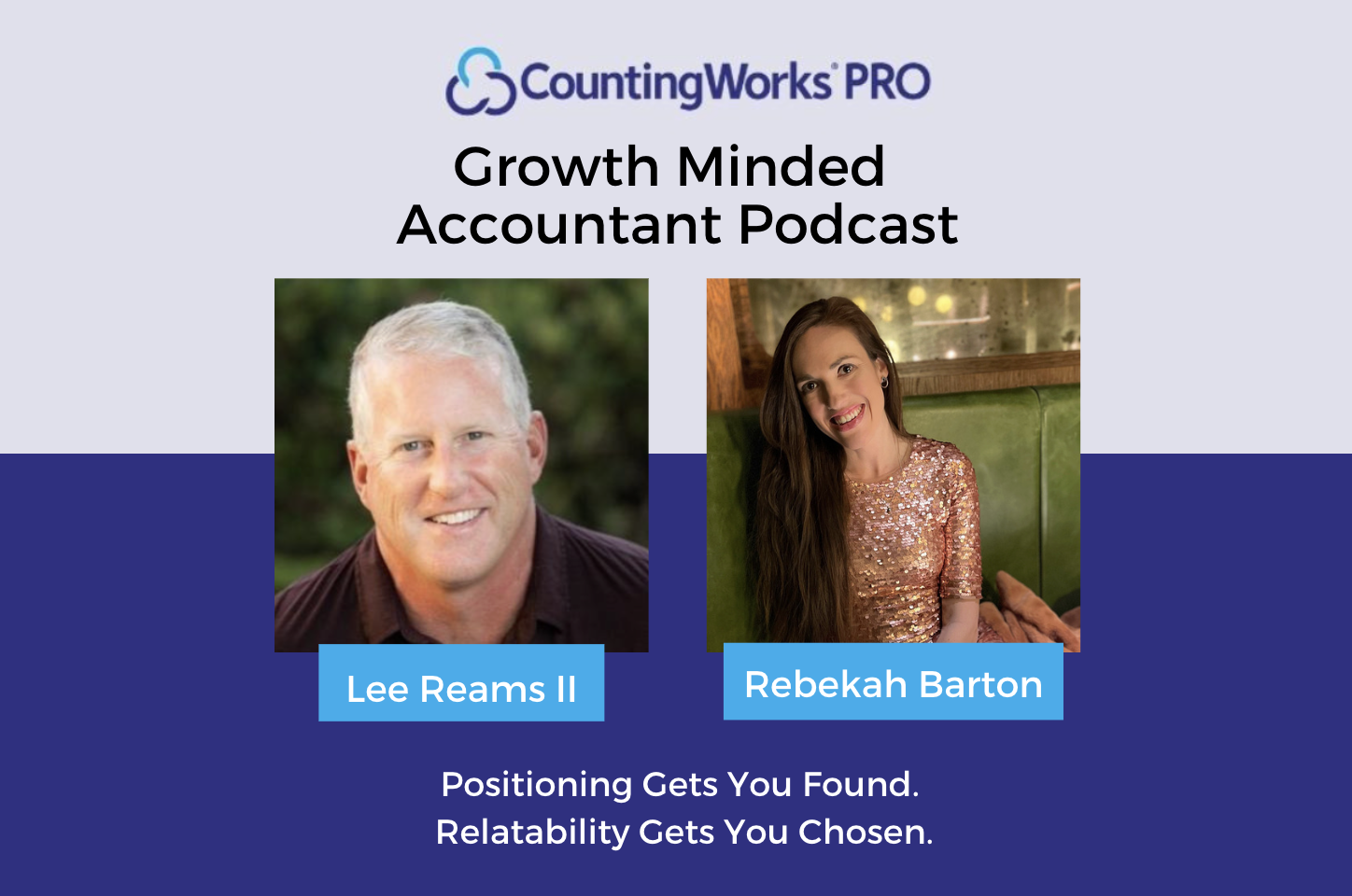
In this episode of the Growth Minded Accountant Podcast, Lee Reams and Rebekah Winters Barton explore why positioning gets your firm discovered—but relatability is what ultimately earns trust and wins new clients.
As prospective clients evaluate firms through Google, AI search, reviews, websites, podcasts, and social media, technical expertise has become an expectation rather than a differentiator. The firms that stand out are the ones that communicate a clear identity while also feeling authentic, human, and easy to trust.
Lee and Rebekah discuss how accounting firms can combine positioning with relatability to improve conversions, strengthen referrals, increase recommendation readiness inside AI search engines, and build stronger long-term client relationships.
Whether you're a CPA, EA, bookkeeper, or advisory-focused accounting firm, this conversation provides practical ideas you can implement immediately to improve your firm's visibility and conversion rate.
Get Your Free Firm Growth Breakdown
We know that everyone digests information differently. That’s why we’re now sharing the full transcript of each episode of The Growth Minded Accountant right here on the CountingWorks PRO blog. Whether you’re short on time, like to scan and highlight, or simply prefer reading over listening, you can catch up on every conversation at your own pace.
Each week, we cover topics that matter most to tax and accounting professionals—from AI and automation to marketing strategies, firm growth, and client relationships. Scroll down to read the full episode, or subscribe to the podcast to listen on the go.
Lee Reams
Welcome to the Growth Minded Accountant Podcast where our experts will share best practices on running your firm in the digital age. This podcast is brought to you by CountingWorks PRO. Let's get started. Welcome back to another episode of the Growth Minded Accountant Podcast. My name is Lee Reams. I'm the founder and CEO of CountingWorks PRO and our sister company TaxBuzz.
And today is Wednesday, February 4th. It's going to be our last what I call longer form Growth Minded Accountant Podcast for a little while. We're going to go into like what we call quick hits, little 5- to 10-minute sessions going forward that are going to be very focused on getting more out of your tax interview and advisory and things like that. So, lots of fun stuff to talk about, but we wanted to finish this longer series before we go into what I'll call the quick hits on a big topic that I think a lot of tax and accounting firms miss out on. Unless of course you've hired an agency and they kind of gotten you to think this through on the branding side, but it is positioning and defining what positioning is. And you know basically the way I look at is positioning gets you found, relatability gets you chosen.
So Rebekah you are hosting with me today. You are Chief Visibility Officer here at CountingWorks PRO and a proud Indiana Hoosier fan. Um, and I was watching USC luckily beat Indiana in hoops last night. We needed that win. But there was a comment that was made that I thought we can kind of use a little bit as a theme today. And I learned some trivia that there's over 800,000 living alumni from Indiana.
And over 400,000 actually live in the state of Indiana. And I think that is a good kind of well I'm just throwing this out here for you to set you up that if we want to use this as an example of how you position and how you become relatable to a group that would be a good one. So meaning positioning is I do tax and accounting for entrepreneurs that have graduated from Indiana. And relatability is perhaps photos at the games. Uh how you're part of support groups, how you help give back to the university, how you do guest speaking at the university, whatever. And I'm just giving you some examples and we're going to try to run through today why this is so important.
So before we get into the topic here and there's a lot of great takeaways. So this one is worth spending the 30 40 minutes whatever this takes there are going to be at least three or four things that you can take away from this podcast that you can apply to your own practice. But before we go we just passed 7,000 subscribers on the Growth Minded Accountant Podcast. As you reminded me, we're not allowed to celebrate until we get to 7,500 now because, you know, you just don't do every thousand and then 10,000 will be our next one. And then hopefully we keep we keep cruising along. But thank you to all our subscribers.
U all the feedback. Uh we we really appreciate it. It really keeps us grounded on getting things going. So, let's talk about today's topic. Again, positioning gets you found. Relatability gets you chosen.
So, if you're a tax and accounting firm listening to this, you probably worked on positioning before, but you may have looked at it like a niche or perhaps a service or a specialty. And that was important, but I think in the modern AI age, it's not enough anymore. Okay? So, because once someone knows that you're for them, they immediately move to the second question. And this is going to be pretty obvious, and it's a it's an issue we see often. Do I like these people?
Do I trust them? Would I refer them? And that's what we're unpacking today. And I'm going to start off with you, Rebekah, about, you know, we or we post every website that goes live. Right now, we got 5 to 10 going live a day. And I personally actually review the out outputs, right?
And we have a very stringent kind of policy on how we work with clients, getting them to tell their narrative and figuring out how to tell that on the homepage, how to tell that in the subpages, and what is the biggest peeve that I have when a site launches and they might be positioned perfectly clear and wonderfully, but guess what? They're not relatable. And explain kind of how that falls short and how that you need the two together to really work.
Rebekah Winters Barton
Yeah. So, these do go hand in hand. Um, you can have the best position in the world, but if someone goes to your website and it's a bunch of random strangers in a boardroom, they're not going to relate to you in the way that you want them to. So, you can say, "Hey, we serve IU alums in the state of Indiana, blah blah blah, whatever, and have a very narrow focus and position yourself really well." But if the imagery on that website, just going off your earlier example, Lee, is something totally unrelated to what you do. It's random people. It's not the people that your clients are going to be working with.
It's just stock imagery. That's tough. It's a tough cell, especially in a world where authenticity really, really matters. And it does today. People want authentic, relatable, raw content. So, a lot of what we talk about when we work with clients is telling your story, injecting some personality into it.
And that looks different for everyone. I want to be clear that this doesn't mean you have to have photos of your dog all over your website or how that helps, Rebekah. That that's a gamecher. Or a dog, you're you're winning. But go ahead. It is great.
We do have clients who do that. But we actually just recently worked with a lady whose niche is really all business. She's a motivational speaker, very empowering to young women starting businesses, and that's a totally different world. She wants to be very professional, wants to be very business-minded and not have a lot of things about her personal life. And yet, the site was very personal because it had photos of her at speaking engagements, at an AICPA summit, things like that. So, no matter what your position is, there is a way to personalize it and to add some measure of relatability regardless of how personal you want to get, which is something that we talk a lot about and something I want to lean into a little bit today.
Lee Reams
Well, and just your example, the kind of the relatability there is expertise. I am looking for an expert. I see this person at a TED talk or an AICPA conference and they they look powerful. They look like they look like they know what they're talking about. They look like the expert. I'm more I mean, and that's what relatability is all about.
So, I found someone who is, you know, women-based entrepreneurs and I help them grow to whatever. So, there's your positioning. Now I'm seeing the photographs. I'm seeing your story, your narrative. What do you say about this? That's where I start relating to that person, that story.
And that's where I decide, whoa, this person is right for me or not. Perhaps if you were, you know, buttons undone, and you know, you look like me, more casual, and if I'm not looking for that more casual, hey, I might not want to listen to them or I might want not to hire them. Right? So that's kind of how the relatability part works. So I want to define a little bit more Rebekah and we'll set you up for some talking points on what actually positioning means. This this webinar or podcast I guess is not necessarily about positioning.
It's about the two working together. But I think we need to define you know sometimes people think they they are positioned just because they they have a list of industries they serve and that's not what we mean. So if you could for clarity sake what are some things that positioning really is and give some concrete examples that people could get this takeaway.
Rebekah Winters Barton
Yeah. So this is not marketing jargon. This is not internal exercises. This is not sitting around with your team and coming up with cute little slogans. This is about defining who you are, what you do, and who you serve for the outside for external people who are visiting your website. So, it's really important to remember that you need to answer a single question with your positioning.
Is this firm for someone like me? That's what prospects want to know. The second you can answer that question successfully, the more likely they are to then move on to those other questions, Lee, that you just said. Do I like them? Would I refer them? All of these other things.
But until they know that the firm is for them, they're not going to choose you. So, it reduces the cognitive load or the stress on the buyer. You are telling your prospects immediately that you are for them by positioning yourself well. So effectively something like tax prep for everyone might sound really good when you're in a marketing meeting but what is that really saying right? Saying something like tax strategy for multi-state W2 professionals that is a positioning statement that tells someone who works in multiple states, hey look, they can help me. Uh, we do bookkeeping and we do it well might sound great when you're talking amongst your team, but saying on your website or in your marketing materials, we help businesses making5 to$10 million in the service industry understand cash flow before it becomes a problem.
That's a positioning statement. You want to effectively address a pain point or a problem that people have and how you're going to solve it for them based upon specific parameters. So, that's really what positioning is. It's not vague. Positioning is highly specific, but also broad in the sense that there are a lot of service businesses making5 to$10 million, but it also really niches you down so that you don't have a bunch of people who are outside of your niche area or your target position contacting you. So, it helps you and it helps the client, right?
It filter if you do this correctly it filters both even the referrals that come to you the type of people you attract and more importantly what tools like ChatGPT Google's AI tools how they understand your business your practice and then who they match you with hey they're not so if you think about it if you're trying to market to everybody you're marketing to nobody so figure out what your positioning statement is and then use that for relevance okay but that doesn't equal conversions anymore. And we're going to explain kind of what this means. So, uh, there's a bunch of studies and and we've talked about this before, but roughly 65 75%, maybe more like 70% of the buying decision now happens before someone ever talks to a salesperson. People are tired of being interrupted. They're tired being sold to, right? They like being able to do their own research.
They're encountering brands in Google. They're finding your blog. Perhaps you wrote something about, you know, Indiana football, you know, entrepreneurs, I don't know, follow, you know, whatever. Uh, they're reading your reviews. Perhaps they're your social content. Maybe they came across one of your podcasts.
Uh, and more importantly, increasingly, you're being referenced, if you're doing this correctly and your position correctly in tools like ChatGPT. So, by the time someone actually reaches out to your firm, they've already compared alternatives. They've decided, is this an intent? Is this something I want to solve? Is there a pain that I want to solve? Right?
They've probably read your reviews. Uh they've looked at your website. Uh you know, maybe your social media profiles and they've made assumptions about who you are. Okay. So, positioning was is what allows you to even show up during this invisible buying phase. But the question now is positioning alone will not hopefully convert as many people as you think it will.
So, let's talk about how this works. So, uh, most firms I would say they probably stop when the positioning is clear. They say, "Here's who we serve. Here's what we do. Here's our credential." So, we love, we have professionals. I have one professional.
I think he has eight credentials after his name. I mean, he has more designations than I don't even know. I have to Google half of them. It's like, you know, getting texts from my daughter. Half the time I'm like, "What does this mean again?" You know, YWDM, whatever. But you know what they do is they present it in the safest most neutral way possible not to offend anybody right it's professional polic but forgettable so in a market that's flooded with comp competent options competence no longer differentiates I think it's almost comes to the point where people just expect you know what you're talking about okay and this is where relatability comes in so this is where I think most firms specifically in the tax accounting space and if I went out to say a percentage you know what do you think Rebekah 89% of the firms don't do maybe they have they kind of kind of get positioning it's high and then from there how many are actually relatable
5% yeah I was going to say I would say 10 is generous to say that we have that 10% of firms are truly relatable every now and then there's a site that comes through and I'm like yes like you hit it and we work with everyone right here to to really get that relatability and the positioning down. But when it really clicks is when both the professional and our team are on the same level, which just doesn't always happen because this is it's a different concept for a lot of people. Um, and that's why we talk about it on the podcast and things like that to help you understand the importance. But we do get a lot of people who will try to get there and it still, you know, just isn't we're not fully aligned with what they think relatability is and what we think relatability is. So, it's not always a bullseye. Um, but we love it when it is.
And it can be for everyone. I think that's the important thing. There there are ways that every firm can be relatable. No matter what your niche is, no matter who you are, no matter what kind of imagery you want to use, there's always a way to make yourself relatable to your target audience.
Lee Reams
Well, and it's also risky. You know, you're putting yourself out there, you're going to be judged, and you know, it's it's uncomfortable. And then the idea of saying, hey, you know, I'm trying to please everybody, but you're really not. You're trying to communicate really to the audience you ideal client profile, right? So, what you want to happen when someone is referred to you or encounters your brand in any way, you know, the question is, do I like these people? Do I trust them enough to work with and recommend to someone else?
Okay, so that's where the relatability comes in and it's going to increase your referrals as well. Uh, and again, Remember referrals don't just happen with human to human anymore. It's very often now machine to human. So the more you're positioned to the machine and even the more relatable the machine is can reason, right? It can understand relatability. It might know that the searcher went to Indiana University and say, "Oh, by the way, here's a local Indiana firm and an Indiana graduate who specializes in entrepreneurs in your city.
I'm gonna start matching that, you know, matching the two of you together. And then you're the one that gets recommended if you were missing that in your marketing material, meaning you were a generalist. You didn't talk about going to Indiana and you didn't talk about working with Indiana graduates and entrepreneurs, you know? So, explain a little bit of how that works because it would make sense, right? Why would Google or ChatGPT then reference your brand even though that's where you live and you did go there, but if it doesn't know, how is it going to tell that story, right?
Rebekah Winters Barton
The internet only knows what we tell it. That's something I I bring up frequently with our clients. Um, the internet doesn't magically know that this is your target audience or that you want to work with other Indiana Hoosiers or people who graduated from IU. That's not something the internet knows unless it's in your bio or it's on your LinkedIn or it's on your Facebook page. And having it in all of those places is actually ideal. Um, one thing we talk about a lot, Lee, is kind of hitting the same points repeatedly in all of your positioning and all of your marketing materials.
And that really comes into play with relatability. The more you talk about these topics, the more the internet is going to understand that they are a core part of who your firm is and how people relate to you. The internet wants to recommend specifically AI engines like ChatGPT. They want to recommend the best possible fit for their clients so that the user will continue returning and therefore get more usership for the brand. So it's really just customer service. So at the end of the day, if you are presenting yourself as this very specific, relatable, well-positioned firm that works with entrepreneurs who went to IU.
So basically, you want to work with Mark Cuban. No, I'm kidding. But [laughter] come on, there's there's 800,000. 805 is what I saw. It's a big number. It's much more than Mark Cuban for God's sake.
It's much more. It's much more. I think someone said everywhere you go, there's always a Hoosier doing something very important. That's because there's so many of us, I guess, but it might have been Kurt Vonnegut, but someone said that. But anyway, if you want to position yourself as someone who works with IU grads who are now entrepreneurs, having it in multiple places is going to help the internet understand that that really is not only your position, but it's a core part of your relatability. So, the two really do go hand inand because you can't have one without the other.
So, the more you talk about it, and it doesn't have to be a huge thing, but just mention it in your bio. Mention it on your LinkedIn that you went to school here. Occasionally re-share posts. Things like that can go a really long way with ChatGPT. Understanding, hey, this is something that this user who is also an IU grad will understand and they're going to connect more with this person than a random tax professional who has nothing about where they went to school or, you know, what type of of entrepreneur they like to work with. So, the the more you put that out there, the better off you're going to be in short.
Lee Reams
Yeah. And I'm going to add something else. Uh what you'll realize quickly is there's a lot of misinformation, surprise, surprise, on the internet. And there might be misinformation about your brand. Like I was searching, we just did some changes to CountingWorks PRO, our main website. And I was on Reddit and you know, there was someone on a thread saying that our tool didn't do something.
It didn't have opt out for the client newsletter, which is the most absurd thing I've ever heard. Everything's CAN-SPAM compliant every you know we have best-in-class newsletter. I'm like, you know, of course I get upset like what is someone on Reddit saying about this? Some random person I don't know where who obviously doesn't know anything about our brand but just is spouting off. But guess what? I looked up our brand and ChatGPT or is it Gemini I think was quoting this person from Reddit.
It's a random person. So you know obviously as a brand we need to get our narrative out there. We need to get our story and we need to correct inaccuracies. So that's kind of why this is so important. So that's why you position yourself. So the internet knows your position and can communicate that to prospects.
Secondarily, it fe it sees these nuances. It sees little details like that and will mention them. So that's where the relatability comes in. So just some, you know, some concepts from like a research-based idea. Trust is built faster through perceived similarity. People refer professionals who feel safe to recommend.
Makes sense, right? If I'm going to recommend you, I want to make sure I don't want to ruin my reputation. My my reputation's on the line. Um, and I want to make sure that the person I'm referring has a beautiful website that articulates what they do, the pain points, how they create better financial outcomes. And perhaps I work with farmers and and if I'm referring another farmer, I feel much more comfortable saying here is my farmer CPA than I would some generalist who doesn't even talk about farmers. Okay.
Emotional confidence matters as much as technical confidence. So I think that's very important. You know people don't necessarily refer you because you did good work. If they don't like you if you don't are responsive they refer you and they feel confident about refer you referring you is because they like you. People like to work with people they like. Right?
So, if a firm feels cold, stock photography, stock generic, you know, cookie cuttered content. We have some competitors of ours. I swear I cannot stand what they're doing to our profession. They're making every single customer theirs look exactly the same, saying the exact same thing. The only difference is the city and the firm name. That's generic.
There's no positioning there. There's no relatability. And then that right now in the AI age is becoming just a sea of common. And that may makes you look more like a commodity than a firm that perhaps is trying to sell advisory, right? And that's also where referrals will start stalling. So even if your work is excellent.
So Rebekah had mentioned this and I think the big misconception that we've talked about is relatability is not oversharing. It's signaling. It's giving prospects something to connect with. And we've mentioned some examples here, but even if you use stock photography, like our library and the the resources we use and our designers, I I love them. They've gotten so good at this. They even get down to the the the color schemes and the photographs and making them all work together.
They can use and they can find some really solid stock photography that doesn't feel staged or old. But you know what I'm talking about? Those just really low-cost stock photos that are so generic. They're not only generic, but they're dated. They look like they're, you know, from a photo shoot in the 80s. You know, the styles are wrong, the clothes are all wrong, and you're just like, "Oh my god, you got to update that." So, uh, you know, you want to share why you chose this work.
That's not oversharing. You know, perhaps you had a family member that was in it or maybe a friend who went through an economic crisis and you said, "You know what? I don't want that to ever happen to my family, right? Talking about your community, you know, the community you support. Perhaps you support the local sports teams or the local high school or the local board of commerce, whatever. You know, you want let you know, you want people to see how you think, okay?
Not just what you know. So when you see firms that do this, well, you know, what are they actually sharing? What are you looking at when you interview our clients? So we always go through an onboarding process. We interview them and we try to figure out, you know, we'll find what makes you relatable, but what are you seeing that's most effective and, you know, when people actually start opening up kind of where are the openings for you to help make that firm more relatable?
Rebekah Winters Barton
Absolutely. It depends on the firm. And this is actually one of my favorite parts of my job. I love talking to people and learning who they are and then kind of figuring out the branding, the positioning, and the relatability for their website. Um, it's fun and it lets me be a little bit creative while still being techy and nerdy and figuring out what the internet wants. So, it's it's a really great kind of intersection of all of the things that make working with clients really fun.
So, it depends on the firm. I will say some firms are very open. They want to talk about how they love camping with their kids and their dog and they moved to another state just so they could have more outdoor time and they just open up to us immediately about everything going on in their life. Other firms are more closed off. We recently had a client who kind of has a professional persona. Um, more like an entertainer might have a professional persona and a personal life.
And that's okay, too. You can have a very polished kind of professional persona and still read as authentic and an expert and really kind of this very polished look on the website, which is also great. So, it depends on the person what I kind of hone in on and the the brand that they want to build, right? If you want a very sophisticated kind of upper class, high-end brand, we're going to hone in on different things than for someone who works with maybe plumbers and blue-collar trade professionals who really want someone who's relatable and in the trenches with them and who understands all of the little nitty-gritty things they're dealing with every day. So, it really does depend, but there's always a detail that they say, whether it's I love camping or hey, I used to work in big four finance in New York and now I'm bringing that to a small town that we can kind of glean a little detail and then build everything around that and make the site super relatable based upon the copy at least super relatable based upon that and then work with design to come up with imagery that connects with whatever that little seed of relatability happens to be.
Lee Reams
Very good. I was going to say something about how there is this is a wonderful thing about what's going on with the AI ages. I think humans are now kind of getting put off on some of the you know what I'll call the thin you know AI created content or bot or and and there's looking to to find humans again. Humans want to work with humans again. And I think that is a wonderful kind of byproduct of what's happening. So it's more important than ever that you sound human, right?
So you want your personality to stand out, you know, and think about this. When everything seems machine-written, what is the best way to be, you know, the the the shining star, so to speak, personality stand out. Founder founder voices outperform brand voices. That is true. Okay. Video beats static content.
Get out there on YouTube. Get out there on Instagram. Get out there on Facebook, TikTok, wherever. Reviews become social proof, not just ratings. And that is so important. And it I always say that your customers can sell you better.
They tell a story better than any, you know, marketing person can. But what you'll see is if your reviews back up what your positioning statements are and what your relatability statements say, it kind of reinforces it. It's like another referral source. Okay? So AI answers questions but people still choose who they trust. Okay, prospects meet firms inside chat ChatGPT for example before they ever talk to them.
But if your content feels generic, AI treats you as interchangeable. Okay, so meaning if your AI-written content has no personality, no positioning, no voice, nothing unique. You're one of hundreds of thousands of CPAs, enrolled agents, bookkeepers, right? But now if I am, if I am relatable, that becomes your, you know, your fingerprint in some respects. Okay? And think of it that way.
That makes you unique. And there's 100% ways to do this. We've talked about examples. We've we've kind of given you the the the road map, the playbook, so to speak. Um, but I'm going to now tie this into how relatability, referrals, and kind of your hidden growth work growth loop works. So most firms say, "Hey, we grow by referrals." Uh, but referrals don't live in a vacuum and often referrals are all over the place.
So what you end up is a firm that is a generalist firm. So every new client you have to learn. You have no pricing power because there's no perception that you are an expert in a particular position. Okay? So if I had used positioning and I had used relatability, I will probably get referrals that match up to both my position and kind of my personality. Okay?
And that what that's what fuels your growth. So clients just don't refer expertise. They refer their experiences with you. Okay? People hesitate to refer firms that they can't easily describe. Uh they're a generalist CPA doing tax returns.
That's not what you're looking for, right? Relatable firms are easier to talk to. There's something to already break down the conversation and they've already seen, oh, you like rock climbing. Awesome. So do I. Do you like, you know, hon?
You know, you can go on and on, right? Did you watch their Netflix? Um, that is why it's so important. So a client isn't thinking, hey, they know what a section 199A is. [laughter] They're thinking, hey, this this firm knows my business. They explain things clearly.
They proactively ask me questions, right? They're easy to work with. I can joke with them, right? And that's relatability. Showing up after the sale and then multiplying your growth. That's how you're going to get more and more referrals.
So, let's go into kind of what a relatability playbook looks like. Uh Rebekah, if you can get ready and kind of I want you to go through this because I think this is in your wheelhouse. So, re relatability is not a vibe. It is a system and relatable firms consistently do many things differently. And I'll start you off if you can go with the the human eyes first impressions and kind of walk through this. I'll jump in here as we go, but just kind of take this and kind of go through what this I would call it a playbook should look like for sure.
So the very first thing you want to do when humanizing first impressions is use real images, not just stock imagery. Now that's not to say that all stock imagery is bad. Lee, like you mentioned, we do have access here to some really great stock images of cities and locations and things like that. But it's really important to at least have photos of your staff, of yourself. They can be professional in your office. They can be you doing something you love.
It just depends on what that relatability factor is for you. Like if it's rock climbing and that's a big focus of your About Me, pop a picture of yourself on a mountain on the website. If your if your relatability factor is that you are an expert in your field and you've spoken at x number of conferences in the past year, have a photo of yourself speaking at one of those conferences. It's going to ground the page and it's going to really help people understand that you are who you say you are. They're going to connect with you immediately. Having founder or partner video introductions is another great thing you can do.
Video is king on the internet. A great thing about these is that they can be on the website, but they can also be re-shared on social media, which is going to kind of further cement your story, further cement whatever that that narrative is that you're trying to get out there into the world. It's also important to use copy that sounds like how people actually talk. Um, we were just talking about how being human really matters. Again, even if you use AI to assist you, that doesn't mean that it has to sound like AI created content. I know Lee, you and I both spend a lot of time training our AI systems to help us, not to basically write for us.
They write very much in our voice when we do use them to assist us. So, there are definitely ways that you can use AI-assisted content and still have it sound very human, very you, and not like any other firm. Another important thing that we've kind of touched on is that the firms that succeed here with relatability and positioning share context, not just credentials. They're not just a bunch of comments. They talk about their story, why they chose doing what they do, who they enjoy working with, why they enjoy working with them, perhaps where that expertise comes from. Uh they might also address how they think about client problems and how they approach working with them.
We had a firm recently that instead of an about us page, they had an our process page that was really fun to build out and it just was a little different in the navigation. It kind of set them apart immediately. And they have a three-step process. So instead of doing the traditional services and about us drop downs, we had an R process and then a step one, step two, step three, which was cool. I believe that site is still in design, so it hasn't launched yet, but I I've been kind of working with the design team on it, and it's a very interesting way of setting it up. So thinking outside the box a little bit with things like this can also be helpful in positioning yourself.
Their big thing is their three-step process. So we really leaned into that when building the site.
I'm going to stop you real quick. Real quick. So that also gives like reassurance to your prospect. So one of their question is you know if I'm if I'm new to your firm I was referred these are the questions can they help me are they for me and then the next one is going to be how do they work you know so if you can communicate that in your marketing material ChatGPT will know that prospects that visit your website will know that that takes again the risk out of that buying decision and then if you can even be more transparent of you don't have to necessarily put your prices there but at least communicate how you price or you know if you're up market say it you don't you want you don't want a bunch of DIY you know nickel and dimers calling you so why not position yourself that is positioning yourself and then being relatable is kind of showing you know your personality or how how I work maybe that is the way they like to work right maybe it's very organized maybe it's very step by step by step task driven versus you know a wider web whatever I'm just giving you example but that is part of being relatable I position ition.
Now I'm relatable as a user. Oh, I like working that way. That matches me. That's what relatability is. Sorry, Rebekah. Keep
Rebekah Winters Barton
Oh, no. That was great. I think that was really important. Um, so that kind of leads me into the next part of this is that they let clients do the talking. Really, really successful firms are looking for referrals. They they want their clients to refer them and they do that in a way that basically tells stories that highlight, you know, what they're doing for people.
They allow they also often include their clients on their website. So things where maybe you have video reviews maybe you ask satisfied clients to record a 30- secondond video saying why they like working with you. You're sending out requests for Google reviews for reviews on tax buzz for things like that. So letting your clients really serve as social proof is great and super helpful when it comes to AI. But more than that, your clients will talk for you in a referral process as well. Um, the more someone likes working with you, the more relatable you are, the more likely you are to come up in conversation within your niche.
So, I think that's something important about positioning that sometimes we don't hit on enough is that positioning yourself well and being a relatable professional is going to make you more likely to get the types of referrals you want both from AI systems like we talked about earlier, Lee, with maybe putting where you went to college or the types of entrepreneurs you enjoy working with so that AI can connect you with the right people. But also, if you have like an IU alumni group, just as an example, and someone's working with you and they love your fandom and they love that you are also an alum, they're going to be a lot more likely to recommend you to their fellow entrepreneurs than some random generalist who they picked basically off the street. Um, so positioning and relatability again are very very much interconnected and they kind of play into everything you do. Multiple everyday touch points are critical here.
Your website copy, your emails, conversations you have with clients, AI-assisted responses, all of that's going to come together to really tell your story and help clients understand why they can relate to you, but also how you can really help them in the long run. You just gave me a a bigger audience to be relatable than Indiana alumni is Disney fanatics. And another another area that I don't get. So, but I was just thinking about it. Great example actually.
Oh, go ahead. I I'm opening it up for you today. So, I think one brand that does this better than almost anything else as far as letting clients do the talking and building relatability is the Muppets. And there is a Muppets revival that's on today on Disney Plus. And they brought Sabrina Carpenter in and she has kind of crafted this whole Miss Piggy persona over the years. And she is working directly with Miss Piggy on the show.
But what they've done with this from an actual branding standpoint is really leaned into what has made the Muppets so popular over the years. They've made it super relatable. They've made it super like every touch point is the same talking points. This is the same Muppets you loved from the 70s. We're bringing it back. This is the same humor.
We haven't modernized it. It's clean. It's familyfriendly. It's something you can watch with your kids. It's bringing it back to the variety show format. Kind of that vaudeville vibe that the Muppets had in the 70s.
They have brought it back for this big special and it is everywhere. The clients, the fans in this case are doing the talking. It's all I've seen today. Not just because it's my algorithm, but because it's all over the Wall Street Journal, the New York Times, Deadline, Variety, Bloomberg, like every website that has an entertainment faction or a business faction is talking about the return of the Muppets today. And it's because they made it so relatable across social, across all of their advertising. They stuck to their talking points.
They stuck to their guns and it's paying off.
Lee Reams
Well, there you go. And then I don't even want to guess how many fanatics, Kingdom fanatic, Disney fanatics there are in the world. But that would be a very large audience to position and be relatable with. But all right, we're moving on. I think we've gotten our point across. So one last thing I want to add before we move on to the next section is we've talked about now putting this relatability into all your touch points.
So in your newsletter, on your social, on your website copy, in your emails, even utilize the firm's personality in your proposal language, in your engagement letters, even in your conversations. And if you're using technology, you're able to kind of create a memory or kind of like a persona that you know, so we have like agents that can prewrite a response to a client. Like here's a client's response and it will do the research, respond to what their questions are, but it also has the ability to put in your personality, your position statement. If they're a dentist, talk about dental things, right? Don't make it so generic. I think that's really important and that's how even AI responses can have relatability and everyday touch points.
If you do this together, you're really nailing the client experience. And if you can nail the client experience, you can outflank any one of your competitors in the AI age. You're going to run circles around them because they don't do it right. So relatable firms just don't try to impress everyone. I think this is really important. They make it easy for the right people to say, "Hey, I like them.
I trust them. I'd refer them. So again, if you're marketing to everyone, you're marketing to no one. So my last segment before we close this up is kind of the and I want to just kind of we we like to review what we've talked about. So positioning answers who this is for. Hopefully that's very clear.
So is your practice right now when you go to your website or you see anything or what you're known for, do you think you're communicating who you were for? Relatability answers. Why you? Okay, so firms that get both of these right, they get found faster, they convert more confidently, and I think the conversion rates are the big deal. You may already be getting traffic to your website. But if you're not relatable, if you don't have social proof, it's just there and gone.
You're getting no phone calls, you're out of the game, and you don't know why, right? And you're probably scrambling and then you're changing your messaging over and over again because you never were relatable and you never fine-tune the conversion rates, right? And then more importantly, what you get is you attract better fit clients. You don't waste your time on people that aren't right for you. You aren't right for them, right? So when a world in a world where everything is automated, being unmistakably human is no longer a risk.
It's an advantage. And I think this is really important. So, uh, before we wrap up, uh, I did mention this in the beginning, but a little bit of a programming note. Uh, this is our last long-form episode for the next few months, I think. And I don't know what I think I'm actually doing the last one on tax day or we're going to do. I don't know.
I haven't figured out how we're going to do these, but we're shifting to um, what I'm going to call 5- to 10-minute quick hits, short practical episodes you can actually use during the busiest time of the year. It is worth your time to listen to these. Uh, we're going to teach you how to ask better questions in client meetings. We're going to teach you advisory conversations that convert. Uh, how to spot upsell opportunities, how to get more out of every client interaction this tax season. So, they're going to be bite-size, high value, uh, designed to fit into real firm life, what you're experiencing right now and all the way through April.
So, look forward uh, to seeing you up here in the next coming weeks. Uh, and I hope that today's conversation resonated. Is not exactly what tax and accounting firm CPAs are taught. You're never you don't really get this side of things. And to me, the differentiation in the future specifically in the AI commoditization stage. Again, remember if everyone has tools that could do things even whether or not they know exactly what they're doing, but the tools could do them.
What's going to differentiate you? It's going to be your position. It's your client relationships. That is your moat. You have to do this. And the firms that are doing it are killing it right now.
So, um, from clear positioning to real human connection across marketing, referrals, and client experience. What do we do at CountingWorks PRO? We help you, uh, optimize this. We help you stand out, feel relatable, and attract the right clients in a crowded market. So, if you have any questions about what we talked to about today, please just visit our YouTube channel, CountingWorks PRO's YouTube channel. That's where the Growth Minded Accountant Podcast gets the most traffic.
Uh, we also have a very robust blog at countingworkspro.com. Um, and you know, you can follow either of us on LinkedIn. I post on LinkedIn weekly. So, a lot of these tips. We also have a Growth Minded Accountant Podcast Redditit channel that we post a lot of different ideas and a lot of ways to learn. So, hopefully this is resonating with you.
Hopefully, there's I said at least three takeaways from here. Uh so, again, thank you for being a listener to the Growth Minded Accountant Podcast. Until our next quick hit next week, I hope you're enjoying tax season. Get through. I know this is a a lot of new nuances this year, but a lot of opportunities to really excel. So, thank you again.
What is positioning for an accounting firm?
Positioning clearly defines who your firm serves, what problems you solve, and why you're uniquely qualified to help that audience.
Why isn't positioning enough anymore?
Modern buyers compare firms across multiple channels before contacting anyone. Relatability helps build trust once positioning has established relevance.
What does relatability mean?
Relatability is the ability for prospective clients to see themselves working with your firm through authentic stories, team members, values, communication style, reviews, and client experience.
How does AI affect accounting firm marketing?
AI platforms increasingly recommend firms based on specificity, authority, consistency, and trust signals found across websites, reviews, podcasts, LinkedIn, blogs, and other digital assets.
Should accounting firms avoid stock photography?
Not necessarily. High-quality stock imagery can still be effective, but real team photography, founder images, speaking engagements, local imagery, and authentic content typically create stronger trust.
How do referrals connect with positioning?
People recommend firms they can easily describe. Strong positioning and relatability make those recommendations much easier to communicate.
Listen to other podcast episodes or read other related blog articles with relevant information and insights.


