Most tax and accounting firms believe growth comes from better pricing, more referrals, additional staff, or new technology.
But before any of those factors matter, something else happens first.
Prospects make a decision.
Within seconds of visiting your website, seeing your firm online, reading your messaging, or interacting with your team, they begin forming opinions about your expertise, trustworthiness, value, and whether you're worth contacting.
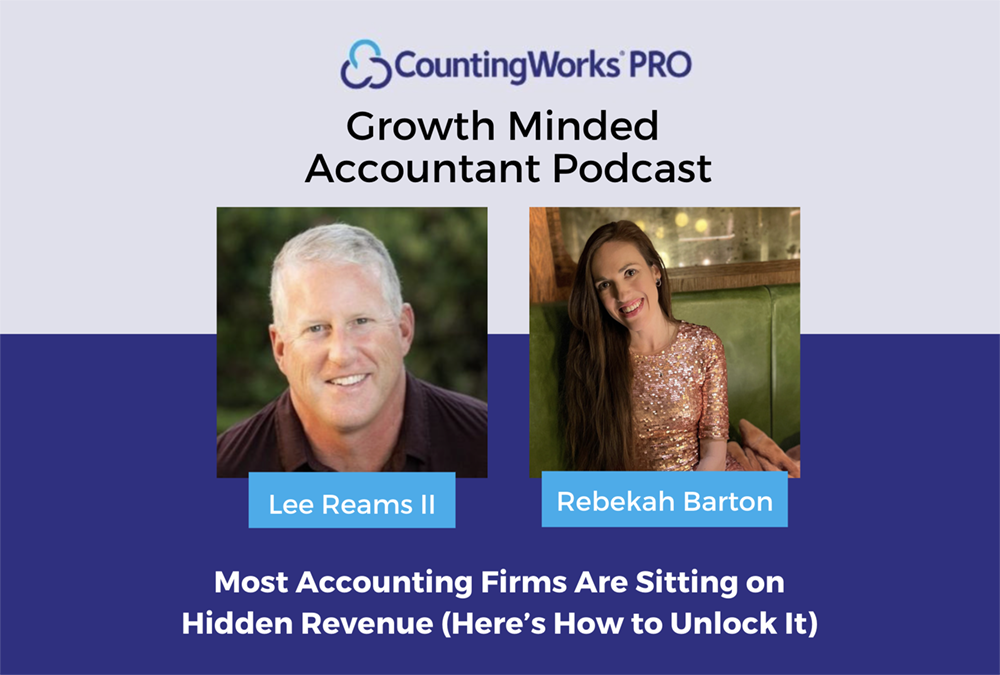
In this episode of The Growth Minded Accountant, Lee Reams and Rebekah Barton explore the psychology behind first impressions and how accounting firms, CPA firms, tax professionals, enrolled agents, and bookkeeping firms can improve client acquisition, pricing power, conversion rates, and advisory growth by strengthening how they show up online.
Drawing from behavioral psychology, marketing research, hospitality experiences, and real-world accounting firm examples, they explain why first impressions directly impact trust, perceived value, referrals, and revenue growth.
Whether you're a CPA, tax professional, enrolled agent, bookkeeper, or advisory-focused firm owner, this episode provides practical strategies to improve client experience, strengthen trust, increase conversion rates, and build a more profitable accounting practice.
The firms that win in today's market aren't always the firms with the most technical expertise.
They're the firms that create trust the fastest.
Discover where operational friction, client experience gaps, visibility issues, advisory opportunities, and growth bottlenecks may be limiting your firm.
Get your free assessment here: https://www.countingworkspro.com/start
We know that everyone digests information differently. That’s why we’re now sharing the full transcript of each episode of The Growth Minded Accountant right here on the CountingWorks PRO blog. Whether you’re short on time, like to scan and highlight, or simply prefer reading over listening, you can catch up on every conversation at your own pace.
Each week, we cover topics that matter most to tax and accounting professionals—from AI and automation to marketing strategies, firm growth, and client relationships. Scroll down to read the full episode, or subscribe to the podcast to listen on the go.
Lee Reams
Welcome to the Growth Minded Accountant podcast where our experts will share best practices on running your firm in the digital age. This podcast is brought to you by Counting Works Pro. Let's get started. Welcome back to the latest episode of the Growth Minded Accountant podcast. My name is Lee Rees. I'm the founder and CEO of CountingWorks and our sister company Tax Buzz. And this is our first episode post tax season. So what we've heard from lots of firms is it was very very busy this year. the complexity in the tax code the shortage of talent your workload was big time this year and most of our clients or most of our subscribers haven't even come up for air yet. So we're probably going to hear from you next week. But there's a lot of things that you probably took away from this past tax season. We went through a bunch of these things. You know, certain tips how to get more out of tax season, how to get more advisory. But at this point, let's take stock and think of the things you're probably thinking. Hey, we're maxed out. we need to raise prices. We need to fire some of our unwieldy clients. We need better clients. or maybe you're just thinking, hey, I don't want to run like this again next year. And while it's fresh in your mind, I think it's important to take stock and actually do something about it. Right? So most firms immediately they go to, hey, I need to hire more staff. Maybe you're going to get some offshore. perhaps you're going to look at some AI technology to automate some processes. Maybe you will do the cutting of clients. or you're just going to push your prices up and see who sticks and you know, let it roll from there. but they skip one of the fastest high lever changes that you could possibly make and it's not necessarily operational and it's not technical and this is the thing I see a lot because most firms you know they they started back historically everyone was kind of a generalist the idea of niching down or selling advisory was not the thing right so what you build is a very diverse client base which is good at times so meaning if you have clients from all sorts of backgrounds if there's you know an economic downturn in a certain sector for example, you're kind of isolated or covered from that. but the reality is you have clients from all sorts of backgrounds, all sorts of demands, different type of scenarios, and it makes it more difficult to kind of run your firm. Your firm's kind of running you, if it makes sense. So, what we're going to talk about today is how your firm shows up in your first interaction and how that sets the tone for your practice and more importantly, how can you attract the right type of a clients that you're looking for that will help you scale and run a business that is for you, not necessarily again just like going, you know, on a on a treadmill so to speak. So, where does this show up? This shows up in your website. This shows up in your messaging. It shows up in your responsiveness. and more importantly in your positioning. You know, what does the market think you do? What are you delivering? Who do I work with? So, because you know, whether you realize it or not, your pro prospects and even your clients are deciding in seconds who you are, right? And that decision shapes what they're willing to pay, whether they trust you and trust you at the beginning, which is really important, whether they refer you, which is obviously important, and whether they ever buy advisory services, whether they go from compliance to advisory. So, today I am joined by Rebecca Barton, fresh off a trip to Vegas. how was it? Everything good?
Rebekah Winters Barton
Good. It was good. It was oddly refreshing for Vegas. Lots of pool time. Saw the Eagles. It was a good trip. All right. So, you're ready then to talk about the ROI of first impressions. And I believe this is one of those things where again you can step back and almost do a practice reset and start understanding why this is important and how it will shape the way your firm runs here in the future. So, Rebecca, I've kind of set the table. If you want to take over and start running with this. Yes. So, I think one of the very first things to remember about first impressions is that it's not all about aesthetics. People often hear, "I'm going to make a first impression." And they think website, branding, logo, what does it look like? And while that's all important, we don't want to sit here and say that cohesive branding isn't important because it is. But your first impression really is about the trust and confidence that people are having in you from the get- go. you have I think there's a study that says you have like 5 seconds or something like that to make a first impression. And that is what we're talking about today. It's not all about how things look. It's also about the pricing power. The more trust and confidence people have in you, the more you're going to be able to charge down the road because you're delivering a valuable service. So, within just a few seconds of visiting your website, people have already decided who you are and they've already started to form an opinion about whether or not you're going to be able to help them in the future. So, that's what we're really going to get into here. And I think actually our next section is kind of about the psychology of all of this, which is a super important component of attracting not only new clients, but attracting the right kind of new clients, right? And I'm going to back this down before we go into the psychology side of it, but you know, there are two issues here when you're trying to build a firm or a marketing plan. One is your kind of rankings, and where does your firm show in ChatGPT? Where do I rank when people search certain terms? So, you can rank really high, and we get clients all the time. We rank them really high. They're showing up everywhere in ChatGPT. But sometimes clients won't listen to the first impression part of our pitch, right? That's what we do for our clients. We help them form narratives. We help them make really strong first impressions backed up by social proof. And what happens is you can have 50% of this. So you can, we had a client, we're driving thousands of prospects a month. and then they're not listening to us on the conversion side. So those first milliseconds, those first impressions, those first five seconds, they weren't backing up their story with proof. Right? So, and this isn't just an opinion. There are studies Princeton did a study one of the most cited ones that showed people form impressions of trustworthiness and competence in about a 100 milliseconds. I'm like whoa. So before someone even reads your bio, before they understand your services, they've already decided how they feel about you. And Rebecca, that is wild, isn't it? Really, really wild. But it also explains why some firms seem to have more success in this way because people are forming these opinions very quickly. And honestly, it's subconscious. I know I've done it when I've looked at brands or looked at service providers and immediately I'll click off a page because something about it just doesn't feel like what I want. And then I'll go to the next provider and I'll spend some more time because I've immediately formed that opinion that hey, maybe they are a good option. So I think we all see it in ourselves too, right? Like as you're searching for anything online, you start start to think about this and you'll find yourself forming those almost knee-jerk reactions to a website to maybe, you know, an H1, the very first thing they say. All of this happens basically at breakneck speed. So that's why the information you're putting out there from the first second is so so critical. Rebecca, no one knows what an H1 is. The title of your homepage, whatever. The very first thing you see on your website. So, what this is is it it starts a form of confirmation bias, right? So, we're getting into a little bit of behavioral psychology. You know, once someone forms an opinion, they start to look to for evidence to support it. So, if your firm feels polished, everything reinforces that trust. Okay? if it feels confusing or generic. I don't know who I work with. do you work with people like me? what does that do that feels generic perhaps? and that starts reinforcing doubt and then they're going to start looking for the polished side of it or what are other people saying about this firm. So, you know, if I land on a website, for example, and I'm a restaurant owner in the Backbay in Boston and I go to the site and it speaks to me and I can tell they work with restaurant owners and there's visuals of the area geographically where I look, right away I'm probably feeling I'm connected or I'm attracted to that and I will read on. And that's starting to build those are the signals to my brain that says, "Okay, this isn't confusing. They work with restaurants. This isn't generic. They work with restaurants in my area and they do CFO advisory services. And then here's six clients who work with you already. Brands I may already know, other restaurant owners. And that takes me from the opposite way of like a generalist where I go to and I start, you know, going astray. This isn't for me. And I think that's a big deal. So kind of talk about how does that either build momentum or resistance. So, I always kind of think of this in my own head as a mad lib and you're filling in all the right words that you want to draw people in, right? Sometimes with a generalist, it can just sound kind of like gibberish by the end because you're saying exactly the same things that everyone else is saying and it's not really processing or penetrating for the client because you're just saying, "We do taxes." Well, so does everybody else. So, if you're doing something like what you just described, Lee, where you're saying, "Okay, we serve restaurants in the Back Bay in Boston." Immediately, that's going to build momentum with the right kinds of clients because they're going to be drawn in. They're going to say, "Okay, this sounds this sounds like what I want. This is me." And then they're going to start diving further into your web page. They're going to start looking at the service pages. They're going to start looking up your Google reviews. They're going to search you on chat GPT. And so all of those things are going to come together to really build momentum and lead them to contact you. If you don't have that correct information that tells who you serve, what you do, that kind of polished look, you are going to be met with resistance. Just naturally, people are going to be more distrustful of a website that features extremely generic images of random stock image people and says, "Hey, we can do your taxes next year." That's not really instilling a lot of confidence in a world where there are firms that are putting forth these really great high-end narratives that tell people exactly who they are and what they do. Use industry specific language and kind of go through services that are specific to those industries like the restaurant field or the medical field. These different different niche industries that are going to differ a bit from just general tax preparation and advisory work. Yeah. And let's get off of the the niche side and let's just go into what's called the halo effect. And the Harvard Business Review talks about it a lot a lot. And it's how someone perceives one positive thing about you. They assume then that other positive things are true. So they start connecting the dots. So I I come to a professional clean website. They're probably organized. Okay. you respond quickly. They're reliable, right? Clear messaging. they're you're telling people exactly who you work with or what we do, they're competent. Okay? So, even if none of that has been proven yet, you they haven't actually hired you, these are signals, these are biases that start adding up. And this is where this kind of this whole first impression thing happens. So, I'm going to add one more layer. We're going to get into we're actually going to talk neuroscience. And I I know this is and I can't even pronounce the guy's name and make sure I got this right. Antonio, I think it's Damasio. Damasio. Okay. Right. So, emotion actually drives decision-m and I know Rebecca, emotion drives your decision-m. So, what does that mean? Clients choose the firm that feels right and then they justify it logically afterwards. But just talk about any sort of emotional purchase perhaps you make and then kind of your mindset. You it doesn't have to be tax and accounting, but you know how you then logically say, "Oh, I just spent $300 or $500. I'm probably way under source, right? $2,500 for that purse. Am I getting in the ballpark now?" You're getting in the ballpark. So, we all know where I'm going to go with this if you've been here. So, my Disney annual pass, right? Every single year in January, I say I make my annual donation to Disney so that I can go for free, which is what we like to call Disney math. But on a serious note, I think for me, decision-m is definitely emotionally driven. I want the magic. It makes me feel good. It makes me happy to know that I can go to the park any weekend I want. And I feel excited the second I click that purchase button, right? And the same goes for any emotionally driven purchase. So, I spend a lot of time justifying my Disney purchases afterward, right? Like ask my husband. I spend a great deal of time being like, "Well, this made sense." Because and I think anyone does that, like I joke, but on a serious note with your firm, you want people to feel good about choosing you from the start. If they feel good about you and about the work you're going to do and about the services you're going to provide and you have clean, highquality imagery, you're explaining who you serve, you're putting forth words that make them feel confident in who you are and that you know exactly what you're doing. They are going to feel good about picking you. And this is where the impression comes in, right? Because this all happens before they've ever said one word to you. There's a lot that goes on in a person's brain before they actually make a decision here. So, this is what we're talking about. That impression that you put onto the internet on any of your marketing materials really is going to help drive that feel-good effect that you want people to have because the better they feel about your firm, the more likely they are to choose you, even sight unseen, without ever saying a word to you. And then their decision is largely made by the time they actually reach out. And I'm going to take this now further. So, we talked about kind of the the basics of someone finding you or a client's thoughts of you, but now let's take that and bring it into your client onboarding experience. and I I was in Cabo for spring break while you were in Vegas. And I wasn't there this time, but I I often or used to when I could afford to go to the one and only brand Palmia. And the pome is down a little bit dated, but they I think a lot of what I'm going to talk about really applies here, but they narrowed or nailed that wow moment and repeating it consistently. And what I mean is when you just enter the gate, someone greets you, makes you feel welcome, right? When you walk into the lobby, someone greets you again. Every staff member will stop and pause and greet you. When you walk the property, everyone acknowledges you, right? And after a few minutes, you realize, you know, this is designed. They have a system in place and it does something that I consider simple. It removes friction. It kind of lowers my defenses. I'm not I'm spending a lot of money to be here. You know, I'm already kind of like, is it going to meet my expectation? And what it does is it actually lowers my guard. I'm like, it makes me feel like, hey, I made the right decision to spend $2,400 or $1,400 a night or whatever it is now before anything even happens. like this is, you know, right when I walked in, they gave me a cold towel. They gave me a drink, right? A refreshment drink. They had me sit down in a comfortable chair in a setting that was very comfortable, right? and I think this is something you can understand and kind of build into your own practice again from first impression on your website. Now, you bring them into the firm. How do you set all those expectations? How do you make them feel this is about you? I'm not too busy to work with you, right? That kind of thing. So, I I think Rebecca, that is a a pretty good point. Don't you think? Great point. It's a great point. And it doesn't have to be these big flashy gestures, right? It can just be things feeling right, feeling comfortable, feeling like a good fit. Like the puzzle pieces are all kind of connecting in a way that works. And if you do have an office, you can take some of these principles from like fivestar hotels and apply them. Have waters in a mini fridge. Have, you know, a basket of snacks for people who might be waiting to meet with you. all of those kinds of things are going to go a long way and those are the sorts of little details that stick in people's minds and they're what make resorts like the one you were talking about, Lee, or even the Disney experience feel so good because there are the little things that just make you feel immediately like, yes, I've made the right choice here. And you can do the same thing for your tax clients. Zoom meetings, have a nice professional background. Don't have it be in your bedroom with your, you know, laundry basket in the background. So, you know, and and then I'm now gonna apply this to kind of like the the I the idea of ROI, right? So, because what we're talking about isn't necessarily theory, it's math. So, let's say you have 350 clients, pretty standard firm. now let's look at your industry ranges based on some CPA benchmarking data and surveys from, you know, like the CPA practice advisor, other benchmarks. So, low-end firms, $300 to $500 per return. Mid-tier, $800 to $1,200. I'm just talking tax returns. I'm not getting into virtual CFO. High-end position firms, 1,500 to 3,000. So, now let's run it at $500. At 350, you're talking about $175,000 in revenue. 350 clients, same amount of clients. At $1,200 is $420,000 in revenue. so what is that? almost a4 million dollar difference. Same clients, same work. and that's the crazy part. So, where would you rather position yourself? How would you, you know, if if these firms that are charging more, are they doing more work? Probably. I mean, there's more sophisticated. Are these firms necessarily better than you? Do they know more than you? Probably not. But what? they are better positioned. Okay. And and if we look at it and turn it into advisory, now you have 100 bookkeeping clients. Let's say if 10 of them 10% start, do they upgrade to your advisory CFO? So now $2,000 a month versus whatever a bookkeeping client was paying $24,000 here. 10 clients, almost a quarter million dollar, right? So Rebecca, what's important about that? You already have this asset. The clients are there. we we talk about this a lot, how your existing client base is your biggest funnel. you can tap into them in a way that you cannot tap into complete strangers. They trust you already. They know you already. They're already paying you and already have confidence in your work. So, you don't necessarily need more leads. You need a better first impression and better positioning. And therefore, the trust comes, the willingness to spend more money with you comes, and basically everything's going to start to come together for you. But it all stems from that first impression that you're making even on your existing clients. Yeah. And again, that's your lowest hanging fruit. Let's just talk there. But now, let's say you are bringing in a lot of new inbounds. Let's say you did do a custom narrative. You position to attract the right type of clients. Now, think about it. If you improve your messaging just a little bit, your responsiveness, your speed, improve the experience of this prospect as they come into your firm. So maybe you add a 100 inbound leads, you know, a year right now. Maybe you convert 30%. I'm just saying you do well. That's 30 clients. With that list, if you just do a few of the things we just talked about, you turn that into 45% conversion. That's 45 clients. 15 extra clients at average of $1,500. That's another 20 almost $25,000 annually, right? And that's being conservative. So you don't have to recreate everything in your world, right? and what happens is you don't necessarily have a lead problem. And I'm going back to this client that I was talking about before. You have a first impression problem. So, that client is getting a thousand leads per month. We have other clients that have done for example, we have like infomercials about clients that we've done. We use AI technology to kind of take all the personalization and make like a really polished kind of like mini podcast conversation about a client. So, we have a client who puts social proof on her homepage. She shows her personality. She shows pictures of herself and her partner. They tell a story. And then she has this audio podcast. And guess what? About 100 to 150 plays per month happen. She's loaded with good quality clients. And that's because she makes a great first impression versus someone else who we get them ranking well. So, they we've solved the SEO problem. We've solved the geo problem, but guess what, Rebecca? They haven't solved that first impression problem. And you know, kind of how does that stack up? How do you get people over the hump to to put themselves out there? So, I think one of the biggest things you need to do is have that real world proof that you were talking about, Lee. that's super important here. Like you were talking about the client who has that that deep dive on her website, and I think that's absolutely huge. You can do all that you want to make a good first impression, but without social proof, without people, other human beings kind of giving their approval of this firm, I think you are going to struggle. And I think that is one of the most important things I want to leave everyone with is that your first impression includes social proof, which is something we talk about social proof a lot on this podcast, but I don't know that we talk a lot about social proof in regard to the first impression that you're making. And I think that having reviews on the homepage, having things like a deep dive that really give people the opportunity to dive in who you are, those are the sorts of little details that are going to kind of get you over that hump and help you to kind of differentiate yourself from all of the other players in your area and all of the competition who are absolutely not doing those little things. So, that's a key part of first impressions, too. doing the little things that go the extra mile like we were talking about with these resorts or these brands that are really going to stick in people's minds and those are the things that are going to make people say this firm not that one. No, absolutely. And so what we do and the way we tackle this is we break it into five layers. So visibility which is what I was just talking about now relevance does your narrative what your story is relate to that prospect. Then I go into speed, everything. Speed of your website, speed of how quickly you respond. that leads into the user experience. Are you like the one and only, right? have you dialed it in? Do you have cold water? Do you have snacks? Do you make that experience better? And then direction. How do I work with you? How do you work? Right? How do I get on boarded? Right? And if you have one or two of these, you're getting there. But the reality is you can fail just with a bad experience or no direction. They may be ready to to they've already gone through that bias and they're ready to work with you, but then there's no direction. I don't even know where to start, right? Because it's lost in page 12 of your website. So what happens is it's basically game over. And it's not a catastrophic failure. It's just leakage. So we see this in every day firms go from struggling to convert price sensitive clients, inconsistent referrals to daily inbounds, so that thousand prospects a month, stronger clients because you're matching your your first impression is matching with the type of clients you want. And guess what? If you set the table correctly, they're going to pay higher fees. There's a perceived value that you might be an expert. they're going to get a better financial outcome by working with you. And guess what? All the stuff we're talking about, nothing changed operationally. you just showed up better. You actually delivered on your promise. And I think, you know, now that tax season is over, I think relationships are more important than ever. That is your moat. Now, think about the landscape you have right now. you got private equity firms coming in and buying CPA firms, enrolled agent firms and they're kind of commoditizing things and you're seeing a lot of push back on that. so that makes it that's kind of a moat item to you. If you have strong relationships with your clients, you're going to be able to out compete there. Then you're going to have the IT AI enabled tools that as we know 90% correct is 100% wrong. They mi miss so many nuances. Human in the loop is the way to go. So, what would I do if I were coming out of tax season right now? I would sit back and say, "Okay, I need to change something." But before I tell you, you have to retrain your entire staff and bring in this new practice management system. I'm saying, "No, start here. Step back. Look at your firm like you would as as a prospect. What do they see first? How fast do you respond? Do you feel different or a commodity, an interchangeable firm, right? And because the firms that win aren't just better at tax, they're better at trust. And Rebecca, I think that says something. It's not a massive rebuild. This is purely about messaging, responsiveness, and more importantly, clarity. How do you help when you talk to clients? How do you get them to that clarity kind of aha moment? I think a lot of the time it's going back to things they already know about themselves, but they haven't really taken the time to put into terms that they can really sit and sit with, right? Like for example, they might have a niche or they might have a target audience, but because they've been a generalist for so long, they haven't even taken the time to look at the fact that, oh, 70% of my clients now are pediatricians or are veterinarians or whatever the case may be. And as we talk and have those conversations, it's kind of like that light bulb goes off and they start to realize that they actually do have things that they can hone in on or improve on or polish. perhaps they recognize that they don't want to offer this service anymore. They want to offer this type of service instead. Pricing is another big thing we talk about. That gives a lot of clarity. We were just talking about increasing your prices by a relatively modest amount can actually have a huge impact. financially on you as a firm owner. That's something we talk about a lot to help people get clarity. Even just having a pricing page on your website can be really helpful to people and kind of provide that aha, okay, wait, this is who I am. This is what I charge kind of moment. So, it's these little things just really sitting with yourself and sitting with who you are and what kind of firm you want to run that can have a major impact. And this is something everyone can do. that's something I want to just leave people with. This isn't something that you can only do if you're super tech-savvy or you understand marketing. That's not what this is. This is something that every single firm owner should be sitting and doing now that tax season is over, kind of moving ahead into next year. Yeah. And I'm going to give like a little bit of an exercise. We'll close this up, wrap this up. So, what I would do if I were you, go to your website, go to chat GPT and type in your, you know, put in your domain name and say, "Hey, you know, act as a prospect for my CPA firm or my enrolled agent firm and tell me what you think about me based on my homepage in the first five seconds." You know, what what what is the impression that you would get? And then what I want you to do is compare that to the impression you think you are like who you really are, what you're really trying to do. And I bet you you will be shocked how off message you are. So from there you can work with firms like us at CountingWorks Pro to kind of step back and create this narrative or start working with whatever professionals and try to figure it out. But I'm telling you this exercise, this investment, take the month of May by you know June 1, relaunch in your new messaging, you are going to attract better clients. You are going to convert more clients, more highpaying clients. You're going to have a more successful practice. and I think it's just it's probably the best investment you can have today with again without not having to rip out all your processes and do you can just put these little details in. you know be more respon you may maybe tackle you know be more responsive in inbound inquiries is kind of another new practice management thing but from the first impression side you're going to really get a huge ROI in this investment. So that wraps up this edition of the Growth Minded Accountant podcast. we have a ton of fun things happening. The industry is obviously changing very quickly. there's a lot of uncertainty. There's a lot of noise out there and we're going to try to make it as clear as possible for our audience on where the industry is going, what the best practices are, and more importantly, what the leading firms are doing that are making them so successful. So again, thank you for being a listener for the Growth Minded accountant podcast. Until next week, we hope you have a an enjoyable break from tax season and let's get back at it in a few weeks. Thank you.
Q: How quickly do prospects form opinions about an accounting firm?
Research discussed in the episode suggests people begin forming impressions of trustworthiness and competence within fractions of a second. Long before a prospect schedules a consultation, they've already started evaluating whether your firm feels credible and relevant.
Q: Why do first impressions affect pricing power?
When prospects trust a firm and perceive expertise early, they're less likely to compare providers solely on price. Strong positioning and credibility help shift the conversation from cost to value.
Q: What is the biggest mistake accounting firms make with their websites?
Many firms rely on generic messaging that could describe almost any accounting practice. Prospects want to quickly understand who you help, how you help them, and why you're different.
Q: How does social proof impact client acquisition?
Reviews, testimonials, client success stories, and visible trust signals reinforce positive first impressions. They provide validation that helps prospects feel more confident about contacting your firm.
Q: What is the First Contact Stack?
The framework includes visibility, relevance, speed, user experience, and direction. Together, these elements shape how prospects perceive your firm during their earliest interactions.
Q: What's the fastest improvement firms can make after tax season?
Evaluate your firm through the eyes of a prospect. Review your website, messaging, responsiveness, positioning, and onboarding experience to identify areas where trust and clarity can be improved.
Listen to other podcast episodes or read other related blog articles with relevant information and insights.