One of the biggest threats to profitability in accounting firms isn't losing clients.
It's doing work you never bill for.
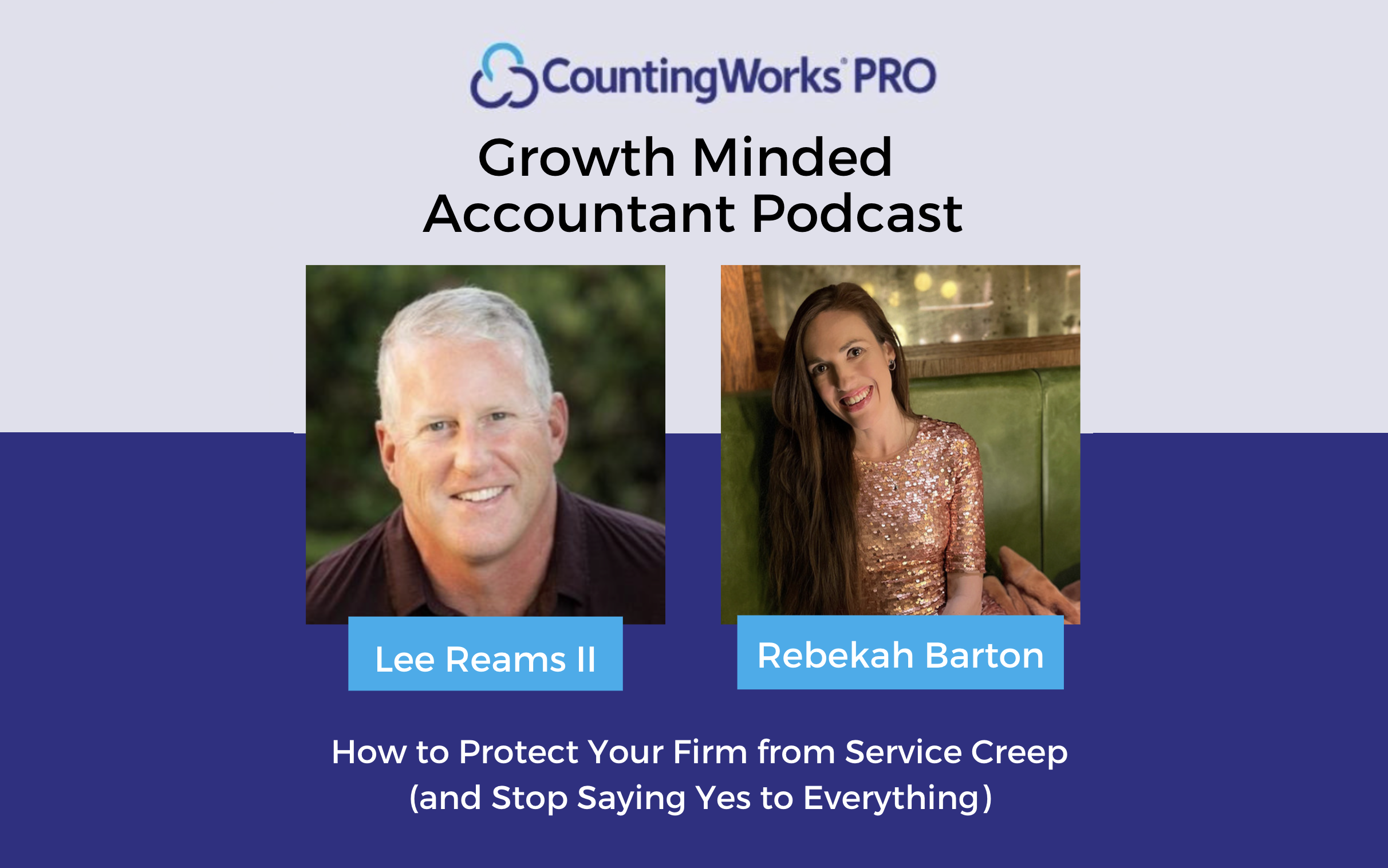
In this episode of the Growth Minded Accountant Podcast, Lee Reams II and Rebekah Winters Barton explore one of the profession's most common—and expensive—problems: service creep. They explain why accountants naturally struggle to establish boundaries, how unclear engagement scopes quietly erode profitability, and what firms can do to protect both client relationships and profit margins.
From engagement letters and proposal automation to practical client communication scripts, this episode provides actionable strategies for transforming invisible work into billable value while maintaining exceptional client service.
If your firm has ever heard, "Can you just...", this conversation offers a practical framework for protecting your time without sacrificing trust.
Get Your Free Firm Growth Breakdown
We know that everyone digests information differently. That’s why we’re now sharing the full transcript of each episode of The Growth Minded Accountant right here on the CountingWorks PRO blog. Whether you’re short on time, like to scan and highlight, or simply prefer reading over listening, you can catch up on every conversation at your own pace.
Each week, we cover topics that matter most to tax and accounting professionals—from AI and automation to marketing strategies, firm growth, and client relationships. Scroll down to read the full episode, or subscribe to the podcast to listen on the go.
Lee Reams II
Welcome to the Growth Minded Accountant podcast where our experts will share best practices on running your firm in the digital age. This podcast is brought to you by CountingWorks PRO. Let's get started. Hello and welcome back to another episode of the Growth Minded Accountant Podcast. My name is Lee Reams II. I'm your host and founder of CountingWorks and our sister company TaxBuzz. Today we're going to talk about one of those problems that sneaks up on every firm no matter how experienced you are. Whether you call this service creep, whether you call it scope creep in the software industry, we call it feature creep. That's when product people start destroying features and start making it more and more complex and then no one can use it. But today we're going to talk about uh the service side.
So the moment when a client says, "Hey, can you just do this?" or uh before you knew it, you're doing all this extra work that you didn't bill for again. Um today I am joined with Rebekah Barton, our chief visibility officer. Rebekah, if you can say hello and uh let's start this conversation.
Rebekah Winters Barton
Yes. Hey everybody, as always, I think we've got some good stuff for you today. Yeah. And the the phrase service creep makes uh everyone flinch a little bit. And we've done a bunch of research on different surveys. In it did a big survey. I think Ignition did a survey that we're going to talk about, a UK based firm. Uh, but service creep is real and I think most I just even saw a big discussion on this on LinkedIn which kind of flagged it a little bit more um as a topic. You know, it's not just about loss revenue, right? It's about your energy, your boundaries, and keeping your team sane through busy seasons. So, today we're going to dive into how to stop saying yes to everything. I know 100% us CountingWorks PRO, we are very bad at this.
So there's a lot of things that we've learned here. We say yes to everything. We have people that we're doing it support for and it's like there's nowhere anywhere in our software agreement that says, you know, we're going to help you troubleshoot your network and you know, your firewall. So the the reality is you need to help protect your firm. Uh we're going to give a bunch of different takeaways here, things that you can use starting tomorrow, today really. You know, how to write clear engagement letters, how do you train your team, how do you politely push back a little bit, right? and how how can you build better systems that keep you profitable and in control. So, I broke this up like normal uh into different segments and each one's going to kind of define different talking points about the subject.
And the first one is what does service creep? Scope creep again, however you want to call it, look like. So, uh service creep happens when the scope of your work expands but your fees don't, right? So, it's pretty common sense. So, a client says, "Hey, can you just look over this uh lease real quick? um can you look uh can you hop on a call to explain this notice from Wyoming's you know labor department right so each seems somewhat harmless and unless they're in some sort of advisory or virtual CFO um arrangement this is what is service creep is all about so you multiply that across dozens of clients each month and suddenly you're giving away a ton of your unpaid time yeah Rebekah kind of talk about a little bit what these surveys say um and what we found there's a couple different ones.
You can go through all of them if you'd like. For sure. So, into it specifically in one of their firm of the future reports talked about how service creep is the number one profitability killer, which is not actually hard to understand. If you're giving away hours and hours and hours of unpaid time, when you multiply it across all of your clients, you are losing out on a lot of potential income. So, very important to remember that as you kind of do these one-off tasks for people, you are probably cutting into your profits in a huge way. Secondarily, Ignition talked about the fact that 89% of accountants that they surveyed have avoided or delayed client conversations due to extra work. Whereas 43%, so nearly half of them just absorb the cost of that work without actually asking for additional payment.
So that's a problem too because you have to be able to be proactive and discuss with your clients these payment arrangements. If they want more work, they need to be paying an additional fee. And then there was also a Libeo survey that showed the firms on average are losing about $7,200 a month. That one really got me. Um, which is almost $85 grand a year in work that they're not billing to their clients. So again, that's just based on the firms they surveyed, but that's a pretty good microcosm of the overall tax and accounting industry. So no matter how you slice it, you're probably losing money by service creep. So, it's a really important topic to think about as you go about your day-to-day life. Yeah.
And I think the the number from the Libeo survey, um, you know, if it's 20%, if it's 40% and you could cut that in half by having some proactive, um, policies in place, you could increase your income 100 grand, 200 grand or more if you're a larger firm. Obviously, it adds up. So, you know, why is it that accountants struggle to say no? It's it's human nature to be a pleaser, right? So um accountants are helpers by nature. You want to solve problems. You don't want to look transactional and you hate to disappoint clients. So I totally get it. So this yes no mode though devalues your expertise. Right. Um there was a study Harvard Business Review put it best. It said professionals who fail to communicate limits end up perceived as service providers not strategic provid uh strategic partners.
Rebekah, why is that so important as as people try to grow and position themselves? So, as we've talked about frequently on GMA, it's very very important to brand yourself, position yourself for the types of clients that you want. So, firms that are growing the fastest, firms that are making the most money are the ones that are positioning themselves as partners, as advisers, as people who are there for you through every financial decision. But those firms are paid for the value they provide. They're charging higher fees for the additional work that they're doing for the fact that they are often more available to answer these additional questions. Their fees go up because they are offering more value. They are offering additional availability. So, it's more of a clarity problem than a client problem when it comes to positioning and branding.
You need to be clear about the services that you provide for X number. And then if people want more than that, there needs to be a new number. That's kind of the short version of what we're saying here. Yeah. And I'll just give a a real life example. I am putting new sighting on my house. I had multiple contractors come out and bid on the project. And it was interesting the difference in detail between contract A versus contractor B's bid. And I was very clear with the the vendor that I chose that I wanted everything written out because what we walked through and we pointed out and if I had videoed then we would know exactly what the scope is. But once you actually start getting into the detail of doing the project. Oh, well that corner. Oh, that woodwork. No, that wasn't involved.
You know, that wasn't included. Well, yes, it was. You know, sprayashing the house. That wasn't included. Yes, it was. You said it was. So, defining that is what Rebekah was saying is the clarity thing. So, let's talk about some ways to protect your firm without losing clients or even having kind of like adversarial uh uh positions with your clients, right? So, uh we're going to talk about prevention. So, there's three ways to stop service creep uh before it starts. And the number one, which is still something that not enough tax and accounting pros use, uh is engagement letters. So, they're designed to be a shield. Obviously, CountingWorks, we thought it was very important that engagement letters are included in every um time you, you know, start working with a client. What do they do? They define the boundaries. They're not just a compliance checkbox, right?
They say it plainly. This engagement letter includes X, Y, and Z. It does not include ABC, B, C. Services outside the scope will be quoted separately before work begins. So, by using language like that and including exclusion lists, um you're automatically setting up your client for a a general understanding of the expectations of what that relationship and they'll think about it too. They won't take advantage. They won't push the boundaries as much, you know, and and I'll give an example here. Exclusions could be this engagement does not include IRS correspondence or amended returns. This agreement excludes payroll setup or cash flow forecasting. You're not saying no, you're saying yes, but let's uh let the scope it right. So if you have an add-on, we'll do an addendum.
We'll do another uh proposal that says okay, now we're doing cash flow forecasting and this is what it includes. Um so I think that's pretty common sense. I think the biggest issue we have seen is not enough firms are using engagement letters with every client. They're not using detailed proposals. Uh obviously what we do at CountingWorks is we've set up our clients to be able to do one-to-one proposals, one-to-one engagement letters for this specific reason. This is what is going to start protecting you from the scope. In reality, it is a revenue increaser, right? If you do it correctly.
Um I think the secondary thing is you're as a partner perhaps if you're listening or if you're a manager you're not always doing the client-facing um discussions right so a lot of times this creep starts entering when the staff is eager to please right so you need to be able to train them to pause and ask hey is this task in the engagement think first before you say that to the client right will it add time or deliverables you know has this client asked for this before and what you're doing is you're starting to kind of say hey you know one time let's give it a pass but two three four times now you're getting into scope creep that is affecting your bottom line so uh you know what you say is instead of the answer is yes I'll do this you know hey let me double check with the team says this may be beyond our current engagement right we'll circle back shortly um and then kind of explain like Rebekah from your point of view too on how you're still trying to be helpful and you know what you could do as a next step if it is out of scope what is like the followup Right?
So, you definitely don't want to alienate people or come across as angry or confrontational when you're doing this. There's definitely a way to do it where you don't allow service creep to affect your bottom line, but you still keep your clients happy. So, a really good way to address this, whether it's on the phone or via an email, is saying something like, "Yeah, we're happy to help. Let us send an updated proposal to include that new service, or let us send an updated proposal that includes X task," whatever the case may be.
But adding something like, "Yeah, we're happy to help with this or we're looking forward to assisting you with this at the beginning of the statement can go a long way toward keeping everyone happy and kind of easing any feelings of like you're charging me too much or whatever that a client may have because that's not at all what you're trying to do." But you just need to phrase it in a way that keeps everybody happy and make sure everyone is on the same page.
Lee Reams II
And guess what? Keep notes in your CRM. you know, when you're talking to clients, if you start seeing scope, um, when you're at renewal time, that's when you now maybe can backfill where those the loss revenue was, right? So, uh, you know, use a system that has digital proposals, that digitizes your engagement letters, has digital client intake forms, things that you can rescope and change and edit in like with us, we use Max AI to do it. Um, it takes moments to create a new engagement letter. It takes moments to create a new proposal that includes that new service and includes that upcharge, right? So there's no awkward back and forth.
And I, you know, and even when way I was working on this presentation and our our tools and I was talking to our product team, you know, Max is so smart already and we already do all these other things. I'm like, we will add shortly at some point. Um, a tool that will actually monitor when some client hub messages come in, for example, that are out of scope of what the engagement letter says or what the proposal says. uh maybe there's some communication back and forth uh in the chat or in maybe some documents that are being uploaded or shared that don't fit in the proposal and it will automatically flag these and identify them for you.
So that's I think ideal world like the the best of the best is when you can use AI um to be able to do that proactively for you. It's like a partner sitting there looking at every engagement going whoa whoa whoa red flag red flag you know and at least it puts it up that you're aware and then you can decide what to do. Um, so let's now talk about how to handle that out of bounds, um, when that creep starts happening. So, uh, this is about your tone. Um, staying polite, clear, confident. Um, you know, and and there's different ways people have different ways to do it, right? So, I put down three or four different options. So, I call one the clarifier, right? Thanks for bringing that up. Make sure we're aligned. that request is outside the current engagement.
I can outline what it would take and send a quick proposal. Simple, matter of fact, polite. Um, and it also feels like you're, hey, you're an expert. You're saying, hey, you're pushing the boundaries of utilizing my services, right? I don't work for free. You're out of bounds. Hey, let's clarify this. U, that's one, that's one path, right? The next one is the transparency response. So, uh, our engagement covers bookkeeping and quarterly reports. The projections you're asking for are separate. So let me quote that so there are no surprises. Now again if you have a proposal tool you can easily just type that up within moments. Let AI create it send it out and now and even receive payment and now you're ready to go. So no long process of delay in the project no awkwardness. It really works.
So the other way to look at it is the partnership approach. So to keep things fair, we treat extra requests as add-ons. I'll send you an update proposal today. Rebekah, you're laughing. Do you like that one? Can we use that one? because we should be using that every day.
Rebekah Winters Barton
I was just going to say that one sounds kind of familiar. I know. I do like that one. Um I think I think equity is important and that's something that kind of addresses doing something for one client. On a serious note, doing something for one client at no charge then charging another or telling them you can't do it can also lead to problems. People talk, people know each other, especially if you're in a local situation where maybe you're working with a lot of small business owners in your area. Saying something like that keeps everything equitable so you don't end up with angry clients who found out that so and so got this service but they didn't or those sorts of issues can arise. So this is a good way to prevent that.
Lee Reams II
You sound like someone because I know your Disney stuff but there's got to be special stuff or VIP influencers that go to Disney and they get something that you don't and then you guys get upset. Is that what is that where this comes from?
Rebekah Winters Barton
I mean a little. No, not really. You can pay $800 an hour to have a VIP tour though. You can $800 an hour. Anybody can. Anybody can.
Lee Reams II
I had no idea. How many people can go on that?
Rebekah Winters Barton
Up to 10. So, if you divide it up, it's not too bad.
Lee Reams II
See? See what we're learning here. Um, all right. The future planning option. And this is what I meant when you kind of go back to the renewal side of a a proposal. It's, hey, that's a great idea. It's beyond our current agreement, but it might fit next quarter's plan. let's flag it up for renewal. Then you address it, you push it off, and you deal with it when you can properly compensate. So, each one of these protects your value and keeps the relationship healthy. I think that's the whole goal of everything we're talking about today. So, I did put together what I consider an add-on proposal template. I'm just going to kind of read it to you.
I'm going to read off of the I put it in a document here, but I just wanted to give like a takeaway so you can get a good idea of like the tone and how to um how to communicate this, right, in a polite way. So, uh, the subject, add-on, proposal, client name, service description. I like personalizing everything. Rebekah, why is personalization one-to-one so important in everything you do?
Rebekah Winters Barton
There are so many reasons, but one of them is that it is simply what people expect today. You're more likely to be ignored if you're not personalizing. Everybody's inbox is full. Everybody's inundated with advertising. Everybody's seeing a million video ads a day on social media, on websites. So personalizing things, one, it allows you to connect with people on a deeper level right off the bat. Two, it builds trust. And three, it builds authenticity with your brand. They're more likely to want to work with you and want to continue working with you if they feel like they are really cared for on an individual level. and you're not just sending out some, you know, canned response that you're sending to every single person who asks for an additional item or asks for more work.
Um, so it's a good way to just sort of let people know that they are more than a number in your firm.
Lee Reams II
Well, and you're also taking money from them. So, this is a way to disarm them and take them from being on the defensive like I'm upset. I mean, this is costing me money. this is I don't like this to you're already talking to them as a human being and kind of explaining to it and it's it actually feels like you're taking care of them. Um so going back add on proposal is a subject client name service description. Hi Lee Reams II, thanks for reaching out about this payroll um and HR planning. Right, this request is outside the scope of our current engagement which covers you know uh your tax your annual tax return. It it covers uh bill pay, it covers audit support, but it doesn't in include this stuff, right? So to complete the requested work, we'll allocate additional time and resources.
So yes, we're investing in you that we're partnering with you, right? The estimated investment is either a fee or a range, right, of its time, timeline, expected window, how long will it take? So, once approved, we'll issue a brief addendum so everything stays transparent. But I think you just do this straight in a proposal. That's the way I would do it. Uh, but if you'd rather hold this to renewal, no problem. We can revisit this later. Appreciate your partnership. You know, Lee Reams II and associates. So, it's simple, professional, uh, instantly billable. Uh I like again that's why we created a proposal tool that allows Max to create one-to-one proposals basically just talking to Max and saying hey I need a proposal for my dental virtual CFO provider.
It only has this scope of work um etc etc and then that is created in moments custom to that client. It makes it much easier to define and then it can take all that information and then include it in the engagement letter so that they're consistent. Right? So scope management is not a one-time task. It's a rhythm. So at every renewal, at every quarterly check-in, ask what are we actually doing for this client? Does it match what our proposals and our billable hours are? Right? What keeps getting requested that's not in scope? So do we now have to um expand that proposal or engagement? Right? Do our fees reflect reality? So meaning if we're billing um unfortunately for me, I always feel I'm bu I'm being build much more than what I'm receiving, but that's my problem. Uh, but do our fees reflect reality?
Yeah, I'm sure my firm is looking at it going, "Oh, oh, we're killing it on this client." Right? So, the idea here though is to normalize those conversations and you'll never wonder where your time went again. So, I think it's really important. So, let's talk here real quick. I'm going to close this up, right? So, strategic takeaways here. Uh, scope creep, service creep is often a sign of success. Clients trust you.
They're asking you for even more help. uh but unmanaged it's a tax on your time and your profitability. uh obviously these surveys and the discussions on social media and LinkedIn show us this is affecting a lot of you right so by defining your scope training your team using automation tools to enforce structure processes you turn invisible work into visible revenue we were doing after I put this whole GMA uh topic together I was just working on kind of our own product development side and what I realized is this is a huge number we already talked about it. 72,000 100,000 for larger firms. This is in the hundreds and hundreds of thousands of dollars. This is a serious leakage that needs your direction. So, um setting boundaries isn't saying no. It's just saying yes to the right things at the right price.
So, your expertise has value. You want to protect it, price it, and build a firm that respects it. So, Rebekah, let's just recap some of the the the stats that we used already just to I know accountants love to hear, tax pros love to hear numbers. I want to hear numbers. So, I know we said it in the beginning, but repetition, repetition. What are some things here that you need to remember?
Rebekah Winters Barton
So, 89% of firms are avoiding conversations about scope creep. Not great. Um, we want firms to to not avoid those conversations and some of the ways that we've talked about here. There are polite, approachable ways that you can address this issue without, you know, scaring people off or sending them to another firm because they get angry. There are plenty of ways that you can avoid scope creep. Like Lee said, they trust you. They want you. So most of your clients are going to be more than willing to pay you a little bit more when you approach this situation in a good way. So that was from Ignition. Then Libeo survey is the one that still really gets me. Firms are losing about $85,000 a year to unbilled extra work. That was a UK UK survey.
I think it even applies more here, but I'm just throwing out the data came from another place. Go ahead. Sorry. Exactly. But I think it is in USD. So I think at least the statistic we have is listed in USD. So I think it's USD, not euro. But either way, that's
Lee Reams II
I translated it. I did the conversion. I did. [laughter]
Rebekah Winters Barton
I didn't want to talk in euros. I know you speak in euros, but I didn't want to talk in euros. But
Lee Reams II
I love it. I love it. Go ahead.
Rebekah Winters Barton
So about $85,000 a year USD. So that is a lot of money. You don't want to lose that kind of money when it's avoidable. And it is completely avoidable. And then the last one that I don't know that we mentioned um from Scopekeeper is that up to 20% of tax firms annual revenue is actually disappearing through service creep. So another kind of staggering statistic when you really think about it that you're only bringing home 80% of what you could be. So definitely an issue that affects a lot of firms um of all sizes. So something that you should bear in mind with every interaction.
Lee Reams II
Easy to fix. We've given all the steps to get you at least halfway there and then tools like scope keeper uh what we're doing here at CountingWorks um actually will add like an AI layer on top of it which is even better. So hopefully you found this episode helpful. I hope you share it with your team, send it to another accountant who's not a competitor who could use a little boundary boost as well. So uh we will I am writing a blog article about this topic as well. So, we'll have some of these takeaways that I talked about, more examples on our countyworks uhpro.com blog. Um, so that will be another resource. I'll try to put like an engagement letter template and some some scripts that we can um share with you guys that you can start utilizing today.
But thanks again for tuning in to another episode of the Growth Minded Accountant Podcast. Uh, we'll see you next time. Um, we're going to dive into a bunch of new things. We keep going into this one-to-one communication. There's a lot of different things that are affecting pros right now. I think one of the biggest ones is is just the confusion over what AI tools I should use. I think people are starting to realize, oh my god, I think there is a big change happen. There's a huge disruption. But then I see people, you know, complaining about, well, AI is replacing us. PE firms are buying our clients. You know, what's the hope? They're putting their hands up and giving up.
But we're saying there is ways to compete in this modern age and there is tools out there and we're going to hopefully continue to expand on that, tell you our point of view, what we're seeing in the market and hopefully more and more of you accountants will start jumping on. So until next time, thank you again for being a listener to the Growth Minded Accountant podcast. We will see you soon. Thank you.
What is service creep in an accounting firm?
Service creep occurs when clients request work beyond the original engagement without corresponding adjustments to pricing or scope, resulting in unpaid labor and reduced profitability.
Why do accountants struggle with service creep?
Many accounting professionals naturally want to help clients solve problems. Without clearly defined boundaries, that helpfulness often turns into uncompensated work.
How do engagement letters prevent service creep?
Engagement letters clearly define included services, exclusions, and procedures for adding new work, reducing misunderstandings before they occur.
What should firms say when a request falls outside the engagement?
A professional response acknowledges the request, expresses a willingness to help, and explains that an updated proposal or engagement will be provided before work begins.
How can AI help manage scope creep?
AI can assist with proposal generation, engagement updates, workflow automation, and eventually identifying conversations or requests that fall outside existing agreements.
How often should firms review engagement scope?
Many firms benefit from reviewing engagement scope during renewals, quarterly advisory meetings, or whenever recurring requests suggest a client's needs have evolved.
Listen to other podcast episodes or read other related blog articles with relevant information and insights.