The bookkeeping profession is changing—but not in the way many firms fear.
Artificial intelligence isn't replacing accounting professionals. It's removing repetitive work and creating more opportunities for strategic guidance, stronger client relationships, and higher-value advisory services.
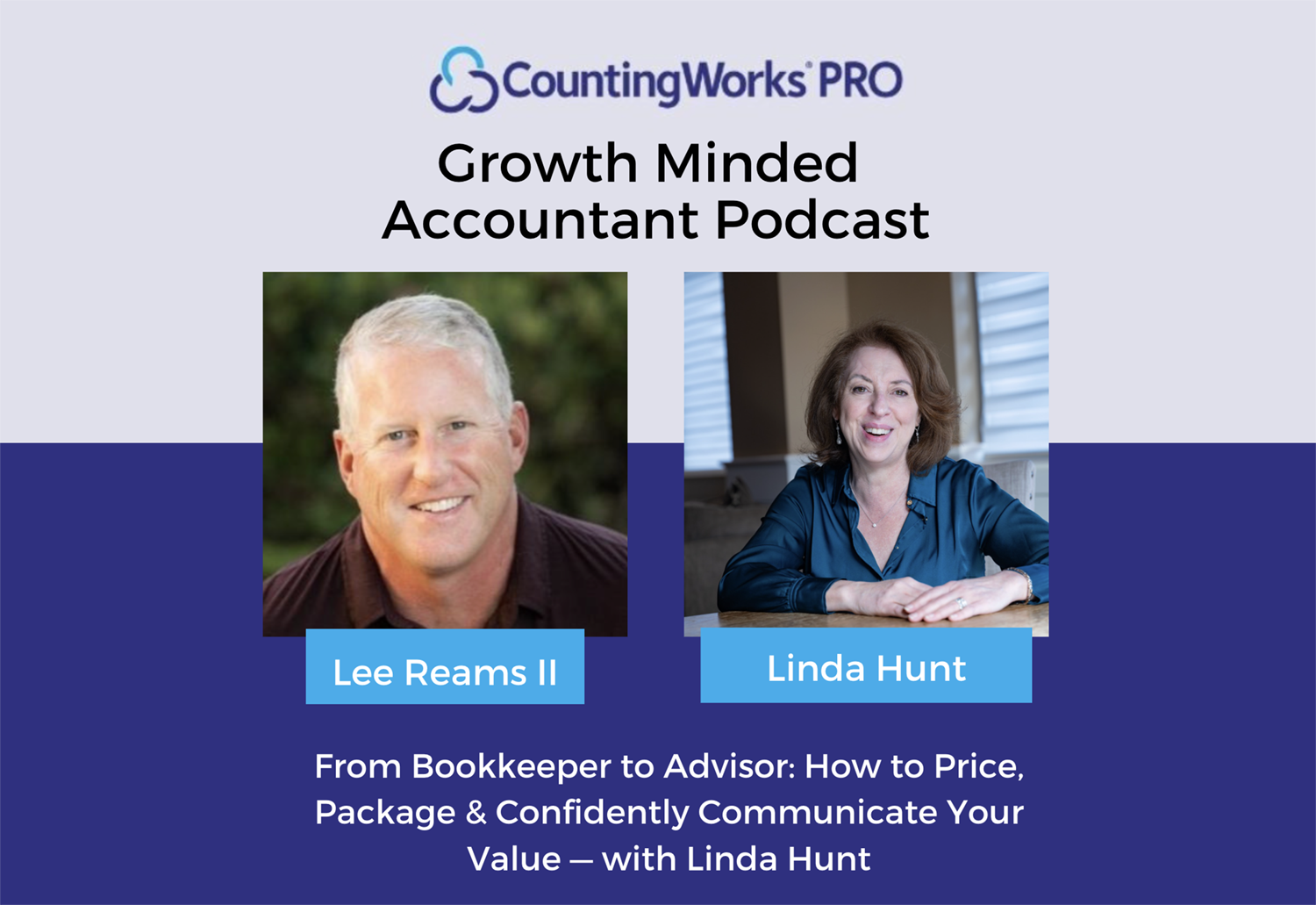
In this episode of the Growth Minded Accountant Podcast, Lee Reams II sits down with Linda Hunt, founder of SUM Solutions and creator of The Perfect Pricing Formula, to discuss how bookkeeping and accounting firms can confidently move beyond hourly billing and task-based pricing.
Together, they explore how firms can package advisory services, leverage AI as a strategic assistant, improve pricing confidence, establish healthier client boundaries, and communicate value in ways clients actually understand.
Whether you're an independent bookkeeper or a growing accounting firm, this episode provides practical strategies for increasing profitability while delivering greater client outcomes.
Get Your Free Firm Growth Breakdown
We know that everyone digests information differently. That’s why we’re now sharing the full transcript of each episode of The Growth Minded Accountant right here on the CountingWorks PRO blog. Whether you’re short on time, like to scan and highlight, or simply prefer reading over listening, you can catch up on every conversation at your own pace.
Each week, we cover topics that matter most to tax and accounting professionals—from AI and automation to marketing strategies, firm growth, and client relationships. Scroll down to read the full episode, or subscribe to the podcast to listen on the go.
Intro
Welcome to the Growth Minded Accountant Podcast, where our experts share best practices on running your firm in the digital age. This podcast is brought to you by CountingWorks PRO. Let's get started.
Lee Reams II
Welcome back to another episode of the Growth Minded Accountant Podcast, where we unpack what it really takes to run a profitable, sustainable practice. Today, we're tackling pricing. Yay! Yay! Get excited. We're kind of going off the AI stuff a little bit, but through a totally different lens.
So, my guest today is Linda Hunt, founder of SUM Solutions. Linda, if you could say hello.
Linda Hunt
Hello, everybody. Thanks, Lee, for having me.
Lee Reams II
Yeah. And she's uh, uh, founder of one of the first fully remote accounting firms in the US. And her team continues to provide accounting services while consulting firms with service providers to streamline their operations and most importantly to optimize their pricing. So, uh, we're going to talk about she's the creator of the Perfect Pricing Formula. So, I'm really interested to see what that means and then what a Minimum Aligned Price means. Uh, so we're going to go over today how to design simple profitable packages, how to use modern tools like AI without losing that human sense of alignment.
So, Linda, first of all, I want to hear a little bit more of how you got into bookkeeping, accounting, and then how that kind of uh, translated into assisting other tax and accounting firms how to price their their services.
Linda Hunt
Sure. So, I am a corporate dropout. I um, was in corporate maybe 10 12 years and I got burned out from traveling all the time. So, I was back and forth to the airport. I got to know my limo driver really well who was a small um, one of the first shared ride services that there was and I started consulting with them and that actually led me to leave corporate because I saw how I was helping them you know reorganize their business and that really spoke to me and inspired me. So I left corporate without a plan and uh, basically started offering remote accounting and bookkeeping services.
What I didn't realize, Lee, at the time though, is I was offering so much more. I was kind of saying this what I was doing, but I was really rebuilding operations, pricing, and all that stuff. Once I started to realize that several years later into my practice and talking to other accounting professionals, bookkeepers out there who were struggling, I started working with them and helping them figure out the business behind bookkeeping or the business behind accounting services. So that's kind of how I got into the educational journey as well.
Lee Reams II
So you basically were with the founder of the Uber concept and then you started advisory services all in one limo driver experience. So pretty much that is pretty good. So, let's talk about what you consider like a traditional bookkeeping firm, how they're running, and then you obviously were offering what I'll call advisory services and things that are a little more advanced behind just balancing the books. Um, kind of explain to me what you think is like the old way of what a bookkeeper does today versus perhaps what they should be doing and then let's get into how to maximize my profits, how to price that.
Linda Hunt
Okay, so old traditional way, right? We um, we think bookkeepers, accountants who are providing the bookkeeping services think in tasks. Oh, I reconcile the books. I enter in, you know, I track the receipts. I do all of that. So, they're thinking about the tasks and that's how they're communicating it.
Um, yeah, we're still doing all of that stuff, but today there's a lot of AI tools that help us streamline and make that like we use double in my firm. I don't know if you've heard of double. It used to be called keeper, now it's being called double. And we use that from day one of the bookkeeping service, right? Um, from day one of the month. And we use it all the way to help us streamline month closes.
We've gotten a lot of our less complicated closes down to 4 days. What that allows us to do is do analytics. It allows us to look at general ledger analysis. It allows us to add value-added services, right? Um, the other piece that we also do is we look at KPIs for our, you know, depending on on who we're working with, we'll create like a dashboard. We'll use a dashboard tool and those kinds of things.
So we're providing more value-added. We're also getting a little bit more involved in financial operations, the feeders into the book, the numbers, right? So there's the reporting side, but I've got my bookkeepers really thinking about how does this get there and how can we make that more efficient, right? So instead of just reporting here's your income statement, here's your cash statement, it's more hey your margins went down or up um, you know your cash flow is forecasted if it goes on this trend for the next 3 months you might be in trouble. What can we change? What if we increase your pricing?
What if we you know reduce headcount? Those kind of things.
Lee Reams II
So you're saying you're already seeing bookkeeping in the new way because of the AI technology. So it what it's doing basically is it's a labor force, right? It's able to do all the tedious work that I don't think any bookkeepers enjoyed unless they're really into their coffee and you know just sitting there mundane tasks, but it actually empowers them. And to me in some ways this kind of the golden age or golden opportunity for tax and accounting firms. Is that similar kind of what you're seeing and what you're doing in your current firm?
Linda Hunt
Yes, it is. And um, the other thing that it's doing is it's getting you out of think you're thinking about results. You're thinking about deliverables. You're thinking about the client I find in a different way. So a lot of accountants and bookkeepers, I don't want to talk about tax professionals because I don't know that mindset, but they they're tired of the mundane, right? They're tired of doing it.
It's like and there also there is this perception that well because business owners are savvy and they're going well AI can do that for me so why do I need you right so then you can kind of feel a you know as um, I was talking to some colleagues the other day like well I you know my my business is going away I'm like your business is not going to go away I go you just have to change a little bit and you have to realize that you are already providing more value to that business then you realize you're just not we have to change the way the profession our professionals our industry has to change the way they're thinking about it.
Lee Reams II
Well, they're they're reading too many uh, CNBC headlines and then the journalists straight out of college that are using AI to write their articles. Um, the doom and gloom and yeah do I believe and I've done a podcast on this already that the bottom what I'll call the entry level stuff even in tax and in the bookkeeping side 100% these tasks uh, bill pays a lot of these things are going to be replaced with AI technology and it's just it makes total sense but guess what that frees you up to do proactive like real advice that gets a business from just going through the motions to say hey here's a plan this our three-month plan. This our six-month plan. This our 12-month plan. You know, what type of profit are we looking for? What type of lifestyle would you like?
How do we now drive the results? And then you said with KPIs, I think this very interesting. And what K what AI is so powerful with is looking at lots of data and being able to put it together in like a way that you can actually understand, right? Um, so if you get more and more people start following this mindset, um, I think you're correct that you have a moat. That client relationship is your moat and you're now adding real value. So an accounting firm, you know, an accounting professional should feel empowered in some respects.
Why do you think you're seeing a little push back or what is the fear? Are they reading too many headlines? Are they is it just because this the same old same way I this the way I've been doing it. This I don't I can't think out of the box. Is that kind of what's holding them back?
Linda Hunt
Yeah, it's a little bit of both, right? It's people don't like change, right? Most of us don't like change. You want to be able, you know, I don't know if you um, QuickBooks Online has actually changed the way it appears. And it can be jarring if you're, you know, you're going to go in and all of a sudden you knew you had to get something done. Boom.
And now um, you're dealing with, you know, it looking differently. The the other thing I find with um, our our profession is we they don't know how to sell, right? They're not comfortable selling. So they're so used to saying this what I do and they're talking about tasks. So we've got to get them thinking more about what are the results that they're delivering. And you were talking a few minutes ago about, you know, what's a three-month plan, what's a six-month plan.
That intimidates a lot of accounting professionals, right? They just want to be able to do the work. They don't consider themselves analytic. And I beg to differ because most of these people are intuitive around numbers, right? They know the numbers. They can probably tell you what the bank balance is for, you know, their 10 clients or whatever because they work with it so often.
They have to it is just a matter of having a new idea in there, right? Having a new seed to say, I'm already doing this. How do I communicate it? And it for I think for a lot of folks in our industry, whether we're right brain, left brain, whatever that is, it's just a matter of pointing out to them that you're already doing this and this the way you speak to it.
Lee Reams II
Well, and there's so I'm going to even back up even more. Um, you don't need to know because if you already understand the numbers, you could pull all those numbers in and ask AI. So our tool we call Max and Max is driven we have like a knowledge layer on top of ChatGPT and Gemini and basically we've taught it everything about the tax code everything about cash flow accounting and it's very intuitive very smart but you can just go in and say hey Max you know I here's my client uh, B&B restaurant um, you know they have you know 25 employees they have $3 million in revenue here's our latest KPIs can you compare this and give me a game plan for them to plan a growth strategy. They want to get a bottom line of X. They want to improve this KPIs by X.
And uh, what's beautiful is Max will kick out this really articulate game plan and then you the human in the loop can fine-tune it or ask follow-up questions to the prompts. But to be honest with you, a layman who's not trained in perhaps accounting or bookkeeping may not know the exact ways to write those prompts or how to get that type of outputs. That you can not only guide and have a conversation with the AI technology, but you actually get a report that now you can communicate um, the game plan and this where your value is. So, you know, are you starting to get people to start understanding that's how the tools versus because you had mentioned you use double um, that's just that's just the underlying software. So, I'm a big believer um, and this what my business is all about. We're about the relationship layer.
And I am a big believer that the relationship layer is going to be the most important part about the tax and accounting industry. I think you're going to have a race to the bottom of AI technology, AI automation, some tools that will get it close or not. There's a rule of thumb. I've mentioned this before. You know, in accounting 95% accurate is 100% wrong. So, how far it goes, how good it gets.
I you know, I I'm not a I'm not going to predict the future. I'm not Elon Musk with my robot army. And you know, we're all going to have, you know, staff and no work and, you know, it's going to be great. But the way I see it today and what, you know, I'm deep into AI is these tools really complement you as a human and they give you superpowers. They really are. They're AI labor.
They're helping you now move past what would be like historical analysis to proactive suggestions, right? Proactive strategies. So now that you're starting to communicate more and more with the tax and accounting space, so let's keep it bookkeepers and accounting. We'll we'll keep the tax people out of it. I just always if I if I don't say tax or if I don't say an enrolled agent, I'll get a lot of, you know, emails or LinkedIn comments. Why do you forget about us?
We don't. We love tax professionals. A huge part of our business. But what Yeah. So how do you see that transformation occurring and over what period of time? And then let's start talking about now how you position kind of these new advisory services in a pricing model.
Linda Hunt
Okay. So basically what's happening well where I started I started talking about double. Yeah. So the first place that I I've started we started implementing this was in how can we further streamline our our um, our service delivery. Um, you know QuickBooks Online we're a QuickBooks Online house. There's a lot of automation there already.
Um, there's other AI tools, but we've we've tweaked that tool so that it really works for us. And it also does provide some analytics. We then take those analytics and we're putting that into AI. We might be doing it in a flat file. I didn't know Max existed. I'm going to be honest with you.
So, um, and we are getting information back. So, we've already my firm offers everything up through controller level services, right? So there are we have bookkeepers out there who are just doing bookkeeping. We have bookkeepers out there who are you know or or firms out there that are offering everything up through CFO services. Um, it really just depends on where they are. Um, you know if you want to talk about I mean bookkeepers can do things in different ways.
Um, but how this how you want to start talking about it is start start talking to your existing clients with this. And I'm a big believer, I do not charge by the hour at all. We are all into value-based packages. Um, even though I have created the Perfect Pricing Formula, which um, is really the Minimum Aligned Price, right? It's it shows you how to calculate the dollar amount that your business needs to and what you need to live without basically hustle burnout or paying your client to do the work, which I have found a lot of accounting professionals still do, right? They um, they underprice because they're either using a spreadsheet because it's based on transactions and there's no correlation between what they need to support their business, right, and live and what they're charging.
So, they think, "Oh, I've got to get one more client. I've got to I've got to do more." What the Minimum Aligned Price does is it brings back in the human factor into your pricing. And then from there you leverage that number into results-based packages. So that's how that's how my firm does it.
Lee Reams II
Yeah. And what's what's great about Max and tools like that and AI we have so we have a proposal we'll call it a feature inside of CountingWorks PRO but basically what we're able to do is you're able to if you and we're not into hourly. I mean, you basically have just capped your income if you're charging hourly. Uh, and you're not taking into effect your expertise and knowledge and being able to create systems and platforms where perhaps you have lower paid um, sources where AI is doing certain work and maybe some employees offshore doing certain whatever. But the real value there is to the end user. And what we even have an AI tool that goes out to the market rates per area or per niche.
So, for example, if you were a dental practice in San Francisco looking for CFO advisory, your probably expectations are much higher for what that would cost you versus if you were in Tulsa, Oklahoma. And and then AI, what's beautiful about it is kind of gives you like an a, you know, back office kind of looking at it going, "Hey, well, you're a little underpriceed, you're a little overpriced here." But I think that is a tool to assist. But value pricing packaging I think is the key to life. I interviewed uh, the CEO of CFO Project last month and we talked about and what they do is they train bookkeepers to become CFO advisors and their average firm picks up just under $2,000 a month per client. Right? So very quickly you have 10 clients that's a you know you're you have a business.
If you have 40 clients and you can minimize the amount of labor, you have a really nice lifestyle business. So I think I agree with you on the packaging. So let's talk about how you now start communicating this value. How do you start packaging? So what are your recommendations? How do you do it at your firm?
What have you seen to be the most successful way to to package let's say bookkeeping through a uh, CFO advisory like service?
Linda Hunt
So what Okay. So, I'm actually um, in conversations with a high-end construction company, a landscaping construction company right now. And basically what I'm doing when I'm having those initial conversations is I'm listening to where are their pain points? What is it they need? Right? Um, now, mind you, this particular firm, there's going to be a bunch of cleanup, right?
There's some data integrity issues. There's all of that. So, we're looking at financial operations. We're looking at reporting. We're going to clean that up. But I'm already planning I'm already planting seeds into what kind of how we can support them on a recurring basis.
So I'm doing that right from the very beginning. Um, from the very beginning I'm also talking about what it's going to give them right. It's going to give them data integrity. It's going you know those types the you have to listen to what the pain points are that they're looking for have solved. And then um, I ring in I says well traditional a traditional month you know I might say something like a traditional month-end close will give you x y and z. It'll and you're you want to relate the task that you're doing to for me anyway this what works to the pain point that they're currently experiencing and what they want to you know move forward from.
So our packages are based on how how I put together packages is basically there's some core services right so that's our minimum package it's the core things that they need right every you know and I look at the accounting cycle that's the other thing that I do what is it this business is going to need for an entire accounting cycle year I price that then we go to okay do you want to have analysis do you want you know then we I but I'm again I'm not sitting there saying do you one analysis. It's like I already know what they're looking for and I'm presenting and saying, "Well, this package and I tell I don't give them a choice.
I don't give them the three, you know, let's just say I have three offerings." I don't turn turn around and say, "Well, I have three offerings." I go in and I say, "What I'm hearing and what would best fit you since you don't have an onstaff CFO is that if we're coming in, we're participating with your leadership meetings, we're presenting your financial results, we're doing cash flow analysis. I'm solving the problem for them and I'm saying this the package that fits you." If there's something different, right, if you get push back or whatever, that becomes a whole different conversation.
Lee Reams II
All right. So, I'm going to throw out something um, to add to your technique. And what we have seen that's worked very well is you're still thinking like a bookkeeper. So, you're still kind of talking about these are the pain points that business owners have. And what is it? They're not usually educated on accounting stuff.
They're salespeople. They're usually sales and development people. They're usually they might be a sole proprietor, right? So, they might be a small business owner. They're a plumber. They're an, you know, electrician.
The last thing they want to worry about is their QuickBooks and I know you say data integrity. We know all this really important, but at the end of the day, these business owners really are looking at how can I have a better financial outcome without any hassles of dealing with it. So, you're taking half of it with what you're talking about. So, you're kind of like the base product is kind of but you're if you add on that aspirational what if I could take your business from $$500,000 a year in revenue to $1.5 million in three years or more. What if I could help you scale? What if I could help improve your cash flow?
Uh, so you know that you're a p profit first mindset and what I have found is that if you can now make that more part of the narrative and put it into everything your website your email newsletter your social media post when you do a proposal include this language inside the proposal and that's the beauty of AI. So AI is able to customize all this articulate it even to their if I'm a plumber use plumbing language right uh, I think that even amplifies the success and how much value that the client gets out of you and their perception. Um, so when it comes to I like this. So I've heard a lot of people we see both sides. We see people do ABC here's my three base uh, proposal products packages versus saying okay I have a base and then I go up or down. I guess you don't go down because the base is a base but you go up and then you decide how far for each client.
So and accountants definitely feel very biased one way or the other. Simplification makes it easier. But what have you seen like as you start seeing um, this? So you're at the base, let's say you have a client and then you suggest something that's a little farther ahead. Let's say it's another $500 a month or $1,000 a month. How do you overcome that?
How do you communicate? How do you present that so your client feels confident that you're going to get the results that you're promising or they're going to get the results they're promising?
Linda Hunt
Well, it's the deliverable, right? It's the it's the result, right? It's the pain point that you're to me. It's still the pain point that you're solving for them. They're looking for something specific and it could be exactly what you said, Lee. Like, you know, I want to do this in the least painful way possible.
Um, a and we're dealing with businesses that are, you know, they've grown. They they did not invest in their financial operations. They did not in they may have invested in their reporting, but there's cracks, right? So, a lot of times we're fixing we're smoothing that out, fixing that, and then we're by that time we've already proved our worth, we've proved our value, and we're into recurring services with them. But I actually want to step back a minute because what you're talking about, you know, you know, I can help, you know, someone going in and saying, I can help your business for, you know, in three years get to X. Not every accounting professional feels comfortable doing that.
So, you know, for or my firm, we're kind of like we offer that consulting services, but not all of your accounting professionals are doing that. So, I'm going to kind of interview you a little bit and say, "How do you, you know, like because I could tell you, I know some of the folks that I talked to, their their stomach flipped when you said that. They're going to be like, "That is so something I do not do." And okay, that and that's okay because not everyone is meant to do that. So, how do you help those folks who are sitting here going that that's why they're panicking about AI because they don't want to do that?
Lee Reams II
Yeah, I think there's a comfort level, but this the reality of where we are today. Um, and I think the market is already so this the one thing that I continue and a lot of times it's deaf ears like I see what's going on. We're seeing how referrals have changed for example into ChatGPT. People are going straight to ChatGPT saying who should I hire or my current accountant only does this who in the market should I should I look at and the market is already moved as far as just the way people are using AI to source people the second area that's happening now is as you said people you know you're hearing accountants are saying it themselves oh I'm going to get I'm going to be out of business well which means no you're not all you need to do is use the AI tools the saying is and I you know I've heard a bunch of people say it you You're not going to get replaced by AI.
You're going to get replaced by an accountant who uses AI. And I 100% believe that. So in the process, Linda, you already said you guys are using dashboards, KPIs. So there's software that already helps them get 50% there. So now let's use tools that and AI that help me now do this advice giving analyze these numbers. All I need to do is ask the right questions.
How do I create? And you can interview a client. You can even use tools like Max to create that intake form and or even a questionnaire of questions. So even on your first discovery call, okay, I'm I'm onboarding a new client who's a construction business. They are currently at X. They have really messed up books.
The beginning we're going to work on this, but let's give a strategy of how I can now take this business from $1 million in revenue up to $$10 million in revenue. I'm just giving a big let's do big dreams. But AI 100% with your assistance can create a story that's personal to that particular client based on their own numbers based on that interview. You can even record the interview, take the transcript of that, throw it into Max, throw in their last income statement, say, you know, this their demographics. This where our goal is and say, "Hey, I want to get a full-on report and a full strategy plan. I want it to be 10 pages long.
I want it to have charts." it's doing all of this. You do not need to be a a brain surgeon to use it. It's just you can't be afraid of it. Uh, and you need to start trusting it. So, the idea here is that AI gets you 90% of the way there. You as the human now go in and analyze.
Well, wait a second. The AI went off, you know, you went rogue here. And I even have I literally have conversations with my tools every day. And like if you're walking by my office, you're like, "Who is he talking to now?" I'm (Laughter) like, I will be and I use the I use the transcript to it. So, I talked to it. I hate I got to the point where I couldn't type fast enough and I have 38 typos.
It still knew what I was asking. But what I have found is I have full-on conversations and I treat the technology as a true assistant and even a partner and I consider it a clone of myself. So, it learns my memories. It learns right um, you know how I do things, how my processes are and you can set it up so you can have your own this my process. This the type of reporting I want to do this on monthly meetings. This the type of strategies and output we want to do go over with our client.
This what a quarterly looks like. This what an annual this what a long-term uh, plan looks like. So what I'm saying is you do not you as a bookkeeper or a trained accountant are way ahead of the game. You know you understand now what these numbers mean. You understand trends, you can see, hey, this a problem. Uh, you know, you might even have openings for fraud and who knows kind of things.
But that is what your value is and that is now how you price. So, uh, that would be my answer to it. We're seeing people that are that are running with this and I'm like begging the profession to evolve and don't be afraid and just, you know, we always say just start with your client communication. Just use it to write responses. Be more responsive to clients and then give a little more analysis and you would be shocked. You know, you might say a client question might come in or a problem and you're like immediately, well, this the answer.
But if you throw it through a an AI tool, it might find 20% more or 25% things of you didn't even think about. And that is where the real value ad is. And the AI by itself is not going to get that output. The human in the loop is really powerful. So, that's kind of my long- winded answer to the reverse interview, but that's how I would do it. And I think what's what's really important and what you're kind of talking about but not getting into is this why we keep talking about client narratives and your brand narrative and how you communicate everywhere.
And if you're getting this kind of information out to clients, um, they're going to start listening and they're going to differentiate you very quickly from, you know, Intuit just what they put $100 million in OpenAI. So QuickBooks is going to be loaded with all kinds of AI tools. You as a professional sure the hell better be able to really add value on top of that because it's going to be a situation where if you don't, then you're correct. That type of tool will automate you, you know, perhaps out of business. The those that move I feel have the ability to be much more valuable to their client base and their clients going to have better financial outcomes. What does that mean?
They're willing to pay you more. They're going to refer you more, etc. So, there's my long-winded. How does that fit into what you're talking about, Linda, on on pricing and kind of moving, you know, the people you're talking to forward,
Linda Hunt
right? So, I I'm actually going to go back to the beginning, right? When I started my remote accounting services business, there wasn't any tools to support being remote back in 98. There. I mean, I think gosh, you had to go into this. I don't even know what you call it, but anyway, there were no tools.
So, we based our the foundation of all of my workflow and all my processes is in communication. It's in that client relationship. So, in a way, I actually didn't realize until we just had this conversation that that's really the crux. I shouldn't say of course I knew it but it's like you reminded me that's the crux of where our services lie and yeah we're using some tools maybe not to the extent that you are to automate us and to enhance the client relationship but our clients are we're doing more of those you know value-added services beyond the AI tools. So, um, again, I'm going to go back to, yeah, AI pricing, you can get, you can use a tool, but there still is that human factor that you're going to need to look at because if your body like when you state a price, if your body doesn't believe you should receive it and you there's cues, right?
There's, you know, when you say something, it's like your stomach flips or you get nervous or you overexplain or you add val or you add extra services when you state your pricing because you know you're not comfortable with it. So AI can say it, but if you don't believe it, you don't believe you are offering that value, you're a lot a lot of times your money story gets in the way. You're not going to you're not going to succeed with it. It. That's what I find. That's what I find in the industry.
It's like if you don't believe it, there are going to be people who will be able to power through it. But then it's just like the person who wins the lottery ticket, right? They might have been poor. They win the lottery and then three years they're poor again, right? So you have to let's sad story. Yes, it is a very sad story.
But that's because they're not used to having money and being rich. So you know and
Lee Reams II
Yeah. So we can get into that whole nervous system side, right? That whole that's where I'm leading and I'm going to say something about uh, so I believe and I've said this to my own staff. Uh, I think the best sales people are not salesy at all. They are completely comp uh, they believe in what they're doing and they're completely confident that I'm going to make your life better. And if you have that mindset and you are moving the needle for clients.
So, I'm going to back up a little bit before we get into the nervous system side of things and then how people look at it. I do believe there is a technique you can use when you're doing kind of this advisory level now. You're kind of moving the needle a little bit where you can put accountability into how you offer these services. So, people feel nervous like I can't promise or I can't help someone go from $500,000 to $1.5 million. Well, you can give them the plan and you can give them bucket A, bucket B, bucket C. These are the things we need to work on.
These are the things that are going great right now. Here's the ones we're looking at. Here's the ones we need to improve. Um, and once you make them accountable and during your monthly meeting, you're going over this and say, "Hey, this looks like we're still a little bit off. What can we do this month to improve it?" Now, you're putting it on them versus you to deliver because you're just giving them the road map. Um, you're not out there running their business.
You're giving them the results of what they're doing and running their business and you're giving them suggestions because of your experience and know-how on numbers how to get there. So, what do you think of that would kind of push bookkeepers uh, a little more confident and then actually, you know, make them feel more comfortable in saying, "Hey, this what we're going to do."
Linda Hunt
So, basically what you just talked about is boundaries, right? And you talked about the line in the sand or where you where you're responsible for what the information that you're providing and what the client's responsible for. And that when you that is to me a blurred line for a lot of accounting professionals. They think if they're giving that advice, they're responsible for that advice. And I love that you highlighted that because that is so it's one of the things that we do all the time.
It's like here you go here's here's your numbers or you know for example there'll be times when there'll be a system that we don't know right and we'll say okay we can align your data with it but we are not responsible we will look at it we will we will identify where things are but we are not responsible to fixing it and our fee doesn't reflect that so you make it very clear up front so it's it's about the line in the sand it's the boundary of where your respons responsibility in your services end and you make that clear in your service offerings in your packages in and this gets into scope.
Lee Reams II
Yeah. Scope creep and why an engagement letter is so important and even in your proposal. This what we do. This not what we don't do.
Linda Hunt
Correct. Yes. Sometimes you have to say you have to actually have to lay out what they are responsible for. Right. Because often times like typical things like now this not such a big deal but when a client needs to get you information right you if you have a deadline and you're following up and they're not giving it to you can't do your job right it's not as prevalent anymore because there's you know there's online access and all that stuff but it still isn't your responsibility there the client has to meet you in the re working relationship uh,
Lee Reams II
look at yourself as a coach um, and just not delivering numbers and results. It's coaching and say, "Hey, this what how we did it last month. These are my three suggestions." And if you're not sure what those suggestions to be, ask AI what it should be and then analyze it and go, "Okay, yeah, well, this makes a lot of sense." And then add some more human to it. But I think if you make it more collaborative, they'll they're going to be more accountable.
So anything just like you know life living on life and discipline and saying you know this how I run my day those without any sort of game plan probably aren't as disciplined it's you know happens with the way they eat the way they exercise the way they spend their time and they get lost on their devices and they're not accomplishing something and I'm not pushing everyone being tightly wound and your life is so this what I do there's a combination or somewhere in the middle is a good one but I think accountants can learn a lot of that um, by just putting in these processes than putting these processes in place for their actual client. So, um, so when I go to the scope creep, like what are your suggestions? So, we've gone through this. You've kind of said this how you like to have one pricing. You have a base. You you add to that.
So, every price is that's on recurring.
Linda Hunt
Yeah, that's recurring services.
Lee Reams II
Okay. Yeah. And you negotiate that. You have a proposal of some sort. They sign up and they pay you monthly. That's great.
Then you put on an engagement letter on top of that. Do you do you do those yearly? Is it a never- ending engagement letter? Like what is your process at your firm?
Linda Hunt
Yeah. So, um, so pretty much it's an you know, it's an ongoing um, it's an ongoing relationship. Um, I don't renew it every year. However, I am talking to them at least once a quarter about this what we've accomplished. This where we are. Um, I'm noticing like I'll say, "Oh, I'm kind of noticing there's there's um, you know a volume increase or I'm noticing that we're doing more analytics." I I'll tell I'll point out the things to them.
Now, mind you, my packages also have a little bit of they have cushion in there because I don't like to nickel and dime anybody, but every quarter we're having that conversation about this where we are in the package. So, if I have to make a change, I'm able to do that. Um, because to me, if you're not servicing your client in um, based on into the retainer that you've um, set, there's one of two things happening. It's either a scope creep or you've got a training issue on on your staff, you know, or or there's got to be an automation issue. It's going to be one of those two things. So, have the conversation.
Don't be afraid of it. The client wants to know, right? They're more interested. Um, I've had some really good conversations about where we are in the package. That always leads to more work and an add-on. Always.
Yeah. I shouldn't say always. Nine times out of 10. Yeah.
Lee Reams II
Well, n that's close enough. That's that's always (Laughter) I'll give you that. 90% is close enough. Um, all right. So, we've talked all around it. We've talked about being confident in delivering it. How to move yourself past just delivering numbers and make it more about the future.
We've talked about being collaborative. What we really haven't dug into is how do you set your base price? You know, I have my feelings, but I want to hear what your point of view is. How do you create what is that entry level base package look like? What do you charge? Is it different per region?
Is it different per type of client, per revenue? Like what are the variables that you put Intuit to kind of determine how you create your perfect price?
Linda Hunt
Right. So, so, okay. So, if we're talking to um, so basically our pricing is our pricing. We work with clients all over the country. Um, our I do not adjust our pricing by region. So, I don't do that.
It's like my firm is based out of Connecticut, but it's not as regional anymore. But, um, I don't let that be a factor. Um, basically what the factor that I'm looking at is what is it the client's looking for? So, I look at packages um, in an old it's it's an oldfashioned way of thinking but I look at it from not in the number of transactions but in the core services right I call it basic processing. What are the things that we need to touch most frequently? What are the things we're touching once a month?
What are the things we're touching once a quarter and I kind of assign a time value to that right so that so there is a time factor in my packages and then that gets I also apply a blended rate um, depending on the service level you know on the technical level that's there and then I'm adding the third thing I'm adding is some contingency right so that we can live and grow with that client without having to go back and say, "Oh, you know, every time you call me, it's a it's additional." So, um, I also have a minimum of which we will work with. So, I know specifically that we're working with clients between $3 million and $30 million. If you're underneath that, I'm not right for you. I'm going to refer you out to somebody else. So, you have to know who it is you shine with and who it is that you service the best.
I also know that we provide accounting department services meaning that we are in step with that client. We are probably talking to various people in that business. So I've my packaging reflects how we're delivering the service, right? Because we're in step. We're we're having a lot of conversation. So all of that gets factored in.
So, you know, I'm I'm I'm kind of giving a broad broad strokes here, but
Lee Reams II
you're not giving me the detailed numbers, which is fine. I don't want you to, but I do you did open up a few things that I think are really important that we're seeing applied over and over again for the most successful clients and that is positioning. So, you work with the 3 to 30, put it on your website, use talking points to speak specifically, use images that speak to this. If you are working with uh, physicians, have images of physicians, speak in their language in your copy uh, in your social post, whoever you're asking for referrals, your newsletter. I think this really important because you're going to a attract more of the like people, like-minded people that you're looking for. You'll also stop wasting time with people that don't fit your model, right?
They're going to self, you know what? You're not going to a Mercedes dealership if they want to buy a Toyota, right? So they know now I'm not. So that's the problem with generalists and that's the problem kind of with the vertical as a whole. No one likes to say this claim my spa spot. This who I am.
This who I target. But the firms that are the most uh, successful do that and I'll give you a couple reasons why. One is it helps people self- select and it also kind of gets them ready for the pricing level that you're going to be able to support. I don't work with smaller businesses here. I can refer you out. This my, you know, who we work on.
And they're already in their mind going, "Okay." um, and then if you are a niche player, now you're saying, "I only work with medical practices with five to $10 million in revenue. Wait a second. Okay. I'm a medical professional that sits in that space. I'm probably going to choose that CPA, that bookkeeper, that CFO advisor over a generalist that because they know physicians and this general, I don't know if they know physicians. So, there's already you're owning the real estate.
Um, what have you seen or how do you articulate that when you're meeting with clients and advising them and coaching them?
Linda Hunt
So, we do we have several industries. You're right. We have several verticals that we are experts in. And the reason why I choose to be in several verticals versus one is because um, back I can't I think it was in the early 2000s in my region when things were still very regional, there was a downturn in construction. There was a downturn in a couple of related industries that really affected my my business. So, um, so I kind of have nonrelated verticals, right?
Um, that I'm working with. Um, I find that people know you for that, right? After like I really don't do a lot of marketing anymore because people just know, oh, you want to like you said physicians. Um, oh, you want to work you're a physician? Go talk to Linda. She's she's the one who's going to be able to help you.
So, you become known for it. You become you become the expert in that field. Um, especially if you're work like for us, we're working we don't do tax, right? So, we work with a lot of tax professionals. They'll refer to us like, okay, this who you need to support you because we work in tandem together. Um, how I'm presenting that to clients.
Clients um, they want to hear that you know them right as you know like you want you want to make when you're talking to them you want to talk to them and make it that you understand what they're going through you understand their industry you understand the nuances and that really and that also you know I'll I'll say like when you're talking to AI it's like AI is going to work for an accounting professional better than a layman because you know the right things to ask AI you like you were I think you mentioned this earlier talk about the prompts. So it's the same concept. It's the same concept. People want to know that you understand who they are and where they are. The beauty of AI is and it's against what people would think. It actually actually allows you to be even more personalized with your strategy delivery um, and everything.
So it's a big deal.
Lee Reams II
And then something that people don't realize is the conversation about who to recommend is slowly but steadily moving into ChatGPT uh, and it's still the market leader or Gemini right so uh, Google's AI tools are all over search so the old way of blue links and people asking their friends and googling them and going to the website those conversations are happening inside these tools now so if you are utilizing what I am suggesting and creating content as I am the physician expert in $5 million to $10 million revenue practices and I have put myself out there and then I have reviews from my clients saying so and so is the best and it's a physician you are going to be the firm they that AI is talking about and recommending and what's happening here is the the professions the professionals are putting their head in the sand like I am all afraid I don't know what to do they're not being a part of these conversations anymore because they're saying I don't need a market that's the last thing you do today in this world, you need to be the expert in whatever vertical or multiple verticals that you're doing and it's really easy to utilize uh, the technology and marketing techniques to do that.
So I think it's really important and then even as you kind of communicate and coach up your clients definitely start mentioning to that to them where and I agree I 100% like you have regional downturns and there's interesting there's a big chat on it was on uh, Twitter or X or whatever you're going to call it today about how the industry was doing and CPAs enrolled agent bookkeepers were talking and there is a huge disconnect. There are parts of the economy that are booming right now. There are other areas in regions. So it could be plumbers in, you know, Southern California are booming, but plumbers in certain parts of wherever are not and there's a huge disconnect and it's all over the place. But by hedging your your bet here, um, you're able to sustain that and you're able to handle the downturns and upturns. And then, uh, I think that's really important that you kind of identified that very quickly.
All of a sudden, you know, the Northeast goes through a construction downturn for whatever reason. Um, you know, some industries shut down, some, you know, migration, whatever, and now you're hedging yourself. So, when you would advise clients, you know, is there a certain amount of verticals that you guys work with or, you know, and I'm going to say that one, and then two, what's nice about this once you know a vertical, you know, all the questions your clients are going to ask before they have to ask them. So your your perception is actually easier to do your job because you already know what they do. You know how you you've seen multiple points of view how other practices run. That's even more value for you.
Linda Hunt
Correct. So um, we work with seven verticals. Um, and then the other thing that I've done is I've actually over uh, at least once a year I bring the decision makers from those verticals together and we have a round table. We actually get together whether it be on Zoom a couple times. We've gotten together. It was before COVID, we haven't done that since but we get together and we have a roundtable discussion and we bring together best they bring to best together best practices not necessarily accounting practices but just different things that they're dealing with in the in their industries and the trends that they're seeing.
So that's a value ad that I just do. Um, and it's it they're always fascinating conversations and I learn I learn how to then I learn what they're dealing with and I learn how to create a solution because I'm putting myself in a situation where I'm learning more about the industry and more about my clients and how my clients are interacting. So, don't be afraid to bring your even if you don't have verticals, don't be afraid to bring your clients together and have conversations. You know, maybe it's a it's a conversation about pricing, you know, like we've done we sometimes we have specific topics, sometimes it's it's a free not I don't want to say a free-for-all, but it's an open forum discuss. You never know where you're going to get on Zoom, so you got to be very careful.
Lee Reams II
(Laughter) You're ready to hit the mute button as much as possible. So, Linda, I think this has been a really good conversation. I know we've kind of gone all over the place with this. Um, is there anything that I've really missed that you wanted to cover today? I know this whole nervous system alignment and capacity and there's a lot of different things you have with kind of the formulas that you've been using but you know what would you Linda to finalize this talk on? I
Linda Hunt
I think for me is don't be afraid of the tools. Don't be afraid of the change. Um, and realize that there is still that human factor. Humanity is not going to go away, you know. So it it's about it's about balancing it and and welcoming the change. So yeah.
Lee Reams II
Awesome. So if if someone was an independent bookkeeper and wanted to kind of uh, wanted some coaching, wanted some advice from you, you know, how do you work with uh, professionals, how would they contact you? Uh, you know, how does that happen?
Linda Hunt
Yeah, so they can go to my website, they can uh, SUMSolutions.com, it's su lu ns.com. U book a I think I call it a financial clarity consult. Book a call with me. Let's have a discussion and I'll see if I, you know, let's see if there's a way I can support you.
Lee Reams II
That is awesome. So, hopefully I've shared some things with you. Uh, hope it was a learn two-way street here on learning. Um, and again for our users uh, or our listeners, not our users, my I'm I'm thinking I'm in my software head right now. Uh, but the listeners to the Growth Minded Accountant Podcast, I appreciate you. Uh, if you found some value here, obviously share, ask us any questions.
Um, I'm obviously available on LinkedIn and love the feedback. Uh, I do want to thank everyone our our viewership for the Growth Minded Accountant. It's not huge in the way that you have Joe Rogan and such, but it is amazing to see how we keep doubling each month and really appreciate all the feedback and hopefully we're trying to educate the entire vertical this industry on how AI and this modern firm should look and how it should operate. So hopefully you'll find a lot of value what we're talking about today. So until next week, we have some really good actually we have I think I already have two or three more uh, episodes the next three weeks already figured out. So really good topics.
We're kind of changing up a little thing uh, here or there. So a lot of value for ROI that you can get before next year so you can plan for 2026. So again, thank you for being a listener to Growth Minded Accountant Podcast. Thank you, Linda for spending time with us and we'll see you uh, next week.
Linda Hunt
Thanks, Lee.
Why is hourly billing becoming less effective for accounting firms?
Hourly billing rewards time rather than expertise. As automation and AI improve efficiency, firms need pricing models that reflect outcomes and strategic value instead of hours worked.
What is the Minimum Aligned Price?
Linda Hunt's Minimum Aligned Price framework helps firms determine pricing that supports both business sustainability and personal financial goals while avoiding burnout and underpricing.
How can bookkeepers begin offering advisory services?
Many firms already possess the financial knowledge required. Advisory often begins by asking better questions, providing strategic insights, and helping clients act on financial information.
Does AI replace bookkeeping professionals?
No. AI automates repetitive work while allowing professionals to spend more time interpreting data, strengthening relationships, and providing strategic guidance.
Why does specialization improve pricing?
Industry specialization builds authority, increases referrals, simplifies marketing, and allows firms to communicate expertise with greater confidence.
How can firms reduce scope creep?
Clearly defined engagement letters, recurring pricing reviews, and transparent client expectations help maintain healthy boundaries while supporting long-term client relationships.
Listen to other podcast episodes or read other related blog articles with relevant information and insights.