Most tax and accounting firms don't have a software problem.
They have an experience problem.
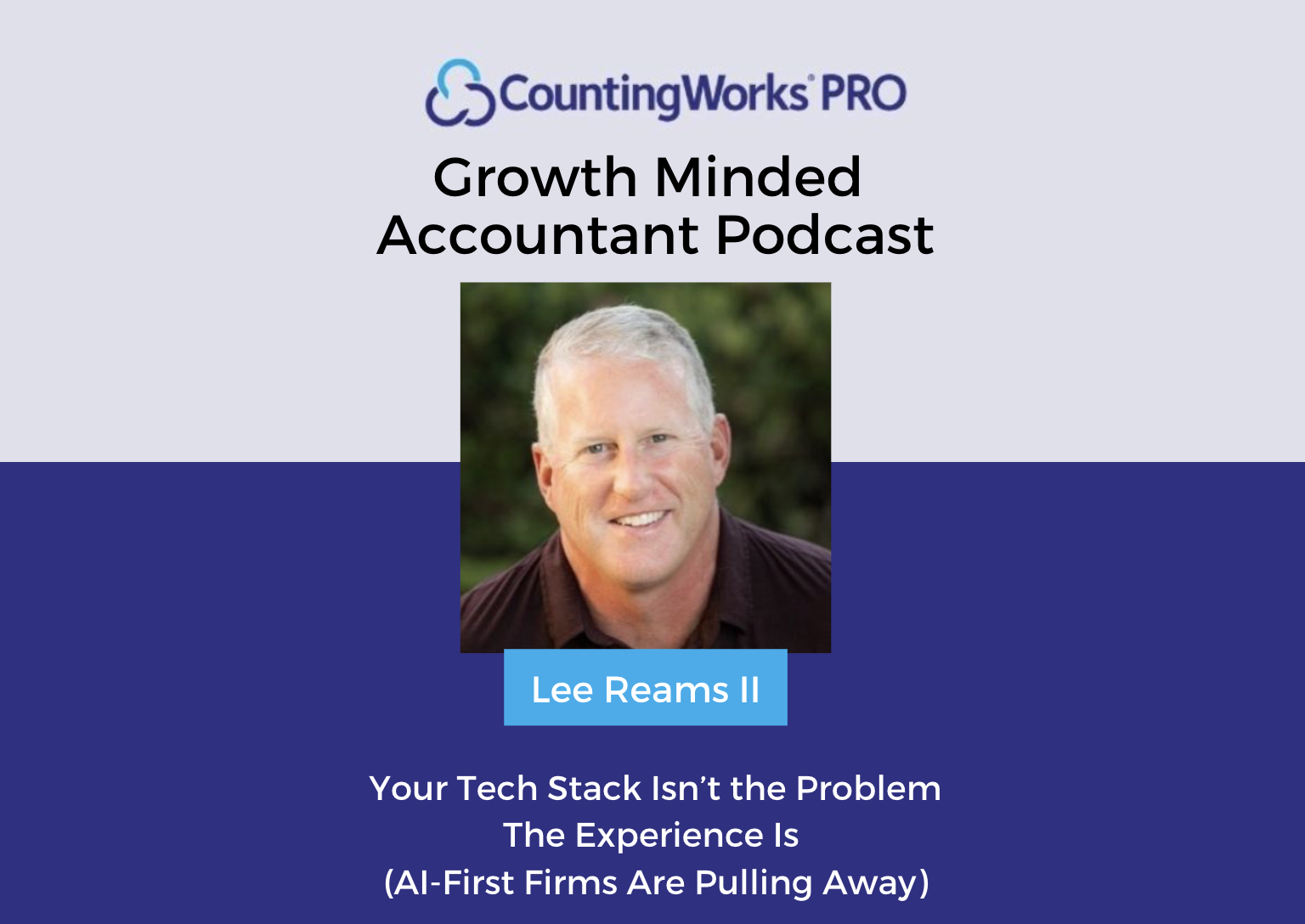
In this episode of the Growth Minded Accountant Podcast, Lee Reams II explores why adding more software rarely improves firm performance—and often creates additional friction for clients and staff. While firms continue investing in new tools, many overlook the hidden cost of complexity: fragmented workflows, inconsistent client experiences, duplicated training, and growing operational risk.
Lee explains why the future belongs to AI-first firms that simplify the client journey rather than expanding their technology stack. Instead of asking, "What software should we buy next?" he encourages firms to ask a more valuable question: "What complexity no longer needs to exist?"
Whether you're evaluating your firm's technology, improving client onboarding, or preparing for the next generation of AI-powered accounting, this episode offers a practical framework for building systems that truly scale.
Get Your Free Firm Growth Breakdown
We know that everyone digests information differently. That’s why we’re now sharing the full transcript of each episode of The Growth Minded Accountant right here on the CountingWorks PRO blog. Whether you’re short on time, like to scan and highlight, or simply prefer reading over listening, you can catch up on every conversation at your own pace.
Each week, we cover topics that matter most to tax and accounting professionals—from AI and automation to marketing strategies, firm growth, and client relationships. Scroll down to read the full episode, or subscribe to the podcast to listen on the go.
Lee Reams II
Welcome to another episode of the Growth Minded Accountant Podcast. My name is Lee Reams II and I'm the founder and CEO of CountingWorks. And today I'm going to take off on the podcast topic that we did last week. Thank you so much. We're at almost 5,000 views now. It's one of our most popular episodes yet. And we talked about client experience and why we think it's the missing layer in most tax and accounting firms. And today I wanted to go off of a couple topics that we talked about in that podcast. We've gotten a little bit of feedback and the questions really revolved about kind of client experience and your own tech stack, right? and why a complex or a very large tech stack can actually create problems for your clients and your own firm when it comes to the client experience.
So today I'm going to chat about that. I'm also going to add why AI firms are all pulling away right now and kind of the difference between what I'm going to call a native old school software product and an AI-first product. So let's talk about this uh in a couple different ways. So, you know, what is the most confusing client experience you've seen caused entirely by good software? And I think that is easy. It's never just one bad tool. It's a pile of good tools all doing different things and not communicating together, right? So, that's what we're going to talk about today. Um, I believe in 2026, the problem in most tax and accounting firms, and what I mean by problem, I'm talking about bottlenecks. you know, my clients don't respond. My clients are unorganized. My staff doesn't know how to use my tools. Uh clients are sending things all over the place, right? There's a lot of confusion. I don't think this is about bad software. I think it's about too much software and not enough thought of how the humans actually experience. Meaning, a lot of times when firms, you know, CPA firm partners, you're going and looking at your software uh tech stack and you're kind of deciding what software you're going to want to use. You're not necessarily looking at it from what does my client actually see?
You know, my client doesn't use this software every day. It doesn't engage my software every day. It's not logging into my portal every day most likely, right? Most clients might be once a month, you know, maybe one time a year. Uh and then when you add a lot of different complexity, you know, for example, all of the this is January uh 14th, we're seeing a lot of clients send out their new client uh tax season welcome emails and then they're listing five and six different stacks on things you have to do to work with me. I consider that confusing. So, that's what we're going to talk about today. And I think the conversation um should shift and I think it's no longer, you know, what tools should we add. Um it's why does this feel so hard and what shouldn't exist anymore. So, uh I broke these down like normal in the podcast. I do them in segments. So, I do kind of like segment one and what we talk about and I kind of break it down and an outline to follow. So, I'm going to start with the too many good tools reality. Uh, and I think we're seeing the same pattern over and over again. And we see it when clients come to us in even looking at CountingWorks PRO as a a software platform, right? A lot of times they're saying, "Here's my eight tools and they're saying um, and I don't consider any of them junk. All of them by standalone are very powerful, right? their respected CRM programs, uh perhaps their tax prep software, their a tax planning tool, their client portal, they have intake forms, they have e-ign, they have questionnaires, uh they might have payments, right?
And then all of a sudden now you have an AI layer on top of it, right? So the reality is um you know, can they'll say to us, can you go feature by feature with all these tools to see how your platform compares? And to me, that's the tell. That question assumes that the firm is actually using all of these features. So whether you go by, you know, really you only need 80% of the features, I I think that's probably true. But the reality is you probably only use 20 to 30% of the tool features that are available to you. And if any anytime you try to go beyond that, the training is long and cumbersome. You need tech people. You need IT people to help you do things. And I don't think that's where most firms want to be. And I, you know, I don't think, again, they're using all the tools. So, my honest estimate, most firms use 20 to 30% of what they're paying for. And not because they're lazy, but I think, you know, training never compounds, right? Uh staff turnover resets knowledge. That's always horrible, right? Processes start drifting. They might even drift during tax season. Okay?
And clients, more importantly, which you realize, don't follow instructions perfectly. So at some point the stack becomes something you maintain instead of something that actually helps you grow. And uh you know and leadership often doesn't see that gap and you know your firm might seem or sound sophisticated. It may sound modern. This is my tech stack you know but behind the scenes your staff is doing workaround work. Your clients are confused or they're ignoring things. They're not sure which tool I use for what. And people not systems are holding everything together. And I consider that fragile. So this is the part where firms dramatically underestimate um you know how how much time it takes to learn these software products, right? I've heard of onoarding practice management systems. 30 day we'll get you trained in 30 days.
Your whole staff that is a serious commitment, right? And that's just one tool. So now multiply that by your CRM, your portal, your intake system, your planning software, e-side payments. uh and now you know you're not just training staff, you're onoarding them into a maze of products to try to work together and and that training doesn't always stack and these tools do not always communicate together. So what I think that does is creates leaks and it it it takes uh you know by the time someone finally understands the system, you know, tax season's already hit, right? Or a process changed or more importantly or worse yet, they leave and then the firm starts over again. I don't consider that scale and I think that churn um you know really hurts your growth. It hurts your systems from moving forward. So I I have already kind of mentioned this but this is what we're seeing this time of year is that welcome to tax season email and every firm has it and we've been you know we get CCed on a lot of them. We see what people are saying um and they don't always know how damaging it.
You know here are the tools we use and this is a list. This is where you upload documents. This is where you chat with us securely. Uh this is where you look at your tax planning strategy. This is where you sign the e- signs. This is where you pay me from. And internally that email may, oh, look how organized we are. We're telling the client step by step where to go. Um but on the client side, it lands like, oh my god, you know, I already don't know how to log into these. I don't even know my username and password, right? So they're thinking this firm is an advanced. They're thinking, I hope I don't screw this up. And quite honestly, you're adding friction in the whole engagement process. And what that means, that anxiety, that friction, I want to put it off. I don't want to deal with this, right? You know, miss uploads, missed deadlines, late responses, you know, incomplete uh intake forms, right? Things are like that. Missing payments, you know, from your proposal, for example, endless follow-up. So, now you're just basically in a to-do list of following up with your clients. So, you'll end up saying, "Well, these clients are difficult." And what I really think is happening is your experience is difficult. You have not laid out the from the onboard point forward how clients should work with you. What are their expectations?
Defining that in your engagements, defining that in your proposals, starting off with a, you know, an intake form or to-do list or things that really systemize everything. I think that is the the way things should be. So, you know, we say the stack nobody sees uh end to end. So, here's the uncomfortable truth. Most firms don't have a system. They have a CRM that tracks leads perhaps, right? Uh but not necessarily relationships. They might have a tax prep system that lives in isolation or may talk to their tax planning software. They have a man a planning tool that's so sophisticated that only a few people trust themselves to use it. Um a portal perhaps is clunky that clients tolerate. And then you have separate tools for your intake, e-sign payments, follow-up. So I think that is um not really understanding the full client story, right? And what happens is your staff becomes that integration layer. They're the ones that are kind of putting it all together, bandating it, duct taping it, whatever you want to call it. So people copy, they paste, they explain, they reconcile, but that's not automation.
I call that human duct tape. So the software actually becomes the bottleneck. Okay, traditional software. Um, and I'm going to, this is where I'm pivoting a little bit north. So, I've kind of, I think, explained what all this tech stacks and kind of the difficulties and some of the problems most firms are seeing. We see it over again on Reddit. We see it on LinkedIn. We hear feedback, not from our clients because they've kind of solved this problem, but we see the pain points. We understand what's happening. So the secondary thing I see is these traditional legacy software products are now bolting on AI on top of it but they still have limited software programmed by humans. They don't have the capabilities you know software is basically inputs in outputs out you know and AI isn't limited that way. So you need to look at AI native products to start replacing these legacy software products. AI adapts it. If you know how to talk to it or how to write prompts and you have the data, um, it can do almost anything you want. You're your own programmer.
You're your own developer, right? You don't have to be limited on, oh, well, the software only does XX and A. Um, now I can do anything. An AI can now personalize scenarios for each client, compare year uh over-year changes dynamically, surface planning opportunities u based on your prompts, you know, and even going in proactively looking at all your data. So if all this knowledge about your client exists in one ecosystem, AI is able to say, hey, you know, these 10 clients should be doing X, these five clients should be doing this, and hey, do you want me to send a proposal? Sure. And it just does it. So I think it's really important to understand that software that relies on fixed logic is becoming the bottleneck. Okay, that's slowing your firm and it's making things more uh complex. So AI first is a new baseline. Um firms should be AI first and this is how you should need to start thinking about your tools, right? So not because AI is trendy uh because it is capabil fundamentally more capable than traditional software tools, right? So instead of asking perhaps what software do we need for this I would say the better question is what should AI handle what truly needs rigid software because I need to make sure this is 100% correct I can't put other variables that we have hallucinations or things that are incorrect and that starts flipping the stack right so what it does is it compresses the amount of steps the tools the training and communication so instead of thinking CRM then intake organizer planning tool email portal followup, you get one system.
So instead of having six or seven systems that I'm kind of juggling to get something done, I got one system that kind of blocks each process. When one completes, it kicks off another one. When that one completes, it kicks off the another one. Right? So one experience, and we're talking about client experience here. You can still have what I believe is you have one what I'll call client experience tool. That's one platform. And then you have what I'll call what goes on the magic behind the, you know, the the Wizard of Oz behind the curtain. Okay? But what you get then is one experience for your client. One conversation that you can look and track and everyone can see that the client actually feels. Okay? Uh I think this is really important and the kind of the main theme of what I wanted to talk about today. So we're not saying throwing out your tax prep system. I'm not saying comp, you know, compliance obviously still matters. Accuracy and trust still matters. But the client-f facing complexity that most firms have created today, I don't believe that's necessary anymore. AI can draft, it can summarize, it can analyze, it can personalize, it can adapt in real time without needing 30 days of training per tool. I think that's the big takeaway.
So what are firms, successful firms doing in 2026, uh that you know they're looking at um you know what else should we buy? They're asking actually what's redundant? What's confusing for my clients? You got to step back and look at your client's point of view, right? What's creating training drag where on my cl my staff doesn't even understand how to use this, right? So, and then what should AI handle now? So, um that helps uh I think create areas where you will see immediate results, immediate ROI and the results are obvious. So what will happen if I have one system that kind of works together is is optimized for my client experience. So you got to remember these legacy products, they're clunky. They don't think about this. They're they're like of the dark ages. You know, we're all about like the Apple experience. So faster onboarding, less burnout of staff, better client conversations, uh more responses, no chasing things, and more trust. That's the great thing. So, there's one other area I want people to think about, especially a lot of uh boomer clients or older CPA firms that are, you know, closer to retirement and thinking of selling. And why would I invest in something about client experience? I just want to get another three years in. I want to sell. Well, think about it this way. What if your firm disappeared tomorrow? Or if you sold it and you know, could another firm or a buyer step in and understand your client experience in a day, right? or do they have to take on your entire tech stack?
Complexity, friction. I'm gonna have to pay less for that firm. It's not as valuable to me. If I could just roll this into my current entity uh and it just runs, I'm going to pay more. There's less stress. I'm going to buy that firm much quicker. You know, less due diligence, everything, right? Um because if I only have people of your firm or staff that know how to navigate this mess, um it creates a bit of a a blot, right? So if your experience, your client experience is in people's heads, not in a simple AIdriven system, uh that's not scale. I consider that risk. And I also think in 2026, that's completely unnecessary complexity. Um and there's just a lot of better ways to do things. So that is my theme, my topic. I just wanted to follow up on last uh last week's uh missing layer, the client experience layer. And I wanted to get into exactly what I see or where I think the problems that exist today are coming from. I think it's because of these incredibly complex stacks. They don't talk to each other. It makes more complexity both for staff and more importantly people are not looking at the client experience.
Then I go into the whole example of AI native. And I I do this as an example of like an buying an EV. Um, if you go out and look at uh electric vehicles, whether your politics or pro or con whatever, but if you go out and look and you look at a native-built EV like a Rivian or a Tesla, and you compare it to what a mainstream like, you know, internal combustion engine has done, it is night and day the difference in the way the tools work. They're simpler. There's less maintenance. They're easier to learn. They don't feel clunky. The buttons don't seem off. And it just works. And that's the same thing for tax and accounting software or software in general. AI native tools just work. So that wraps up this version or this I guess edition of the Growth Minded Accountant Podcast. Thank you again. We've added almost 300 subscribers in the last 5 days. Thank you everyone who has jumped on board. Please keep spreading the word. We're going to continue uh developing some really good content here in the next couple weeks. uh we we we're going to revisit pricing which is something we talked about about a year ago but I think there's a lot of developments on the way you know the billing hour and as AI has compressed how long it takes if you're still billing based on your time uh you're going to start making a lot less money right so there's a lot of things that have changed and I'm going to go over in upcoming weeks some great strategies on how to optimize that as well uh please feel free to like comment ask us questions again spread the word about the Growth Minded Accountant I appreciate it.
And until next week, I hope you enjoy the beginning of tax season. Looking forward to a really big successful year for all of our clients. Thank you!
Why isn't adding more software the solution?
Every additional application introduces more training, more complexity, and more opportunities for client confusion. Better experiences often come from simplifying workflows rather than expanding them.
What is an AI-first platform?
An AI-first platform is designed around artificial intelligence as its core operating model rather than adding AI features onto traditional software. This allows AI to automate, personalize, summarize, analyze, and coordinate work across the client journey.
Why do clients struggle with firm technology?
Clients interact with accounting software infrequently. Asking them to manage multiple portals, logins, document systems, payment tools, and communication platforms often creates unnecessary friction.
Why is staff training such a challenge?
As firms adopt additional software, onboarding becomes longer and more complicated. Staff turnover further increases the cost because training must continually be repeated.
What does Lee mean by "human duct tape"?
Instead of systems communicating automatically, staff manually move information between disconnected applications, creating hidden operational inefficiencies.
How does simplifying systems improve firm value?
Firms with standardized, streamlined processes are easier to operate, easier to transfer, and often more attractive to buyers because less institutional knowledge resides exclusively with individual employees.
Listen to other podcast episodes or read other related blog articles with relevant information and insights.