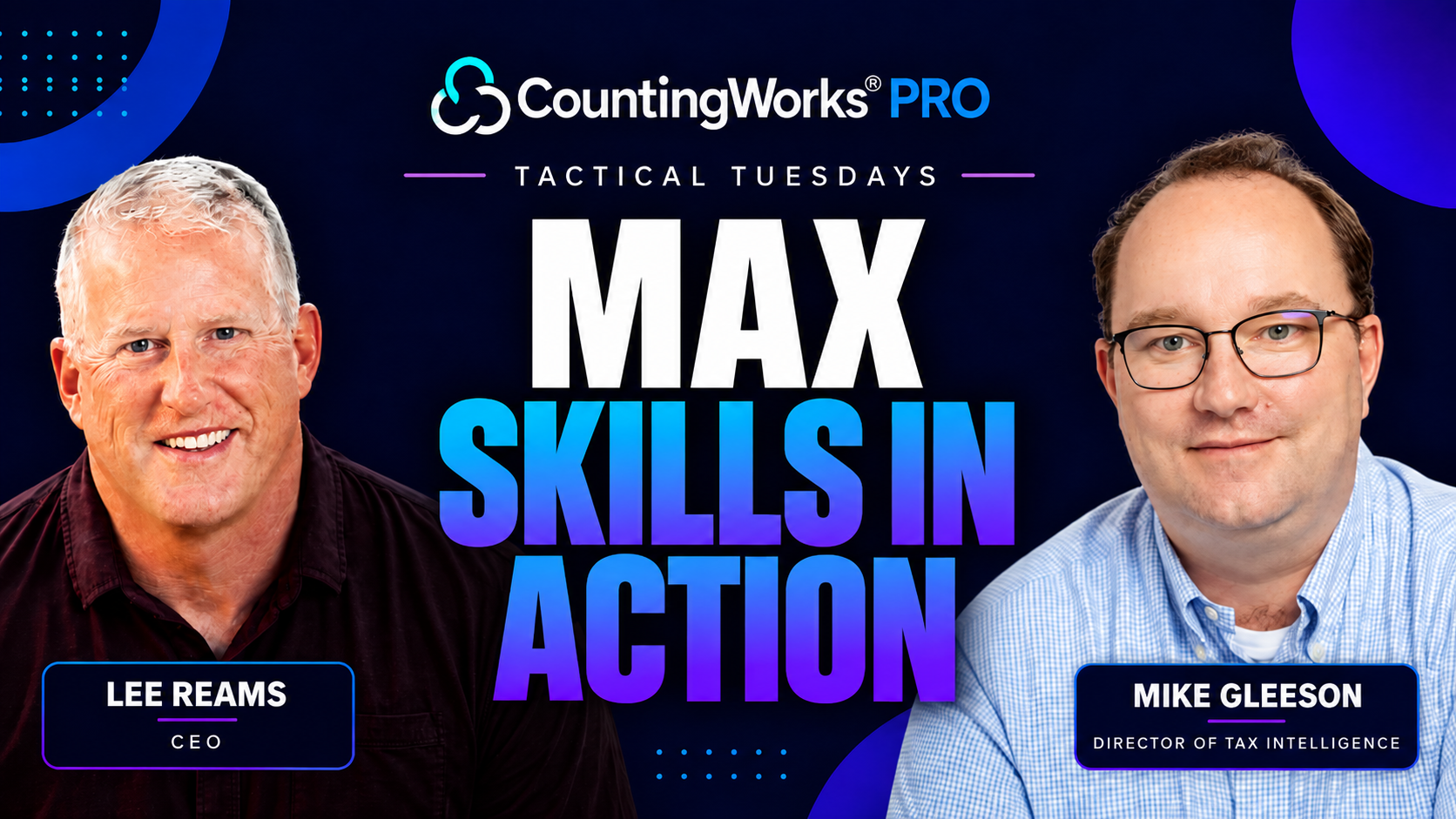

WEBCAST

How a 10-Person Tax and Accounting Firm Can Compete Like a 25-Person Firm

Watch your webcast below

As tax and accounting firms grow past 10 people, complexity threatens margin and control. Here’s how AI agents and a unified front-office ecosystem allow a 10-person firm to scale like a 25-person firm—without fragmentation.

Oops! Something went wrong while submitting the form.

Ready to transform your practice's web presence?

Schedule a demo today
Webinar Series

How a 10-Person Tax and Accounting Firm Can Compete Like a 25-Person Firm

When you reach 10 people, you’re no longer building a practice.

You’re running an organization.

There are managers.
There are layers.
There are recurring revenue streams.
There are meaningful business clients.
There is real payroll.

Revenue may sit between $2M and $5M.

And for the first time, the risk isn’t workload.

It’s loss of control.

Because at this level, growth doesn’t just create opportunity.

It creates complexity.

And complexity — unmanaged — erodes margin, consistency, and enterprise value.

The Hidden Risk at 10 People

At 10 people, most firms don’t break.

They blur.

Silos quietly form.

One manager handles clients one way.
Another prices differently.
One team pushes advisory aggressively.
Another stays compliance-only.

Onboarding varies by department.
Communication tone differs by preparer.
Advisory penetration depends on who owns the relationship.

Externally, the firm looks unified.

Internally, it operates as parallel systems.

And parallel systems don’t scale cleanly.

They scale unevenly.

That’s where margin begins to leak.

Related: How a 3–5 Person Tax and Accounting Firm Can Operate Like a 10-Person Firm

The Real Fear at This Stage

It isn’t hiring.

It isn’t workload.

It’s this:

  • Revenue grows 20%.

  • Payroll grows 30%.

  • Oversight increases.

  • Profit tightens.

  • Control loosens.

Partners start reviewing more instead of less.

Managers escalate more decisions upward.

Leadership meetings become about “who dropped the ball.”

The firm feels bigger.

But not stronger.

And that’s the ceiling most 10-person firms hit.

Growth Without Architecture Is Fragility

At this level, adding staff is easy.

Standardizing performance is hard.

Without infrastructure:

  • Advisory revenue depends on individual rainmakers.

  • Pricing discipline erodes across departments.

  • Client experience becomes inconsistent.

  • Capacity planning is reactive.

  • Hiring decisions are guesswork.

The firm expands — but predictability doesn’t.

And predictability is what determines valuation.

Related: The Solo Tax and Accounting Firm Is About to Become the Most Dangerous Player in the Profession

The Shift: From Firm to Enterprise Platform

The firms that scale from $3M to $8M without margin compression make a structural shift.

They stop thinking of themselves as:

A group of professionals.

And start thinking of themselves as:

An enterprise platform.

A platform standardizes:

Onboarding.
Communication flows.
Advisory triggers.
Pricing guardrails.
Marketing systems.
Performance visibility.

And it centralizes intelligence so leadership can see — in real time — what is happening across the entire firm.

That’s where enterprise leverage begins.

AI at the Executive Level

At 10 people, AI isn’t about saving 10 minutes drafting emails.

It’s about firm-wide intelligence.

Inside a unified front-office ecosystem, AI agents can:

Surface which industries produce the highest margins across the firm.

Identify advisory penetration rates by manager or service line.

Flag capacity strain before burnout hits.

Analyze client responsiveness patterns across departments.

Highlight upsell opportunities across the entire client base — not just one partner’s book.

Generate summaries of firm-wide performance before partner meetings.

Standardize research preparation before high-level strategy sessions.

This is no longer task automation.

This is operational visibility.

And visibility changes leadership behavior.

What Actually Gets Compressed at Scale

When onboarding is standardized across the firm, variance disappears.

When workflow updates automatically across teams, status meetings shrink.

When AI drafts and organizes communication, managers review instead of rewrite.

When follow-ups trigger themselves, clients don’t slip between departments.

When advisory campaigns are embedded across all client segments, growth becomes systematic — not personality-driven.

If each of 10 professionals reclaims just 4–6 hours per week through structural efficiency, that’s:

40–60 hours weekly.

More than a full-time equivalent.

But the real win isn’t just time.

It’s margin protection.

The Economics of Institutional Leverage

Without architecture:

Revenue increases modestly.
Supervision costs increase disproportionately.
Hiring outpaces system maturity.
Profitability tightens.

With architecture:

Revenue grows 20–30%.
Administrative overhead grows far slower.
Advisory scales across the firm — not through one rainmaker.
Partner time shifts from oversight to strategy.

A $3M firm can become a $7M firm without doubling chaos.

Not because it hired aggressively.

Because it institutionalized leverage.

Valuation: The Conversation Most 10-Person Firms Avoid

At this stage, the question isn’t just income.

It’s enterprise value.

Buyers and private equity groups look for:

Standardized workflows.
Centralized data.
Predictable acquisition channels.
Recurring advisory revenue.
Reduced key-person dependency.
Operational visibility.

Firms built on personality sell differently than firms built on systems.

When your front office is unified and AI-assisted, your firm becomes:

Transferable.

Predictable.

Scalable.

That directly impacts multiple.

Architecture is not just operational strategy.

It’s equity strategy.

Where CountingWorks PRO Fits at This Level

CountingWorks PRO is not positioned here as a marketing tool.

It becomes enterprise infrastructure.

It owns the entire client-facing layer:

Acquisition
Onboarding
Engagement
Workflow
Communication
Reviews
Marketing
Advisory triggers

And it integrates with your tax software — enhancing it, not replacing it.

AI agents operate inside this ecosystem, assisting at scale:

Standardizing communication across departments.
Triggering firm-wide advisory opportunities.
Surfacing profitability insights.
Reducing administrative drag across teams.

Not as disconnected tools.

As embedded intelligence.

That’s how a firm moves from reactive management to engineered growth.

The Identity Shift at 10 People

At this level, the defining question is no longer:

“How do we grow?”

It becomes:

“How do we grow without losing margin, control, or valuation?”

Because scale without structure creates fragility.

But scale with architecture creates dominance.

The firms that compete with 25-person competitors aren’t necessarily bigger.

They’re smarter.

They:

Design systems before hiring.
Embed AI before expanding overhead.
Centralize intelligence before delegating blindly.
Architect for valuation — not just revenue.

That’s the difference between a growing firm and an enduring one.

The Real Question

If you’re running a 10-person tax and accounting firm today, the question isn’t:

“Should we add more staff?”

It’s:

“Have we built an enterprise-grade operating system first?”

Because once your front office becomes unified, intelligent, and AI-assisted, your firm can:

Outproduce larger competitors.
Protect margin during expansion.
Standardize client experience across departments.
Increase enterprise value intentionally.

And that’s how a 10-person firm begins to compete like a 25-person firm.

Not by chasing headcount.

By multiplying leverage.

Tactical Tuesday

How a 10-Person Tax and Accounting Firm Can Compete Like a 25-Person Firm

When you reach 10 people, you’re no longer building a practice.

You’re running an organization.

There are managers.
There are layers.
There are recurring revenue streams.
There are meaningful business clients.
There is real payroll.

Revenue may sit between $2M and $5M.

And for the first time, the risk isn’t workload.

It’s loss of control.

Because at this level, growth doesn’t just create opportunity.

It creates complexity.

And complexity — unmanaged — erodes margin, consistency, and enterprise value.

The Hidden Risk at 10 People

At 10 people, most firms don’t break.

They blur.

Silos quietly form.

One manager handles clients one way.
Another prices differently.
One team pushes advisory aggressively.
Another stays compliance-only.

Onboarding varies by department.
Communication tone differs by preparer.
Advisory penetration depends on who owns the relationship.

Externally, the firm looks unified.

Internally, it operates as parallel systems.

And parallel systems don’t scale cleanly.

They scale unevenly.

That’s where margin begins to leak.

Related: How a 3–5 Person Tax and Accounting Firm Can Operate Like a 10-Person Firm

The Real Fear at This Stage

It isn’t hiring.

It isn’t workload.

It’s this:

  • Revenue grows 20%.

  • Payroll grows 30%.

  • Oversight increases.

  • Profit tightens.

  • Control loosens.

Partners start reviewing more instead of less.

Managers escalate more decisions upward.

Leadership meetings become about “who dropped the ball.”

The firm feels bigger.

But not stronger.

And that’s the ceiling most 10-person firms hit.

Growth Without Architecture Is Fragility

At this level, adding staff is easy.

Standardizing performance is hard.

Without infrastructure:

  • Advisory revenue depends on individual rainmakers.

  • Pricing discipline erodes across departments.

  • Client experience becomes inconsistent.

  • Capacity planning is reactive.

  • Hiring decisions are guesswork.

The firm expands — but predictability doesn’t.

And predictability is what determines valuation.

Related: The Solo Tax and Accounting Firm Is About to Become the Most Dangerous Player in the Profession

The Shift: From Firm to Enterprise Platform

The firms that scale from $3M to $8M without margin compression make a structural shift.

They stop thinking of themselves as:

A group of professionals.

And start thinking of themselves as:

An enterprise platform.

A platform standardizes:

Onboarding.
Communication flows.
Advisory triggers.
Pricing guardrails.
Marketing systems.
Performance visibility.

And it centralizes intelligence so leadership can see — in real time — what is happening across the entire firm.

That’s where enterprise leverage begins.

AI at the Executive Level

At 10 people, AI isn’t about saving 10 minutes drafting emails.

It’s about firm-wide intelligence.

Inside a unified front-office ecosystem, AI agents can:

Surface which industries produce the highest margins across the firm.

Identify advisory penetration rates by manager or service line.

Flag capacity strain before burnout hits.

Analyze client responsiveness patterns across departments.

Highlight upsell opportunities across the entire client base — not just one partner’s book.

Generate summaries of firm-wide performance before partner meetings.

Standardize research preparation before high-level strategy sessions.

This is no longer task automation.

This is operational visibility.

And visibility changes leadership behavior.

What Actually Gets Compressed at Scale

When onboarding is standardized across the firm, variance disappears.

When workflow updates automatically across teams, status meetings shrink.

When AI drafts and organizes communication, managers review instead of rewrite.

When follow-ups trigger themselves, clients don’t slip between departments.

When advisory campaigns are embedded across all client segments, growth becomes systematic — not personality-driven.

If each of 10 professionals reclaims just 4–6 hours per week through structural efficiency, that’s:

40–60 hours weekly.

More than a full-time equivalent.

But the real win isn’t just time.

It’s margin protection.

The Economics of Institutional Leverage

Without architecture:

Revenue increases modestly.
Supervision costs increase disproportionately.
Hiring outpaces system maturity.
Profitability tightens.

With architecture:

Revenue grows 20–30%.
Administrative overhead grows far slower.
Advisory scales across the firm — not through one rainmaker.
Partner time shifts from oversight to strategy.

A $3M firm can become a $7M firm without doubling chaos.

Not because it hired aggressively.

Because it institutionalized leverage.

Valuation: The Conversation Most 10-Person Firms Avoid

At this stage, the question isn’t just income.

It’s enterprise value.

Buyers and private equity groups look for:

Standardized workflows.
Centralized data.
Predictable acquisition channels.
Recurring advisory revenue.
Reduced key-person dependency.
Operational visibility.

Firms built on personality sell differently than firms built on systems.

When your front office is unified and AI-assisted, your firm becomes:

Transferable.

Predictable.

Scalable.

That directly impacts multiple.

Architecture is not just operational strategy.

It’s equity strategy.

Where CountingWorks PRO Fits at This Level

CountingWorks PRO is not positioned here as a marketing tool.

It becomes enterprise infrastructure.

It owns the entire client-facing layer:

Acquisition
Onboarding
Engagement
Workflow
Communication
Reviews
Marketing
Advisory triggers

And it integrates with your tax software — enhancing it, not replacing it.

AI agents operate inside this ecosystem, assisting at scale:

Standardizing communication across departments.
Triggering firm-wide advisory opportunities.
Surfacing profitability insights.
Reducing administrative drag across teams.

Not as disconnected tools.

As embedded intelligence.

That’s how a firm moves from reactive management to engineered growth.

The Identity Shift at 10 People

At this level, the defining question is no longer:

“How do we grow?”

It becomes:

“How do we grow without losing margin, control, or valuation?”

Because scale without structure creates fragility.

But scale with architecture creates dominance.

The firms that compete with 25-person competitors aren’t necessarily bigger.

They’re smarter.

They:

Design systems before hiring.
Embed AI before expanding overhead.
Centralize intelligence before delegating blindly.
Architect for valuation — not just revenue.

That’s the difference between a growing firm and an enduring one.

The Real Question

If you’re running a 10-person tax and accounting firm today, the question isn’t:

“Should we add more staff?”

It’s:

“Have we built an enterprise-grade operating system first?”

Because once your front office becomes unified, intelligent, and AI-assisted, your firm can:

Outproduce larger competitors.
Protect margin during expansion.
Standardize client experience across departments.
Increase enterprise value intentionally.

And that’s how a 10-person firm begins to compete like a 25-person firm.

Not by chasing headcount.

By multiplying leverage.

Already a Client and Have Questions?

Send Us an Email to help@countingworkspro.com

Or call our team at 1-800-442-2477.

First Time Hearing About Our Product?

Speak To Us and See Our Product In Action
Webinar Series

How a 10-Person Tax and Accounting Firm Can Compete Like a 25-Person Firm

When you reach 10 people, you’re no longer building a practice.

You’re running an organization.

There are managers.
There are layers.
There are recurring revenue streams.
There are meaningful business clients.
There is real payroll.

Revenue may sit between $2M and $5M.

And for the first time, the risk isn’t workload.

It’s loss of control.

Because at this level, growth doesn’t just create opportunity.

It creates complexity.

And complexity — unmanaged — erodes margin, consistency, and enterprise value.

The Hidden Risk at 10 People

At 10 people, most firms don’t break.

They blur.

Silos quietly form.

One manager handles clients one way.
Another prices differently.
One team pushes advisory aggressively.
Another stays compliance-only.

Onboarding varies by department.
Communication tone differs by preparer.
Advisory penetration depends on who owns the relationship.

Externally, the firm looks unified.

Internally, it operates as parallel systems.

And parallel systems don’t scale cleanly.

They scale unevenly.

That’s where margin begins to leak.

Related: How a 3–5 Person Tax and Accounting Firm Can Operate Like a 10-Person Firm

The Real Fear at This Stage

It isn’t hiring.

It isn’t workload.

It’s this:

  • Revenue grows 20%.

  • Payroll grows 30%.

  • Oversight increases.

  • Profit tightens.

  • Control loosens.

Partners start reviewing more instead of less.

Managers escalate more decisions upward.

Leadership meetings become about “who dropped the ball.”

The firm feels bigger.

But not stronger.

And that’s the ceiling most 10-person firms hit.

Growth Without Architecture Is Fragility

At this level, adding staff is easy.

Standardizing performance is hard.

Without infrastructure:

  • Advisory revenue depends on individual rainmakers.

  • Pricing discipline erodes across departments.

  • Client experience becomes inconsistent.

  • Capacity planning is reactive.

  • Hiring decisions are guesswork.

The firm expands — but predictability doesn’t.

And predictability is what determines valuation.

Related: The Solo Tax and Accounting Firm Is About to Become the Most Dangerous Player in the Profession

The Shift: From Firm to Enterprise Platform

The firms that scale from $3M to $8M without margin compression make a structural shift.

They stop thinking of themselves as:

A group of professionals.

And start thinking of themselves as:

An enterprise platform.

A platform standardizes:

Onboarding.
Communication flows.
Advisory triggers.
Pricing guardrails.
Marketing systems.
Performance visibility.

And it centralizes intelligence so leadership can see — in real time — what is happening across the entire firm.

That’s where enterprise leverage begins.

AI at the Executive Level

At 10 people, AI isn’t about saving 10 minutes drafting emails.

It’s about firm-wide intelligence.

Inside a unified front-office ecosystem, AI agents can:

Surface which industries produce the highest margins across the firm.

Identify advisory penetration rates by manager or service line.

Flag capacity strain before burnout hits.

Analyze client responsiveness patterns across departments.

Highlight upsell opportunities across the entire client base — not just one partner’s book.

Generate summaries of firm-wide performance before partner meetings.

Standardize research preparation before high-level strategy sessions.

This is no longer task automation.

This is operational visibility.

And visibility changes leadership behavior.

What Actually Gets Compressed at Scale

When onboarding is standardized across the firm, variance disappears.

When workflow updates automatically across teams, status meetings shrink.

When AI drafts and organizes communication, managers review instead of rewrite.

When follow-ups trigger themselves, clients don’t slip between departments.

When advisory campaigns are embedded across all client segments, growth becomes systematic — not personality-driven.

If each of 10 professionals reclaims just 4–6 hours per week through structural efficiency, that’s:

40–60 hours weekly.

More than a full-time equivalent.

But the real win isn’t just time.

It’s margin protection.

The Economics of Institutional Leverage

Without architecture:

Revenue increases modestly.
Supervision costs increase disproportionately.
Hiring outpaces system maturity.
Profitability tightens.

With architecture:

Revenue grows 20–30%.
Administrative overhead grows far slower.
Advisory scales across the firm — not through one rainmaker.
Partner time shifts from oversight to strategy.

A $3M firm can become a $7M firm without doubling chaos.

Not because it hired aggressively.

Because it institutionalized leverage.

Valuation: The Conversation Most 10-Person Firms Avoid

At this stage, the question isn’t just income.

It’s enterprise value.

Buyers and private equity groups look for:

Standardized workflows.
Centralized data.
Predictable acquisition channels.
Recurring advisory revenue.
Reduced key-person dependency.
Operational visibility.

Firms built on personality sell differently than firms built on systems.

When your front office is unified and AI-assisted, your firm becomes:

Transferable.

Predictable.

Scalable.

That directly impacts multiple.

Architecture is not just operational strategy.

It’s equity strategy.

Where CountingWorks PRO Fits at This Level

CountingWorks PRO is not positioned here as a marketing tool.

It becomes enterprise infrastructure.

It owns the entire client-facing layer:

Acquisition
Onboarding
Engagement
Workflow
Communication
Reviews
Marketing
Advisory triggers

And it integrates with your tax software — enhancing it, not replacing it.

AI agents operate inside this ecosystem, assisting at scale:

Standardizing communication across departments.
Triggering firm-wide advisory opportunities.
Surfacing profitability insights.
Reducing administrative drag across teams.

Not as disconnected tools.

As embedded intelligence.

That’s how a firm moves from reactive management to engineered growth.

The Identity Shift at 10 People

At this level, the defining question is no longer:

“How do we grow?”

It becomes:

“How do we grow without losing margin, control, or valuation?”

Because scale without structure creates fragility.

But scale with architecture creates dominance.

The firms that compete with 25-person competitors aren’t necessarily bigger.

They’re smarter.

They:

Design systems before hiring.
Embed AI before expanding overhead.
Centralize intelligence before delegating blindly.
Architect for valuation — not just revenue.

That’s the difference between a growing firm and an enduring one.

The Real Question

If you’re running a 10-person tax and accounting firm today, the question isn’t:

“Should we add more staff?”

It’s:

“Have we built an enterprise-grade operating system first?”

Because once your front office becomes unified, intelligent, and AI-assisted, your firm can:

Outproduce larger competitors.
Protect margin during expansion.
Standardize client experience across departments.
Increase enterprise value intentionally.

And that’s how a 10-person firm begins to compete like a 25-person firm.

Not by chasing headcount.

By multiplying leverage.

Guide

How a 10-Person Tax and Accounting Firm Can Compete Like a 25-Person Firm

When you reach 10 people, you’re no longer building a practice.

You’re running an organization.

There are managers.
There are layers.
There are recurring revenue streams.
There are meaningful business clients.
There is real payroll.

Revenue may sit between $2M and $5M.

And for the first time, the risk isn’t workload.

It’s loss of control.

Because at this level, growth doesn’t just create opportunity.

It creates complexity.

And complexity — unmanaged — erodes margin, consistency, and enterprise value.

The Hidden Risk at 10 People

At 10 people, most firms don’t break.

They blur.

Silos quietly form.

One manager handles clients one way.
Another prices differently.
One team pushes advisory aggressively.
Another stays compliance-only.

Onboarding varies by department.
Communication tone differs by preparer.
Advisory penetration depends on who owns the relationship.

Externally, the firm looks unified.

Internally, it operates as parallel systems.

And parallel systems don’t scale cleanly.

They scale unevenly.

That’s where margin begins to leak.

Related: How a 3–5 Person Tax and Accounting Firm Can Operate Like a 10-Person Firm

The Real Fear at This Stage

It isn’t hiring.

It isn’t workload.

It’s this:

  • Revenue grows 20%.

  • Payroll grows 30%.

  • Oversight increases.

  • Profit tightens.

  • Control loosens.

Partners start reviewing more instead of less.

Managers escalate more decisions upward.

Leadership meetings become about “who dropped the ball.”

The firm feels bigger.

But not stronger.

And that’s the ceiling most 10-person firms hit.

Growth Without Architecture Is Fragility

At this level, adding staff is easy.

Standardizing performance is hard.

Without infrastructure:

  • Advisory revenue depends on individual rainmakers.

  • Pricing discipline erodes across departments.

  • Client experience becomes inconsistent.

  • Capacity planning is reactive.

  • Hiring decisions are guesswork.

The firm expands — but predictability doesn’t.

And predictability is what determines valuation.

Related: The Solo Tax and Accounting Firm Is About to Become the Most Dangerous Player in the Profession

The Shift: From Firm to Enterprise Platform

The firms that scale from $3M to $8M without margin compression make a structural shift.

They stop thinking of themselves as:

A group of professionals.

And start thinking of themselves as:

An enterprise platform.

A platform standardizes:

Onboarding.
Communication flows.
Advisory triggers.
Pricing guardrails.
Marketing systems.
Performance visibility.

And it centralizes intelligence so leadership can see — in real time — what is happening across the entire firm.

That’s where enterprise leverage begins.

AI at the Executive Level

At 10 people, AI isn’t about saving 10 minutes drafting emails.

It’s about firm-wide intelligence.

Inside a unified front-office ecosystem, AI agents can:

Surface which industries produce the highest margins across the firm.

Identify advisory penetration rates by manager or service line.

Flag capacity strain before burnout hits.

Analyze client responsiveness patterns across departments.

Highlight upsell opportunities across the entire client base — not just one partner’s book.

Generate summaries of firm-wide performance before partner meetings.

Standardize research preparation before high-level strategy sessions.

This is no longer task automation.

This is operational visibility.

And visibility changes leadership behavior.

What Actually Gets Compressed at Scale

When onboarding is standardized across the firm, variance disappears.

When workflow updates automatically across teams, status meetings shrink.

When AI drafts and organizes communication, managers review instead of rewrite.

When follow-ups trigger themselves, clients don’t slip between departments.

When advisory campaigns are embedded across all client segments, growth becomes systematic — not personality-driven.

If each of 10 professionals reclaims just 4–6 hours per week through structural efficiency, that’s:

40–60 hours weekly.

More than a full-time equivalent.

But the real win isn’t just time.

It’s margin protection.

The Economics of Institutional Leverage

Without architecture:

Revenue increases modestly.
Supervision costs increase disproportionately.
Hiring outpaces system maturity.
Profitability tightens.

With architecture:

Revenue grows 20–30%.
Administrative overhead grows far slower.
Advisory scales across the firm — not through one rainmaker.
Partner time shifts from oversight to strategy.

A $3M firm can become a $7M firm without doubling chaos.

Not because it hired aggressively.

Because it institutionalized leverage.

Valuation: The Conversation Most 10-Person Firms Avoid

At this stage, the question isn’t just income.

It’s enterprise value.

Buyers and private equity groups look for:

Standardized workflows.
Centralized data.
Predictable acquisition channels.
Recurring advisory revenue.
Reduced key-person dependency.
Operational visibility.

Firms built on personality sell differently than firms built on systems.

When your front office is unified and AI-assisted, your firm becomes:

Transferable.

Predictable.

Scalable.

That directly impacts multiple.

Architecture is not just operational strategy.

It’s equity strategy.

Where CountingWorks PRO Fits at This Level

CountingWorks PRO is not positioned here as a marketing tool.

It becomes enterprise infrastructure.

It owns the entire client-facing layer:

Acquisition
Onboarding
Engagement
Workflow
Communication
Reviews
Marketing
Advisory triggers

And it integrates with your tax software — enhancing it, not replacing it.

AI agents operate inside this ecosystem, assisting at scale:

Standardizing communication across departments.
Triggering firm-wide advisory opportunities.
Surfacing profitability insights.
Reducing administrative drag across teams.

Not as disconnected tools.

As embedded intelligence.

That’s how a firm moves from reactive management to engineered growth.

The Identity Shift at 10 People

At this level, the defining question is no longer:

“How do we grow?”

It becomes:

“How do we grow without losing margin, control, or valuation?”

Because scale without structure creates fragility.

But scale with architecture creates dominance.

The firms that compete with 25-person competitors aren’t necessarily bigger.

They’re smarter.

They:

Design systems before hiring.
Embed AI before expanding overhead.
Centralize intelligence before delegating blindly.
Architect for valuation — not just revenue.

That’s the difference between a growing firm and an enduring one.

The Real Question

If you’re running a 10-person tax and accounting firm today, the question isn’t:

“Should we add more staff?”

It’s:

“Have we built an enterprise-grade operating system first?”

Because once your front office becomes unified, intelligent, and AI-assisted, your firm can:

Outproduce larger competitors.
Protect margin during expansion.
Standardize client experience across departments.
Increase enterprise value intentionally.

And that’s how a 10-person firm begins to compete like a 25-person firm.

Not by chasing headcount.

By multiplying leverage.

Practice Growth

How a 10-Person Tax and Accounting Firm Can Compete Like a 25-Person Firm

March 19, 2026
/
10
min read
Lee Reams
CEO | CountingWorks PRO

When you reach 10 people, you’re no longer building a practice.

You’re running an organization.

There are managers.
There are layers.
There are recurring revenue streams.
There are meaningful business clients.
There is real payroll.

Revenue may sit between $2M and $5M.

And for the first time, the risk isn’t workload.

It’s loss of control.

Because at this level, growth doesn’t just create opportunity.

It creates complexity.

And complexity — unmanaged — erodes margin, consistency, and enterprise value.

The Hidden Risk at 10 People

At 10 people, most firms don’t break.

They blur.

Silos quietly form.

One manager handles clients one way.
Another prices differently.
One team pushes advisory aggressively.
Another stays compliance-only.

Onboarding varies by department.
Communication tone differs by preparer.
Advisory penetration depends on who owns the relationship.

Externally, the firm looks unified.

Internally, it operates as parallel systems.

And parallel systems don’t scale cleanly.

They scale unevenly.

That’s where margin begins to leak.

Related: How a 3–5 Person Tax and Accounting Firm Can Operate Like a 10-Person Firm

The Real Fear at This Stage

It isn’t hiring.

It isn’t workload.

It’s this:

  • Revenue grows 20%.

  • Payroll grows 30%.

  • Oversight increases.

  • Profit tightens.

  • Control loosens.

Partners start reviewing more instead of less.

Managers escalate more decisions upward.

Leadership meetings become about “who dropped the ball.”

The firm feels bigger.

But not stronger.

And that’s the ceiling most 10-person firms hit.

Growth Without Architecture Is Fragility

At this level, adding staff is easy.

Standardizing performance is hard.

Without infrastructure:

  • Advisory revenue depends on individual rainmakers.

  • Pricing discipline erodes across departments.

  • Client experience becomes inconsistent.

  • Capacity planning is reactive.

  • Hiring decisions are guesswork.

The firm expands — but predictability doesn’t.

And predictability is what determines valuation.

Related: The Solo Tax and Accounting Firm Is About to Become the Most Dangerous Player in the Profession

The Shift: From Firm to Enterprise Platform

The firms that scale from $3M to $8M without margin compression make a structural shift.

They stop thinking of themselves as:

A group of professionals.

And start thinking of themselves as:

An enterprise platform.

A platform standardizes:

Onboarding.
Communication flows.
Advisory triggers.
Pricing guardrails.
Marketing systems.
Performance visibility.

And it centralizes intelligence so leadership can see — in real time — what is happening across the entire firm.

That’s where enterprise leverage begins.

AI at the Executive Level

At 10 people, AI isn’t about saving 10 minutes drafting emails.

It’s about firm-wide intelligence.

Inside a unified front-office ecosystem, AI agents can:

Surface which industries produce the highest margins across the firm.

Identify advisory penetration rates by manager or service line.

Flag capacity strain before burnout hits.

Analyze client responsiveness patterns across departments.

Highlight upsell opportunities across the entire client base — not just one partner’s book.

Generate summaries of firm-wide performance before partner meetings.

Standardize research preparation before high-level strategy sessions.

This is no longer task automation.

This is operational visibility.

And visibility changes leadership behavior.

What Actually Gets Compressed at Scale

When onboarding is standardized across the firm, variance disappears.

When workflow updates automatically across teams, status meetings shrink.

When AI drafts and organizes communication, managers review instead of rewrite.

When follow-ups trigger themselves, clients don’t slip between departments.

When advisory campaigns are embedded across all client segments, growth becomes systematic — not personality-driven.

If each of 10 professionals reclaims just 4–6 hours per week through structural efficiency, that’s:

40–60 hours weekly.

More than a full-time equivalent.

But the real win isn’t just time.

It’s margin protection.

The Economics of Institutional Leverage

Without architecture:

Revenue increases modestly.
Supervision costs increase disproportionately.
Hiring outpaces system maturity.
Profitability tightens.

With architecture:

Revenue grows 20–30%.
Administrative overhead grows far slower.
Advisory scales across the firm — not through one rainmaker.
Partner time shifts from oversight to strategy.

A $3M firm can become a $7M firm without doubling chaos.

Not because it hired aggressively.

Because it institutionalized leverage.

Valuation: The Conversation Most 10-Person Firms Avoid

At this stage, the question isn’t just income.

It’s enterprise value.

Buyers and private equity groups look for:

Standardized workflows.
Centralized data.
Predictable acquisition channels.
Recurring advisory revenue.
Reduced key-person dependency.
Operational visibility.

Firms built on personality sell differently than firms built on systems.

When your front office is unified and AI-assisted, your firm becomes:

Transferable.

Predictable.

Scalable.

That directly impacts multiple.

Architecture is not just operational strategy.

It’s equity strategy.

Where CountingWorks PRO Fits at This Level

CountingWorks PRO is not positioned here as a marketing tool.

It becomes enterprise infrastructure.

It owns the entire client-facing layer:

Acquisition
Onboarding
Engagement
Workflow
Communication
Reviews
Marketing
Advisory triggers

And it integrates with your tax software — enhancing it, not replacing it.

AI agents operate inside this ecosystem, assisting at scale:

Standardizing communication across departments.
Triggering firm-wide advisory opportunities.
Surfacing profitability insights.
Reducing administrative drag across teams.

Not as disconnected tools.

As embedded intelligence.

That’s how a firm moves from reactive management to engineered growth.

The Identity Shift at 10 People

At this level, the defining question is no longer:

“How do we grow?”

It becomes:

“How do we grow without losing margin, control, or valuation?”

Because scale without structure creates fragility.

But scale with architecture creates dominance.

The firms that compete with 25-person competitors aren’t necessarily bigger.

They’re smarter.

They:

Design systems before hiring.
Embed AI before expanding overhead.
Centralize intelligence before delegating blindly.
Architect for valuation — not just revenue.

That’s the difference between a growing firm and an enduring one.

The Real Question

If you’re running a 10-person tax and accounting firm today, the question isn’t:

“Should we add more staff?”

It’s:

“Have we built an enterprise-grade operating system first?”

Because once your front office becomes unified, intelligent, and AI-assisted, your firm can:

Outproduce larger competitors.
Protect margin during expansion.
Standardize client experience across departments.
Increase enterprise value intentionally.

And that’s how a 10-person firm begins to compete like a 25-person firm.

Not by chasing headcount.

By multiplying leverage.

Practice Growth

How a 10-Person Tax and Accounting Firm Can Compete Like a 25-Person Firm

Thursday, March 19, 2026

March 19, 2026
/
10
min read
Lee Reams
CEO | CountingWorks PRO

When you reach 10 people, you’re no longer building a practice.

You’re running an organization.

There are managers.
There are layers.
There are recurring revenue streams.
There are meaningful business clients.
There is real payroll.

Revenue may sit between $2M and $5M.

And for the first time, the risk isn’t workload.

It’s loss of control.

Because at this level, growth doesn’t just create opportunity.

It creates complexity.

And complexity — unmanaged — erodes margin, consistency, and enterprise value.

The Hidden Risk at 10 People

At 10 people, most firms don’t break.

They blur.

Silos quietly form.

One manager handles clients one way.
Another prices differently.
One team pushes advisory aggressively.
Another stays compliance-only.

Onboarding varies by department.
Communication tone differs by preparer.
Advisory penetration depends on who owns the relationship.

Externally, the firm looks unified.

Internally, it operates as parallel systems.

And parallel systems don’t scale cleanly.

They scale unevenly.

That’s where margin begins to leak.

Related: How a 3–5 Person Tax and Accounting Firm Can Operate Like a 10-Person Firm

The Real Fear at This Stage

It isn’t hiring.

It isn’t workload.

It’s this:

  • Revenue grows 20%.

  • Payroll grows 30%.

  • Oversight increases.

  • Profit tightens.

  • Control loosens.

Partners start reviewing more instead of less.

Managers escalate more decisions upward.

Leadership meetings become about “who dropped the ball.”

The firm feels bigger.

But not stronger.

And that’s the ceiling most 10-person firms hit.

Growth Without Architecture Is Fragility

At this level, adding staff is easy.

Standardizing performance is hard.

Without infrastructure:

  • Advisory revenue depends on individual rainmakers.

  • Pricing discipline erodes across departments.

  • Client experience becomes inconsistent.

  • Capacity planning is reactive.

  • Hiring decisions are guesswork.

The firm expands — but predictability doesn’t.

And predictability is what determines valuation.

Related: The Solo Tax and Accounting Firm Is About to Become the Most Dangerous Player in the Profession

The Shift: From Firm to Enterprise Platform

The firms that scale from $3M to $8M without margin compression make a structural shift.

They stop thinking of themselves as:

A group of professionals.

And start thinking of themselves as:

An enterprise platform.

A platform standardizes:

Onboarding.
Communication flows.
Advisory triggers.
Pricing guardrails.
Marketing systems.
Performance visibility.

And it centralizes intelligence so leadership can see — in real time — what is happening across the entire firm.

That’s where enterprise leverage begins.

AI at the Executive Level

At 10 people, AI isn’t about saving 10 minutes drafting emails.

It’s about firm-wide intelligence.

Inside a unified front-office ecosystem, AI agents can:

Surface which industries produce the highest margins across the firm.

Identify advisory penetration rates by manager or service line.

Flag capacity strain before burnout hits.

Analyze client responsiveness patterns across departments.

Highlight upsell opportunities across the entire client base — not just one partner’s book.

Generate summaries of firm-wide performance before partner meetings.

Standardize research preparation before high-level strategy sessions.

This is no longer task automation.

This is operational visibility.

And visibility changes leadership behavior.

What Actually Gets Compressed at Scale

When onboarding is standardized across the firm, variance disappears.

When workflow updates automatically across teams, status meetings shrink.

When AI drafts and organizes communication, managers review instead of rewrite.

When follow-ups trigger themselves, clients don’t slip between departments.

When advisory campaigns are embedded across all client segments, growth becomes systematic — not personality-driven.

If each of 10 professionals reclaims just 4–6 hours per week through structural efficiency, that’s:

40–60 hours weekly.

More than a full-time equivalent.

But the real win isn’t just time.

It’s margin protection.

The Economics of Institutional Leverage

Without architecture:

Revenue increases modestly.
Supervision costs increase disproportionately.
Hiring outpaces system maturity.
Profitability tightens.

With architecture:

Revenue grows 20–30%.
Administrative overhead grows far slower.
Advisory scales across the firm — not through one rainmaker.
Partner time shifts from oversight to strategy.

A $3M firm can become a $7M firm without doubling chaos.

Not because it hired aggressively.

Because it institutionalized leverage.

Valuation: The Conversation Most 10-Person Firms Avoid

At this stage, the question isn’t just income.

It’s enterprise value.

Buyers and private equity groups look for:

Standardized workflows.
Centralized data.
Predictable acquisition channels.
Recurring advisory revenue.
Reduced key-person dependency.
Operational visibility.

Firms built on personality sell differently than firms built on systems.

When your front office is unified and AI-assisted, your firm becomes:

Transferable.

Predictable.

Scalable.

That directly impacts multiple.

Architecture is not just operational strategy.

It’s equity strategy.

Where CountingWorks PRO Fits at This Level

CountingWorks PRO is not positioned here as a marketing tool.

It becomes enterprise infrastructure.

It owns the entire client-facing layer:

Acquisition
Onboarding
Engagement
Workflow
Communication
Reviews
Marketing
Advisory triggers

And it integrates with your tax software — enhancing it, not replacing it.

AI agents operate inside this ecosystem, assisting at scale:

Standardizing communication across departments.
Triggering firm-wide advisory opportunities.
Surfacing profitability insights.
Reducing administrative drag across teams.

Not as disconnected tools.

As embedded intelligence.

That’s how a firm moves from reactive management to engineered growth.

The Identity Shift at 10 People

At this level, the defining question is no longer:

“How do we grow?”

It becomes:

“How do we grow without losing margin, control, or valuation?”

Because scale without structure creates fragility.

But scale with architecture creates dominance.

The firms that compete with 25-person competitors aren’t necessarily bigger.

They’re smarter.

They:

Design systems before hiring.
Embed AI before expanding overhead.
Centralize intelligence before delegating blindly.
Architect for valuation — not just revenue.

That’s the difference between a growing firm and an enduring one.

The Real Question

If you’re running a 10-person tax and accounting firm today, the question isn’t:

“Should we add more staff?”

It’s:

“Have we built an enterprise-grade operating system first?”

Because once your front office becomes unified, intelligent, and AI-assisted, your firm can:

Outproduce larger competitors.
Protect margin during expansion.
Standardize client experience across departments.
Increase enterprise value intentionally.

And that’s how a 10-person firm begins to compete like a 25-person firm.

Not by chasing headcount.

By multiplying leverage.

Lee Reams
CEO | CountingWorks PRO

As the founder and CEO of CountingWorks, Inc, Lee is passionate about helping independent tax and accounting professionals compete in the modern age. From time-saving digital onboarding tools, world-class websites, and outbound marketing campaigns, Lee has been developing best-in-class marketing solutions for over twenty years.

Lee Reams
CEO | CountingWorks PRO

As the founder and CEO of CountingWorks, Inc, Lee is passionate about helping independent tax and accounting professionals compete in the modern age. From time-saving digital onboarding tools, world-class websites, and outbound marketing campaigns, Lee has been developing best-in-class marketing solutions for over twenty years.

Continue Reading...

Continue Reading...

Rank in the AI Age with CountingWorks PRO

Talk to a human
Create a year-long tax planning strategy for a freelancer earning $75,000 with multiple 1099 clients.

Below is a personalized, year-long tax planning strategy developed by CountingWorks, Inc., specifically for a freelancer earning $75,000 with multiple 1099 clients....

1. Establish a Robust Recordkeeping System

  • Dedicated Business Accounts: Open a separate business bank account and credit card to clearly define your income and expenses. This step not only simplifies your tax documentation but also aligns with our best-practices at CountingWorks.
  • ...

2. Manage Quarterly Estimated Tax Payments
...

Thank you! This is so helpful.
Gladly! Remember, you can also turn this information into audio and send to your clients directly via ClientHub.