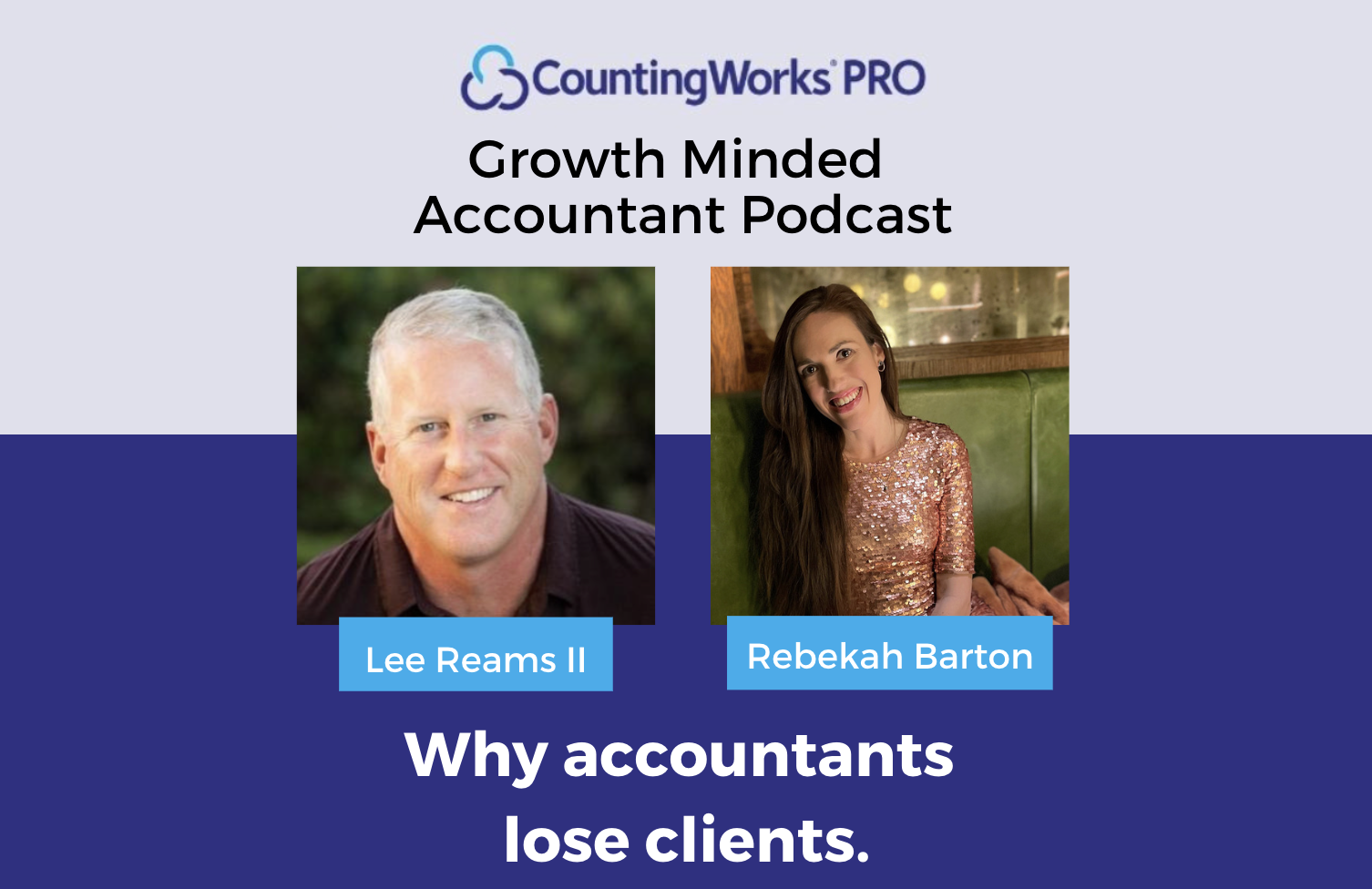
When accounting firms lose clients, many assume the problem is pricing, technical expertise, or competition.
In reality, one issue appears more often than almost any other:
Communication.
In this episode of The Growth Minded Accountant, Lee Reams and Rebekah Barton explore one of the most common challenges facing tax and accounting firms today: responsiveness. Drawing on industry research, client reviews, and real-world firm experiences, they explain why communication breakdowns often damage client relationships long before service quality becomes an issue.
The conversation focuses on how modern firms can improve responsiveness without creating burnout, unrealistic availability expectations, or operational chaos. Instead of relying on individual heroics, Lee and Rebekah explain how systems, technology, onboarding, communication workflows, and expectation-setting help firms deliver a better client experience at scale.
Whether you're a CPA, tax professional, enrolled agent, bookkeeper, or accounting firm owner, this episode provides practical ideas for improving client communication, strengthening client loyalty, and building a more scalable firm.
The goal isn't to respond faster to everything.
The goal is to create systems that make responsiveness sustainable.
Discover where operational friction, advisory opportunities, visibility gaps, client experience issues, and growth bottlenecks may be limiting your firm.
Get your free assessment here:
https://www.countingworkspro.com/start
Thanks for listening to The Growth Minded Accountant, the podcast for growth-minded accountants, tax professionals, CPA firms, and advisory-focused firm leaders.
We know that everyone digests information differently. That’s why we’re now sharing the full transcript of each episode of The Growth Minded Accountant right here on the CountingWorks PRO blog. Whether you’re short on time, like to scan and highlight, or simply prefer reading over listening, you can catch up on every conversation at your own pace.
Each week, we cover topics that matter most to tax and accounting professionals—from AI and automation to marketing strategies, firm growth, and client relationships. Scroll down to read the full episode, or subscribe to the podcast to listen on the go.
Welcome to the Growth Minded Accountant podcast, where our experts share best practices for running your firm in the digital age. This podcast is brought to you by CountingWorks PRO.
Welcome to another episode of the Growth Minded Accountant Podcast, the podcast for tax and accounting professionals who want to build smarter firms, stronger client relationships, and practices that actually scale.
My name is Lee Reams. I am the founder and CEO of CountingWorks and our sister company, TaxBuzz. I'm joined today by my co-host, Rebekah Barton, our Chief Visibility Officer here at CountingWorks.
Rebekah, say hello.
Rebekah Barton:
Hey, everyone.
Lee Reams:
During tax season, we've been doing what we call our micro-topics. These are shorter conversations focused on practical ideas that help firms grow through better systems.
Today's topic is one that shows up constantly in online reviews of tax and accounting firms:
Responsiveness.
If you spend time reading reviews on TaxBuzz, Google Business Profile, Yelp, or similar platforms, you'll notice a recurring theme in many one-star reviews.
It's rarely about technical mistakes.
Instead, clients say things like:
"My accountant never gets back to me."
"It takes days to hear back."
"I don't know what's going on."
Research from Hinge Research Institute and Bay Street Group consistently shows that the number one reason clients leave professional service firms isn't price and isn't technical errors.
It's communication.
When clients feel ignored, they start looking for another firm, even when the work itself is excellent.
The reality is that most tax professionals genuinely care about their clients and want to be responsive.
The problem isn't willingness.
The problem is structure.
When responsiveness depends entirely on the accountant personally responding to every email, message, and question, things begin to pile up.
One request is manageable.
Ten requests become stressful.
Fifty requests become overwhelming.
That's when responsiveness starts to break down.
The real question isn't whether firms should be responsive.
Of course they should.
The real question is this:
How do you build a firm where responsiveness actually scales?
One of the first places to start is setting expectations early.
Many firms unintentionally leave communication expectations undefined.
Clients don't know how communication works.
They don't know what response times are normal.
They don't know when questions should be asked.
They don't know what's included and what's billable.
When expectations aren't defined, clients default to urgency.
Every question feels like an emergency.
Every email feels like it requires an immediate response.
Growth-minded firms address this proactively.
They communicate expectations in engagement letters, proposals, onboarding processes, and even on their websites.
Many firms have dedicated sections explaining exactly how they work.
When expectations are clear, the relationship becomes healthier for everyone involved.
Clients don't feel ignored.
Firms don't feel pressured to respond instantly to every request.
Rebekah, this is where branding and visibility become important because firms often assume clients understand how they operate.
They don't.
Clients only know what you've clearly communicated.
Can you expand on that?
Rebekah Barton:
Absolutely.
Clients experience your firm long before they ever contact you.
Most people visit your website, read your reviews, and look at your social media before reaching out.
That creates an opportunity to explain how communication works at your firm.
Your website, proposals, and onboarding process should clearly explain things like:
If you don't communicate those expectations, clients will create their own.
And those assumptions often involve urgency.
It's also important to understand that responsiveness and availability are not the same thing.
Responsiveness means clients feel acknowledged, informed, and supported.
Availability means clients expect you to drop everything for them whenever they ask.
Responsiveness builds trust.
Constant availability creates burnout.
That's the distinction firms need to understand.
Lee Reams:
That's a great point.
Constant availability doesn't just create work-life balance problems.
It creates work-flow problems.
If you're constantly interrupting focused work to answer messages, you're less productive overall.
Most professionals need uninterrupted time to complete meaningful work.
When you're continually reacting to communication, it's difficult to make progress on larger projects.
This is where technology and communication systems can make a significant difference.
Modern communication platforms can help firms manage responsiveness in a much more structured way.
For example, communication systems can automatically draft responses to common inquiries.
Imagine arriving in the morning and finding ten client messages waiting for you.
Technology can research those questions, draft responses in your tone and style, and present them for review.
You simply verify the information, make adjustments if needed, and send.
Something that might have taken hours can now take minutes.
Technology can also help with appointment scheduling, follow-up communication, and workflow management.
Transparency is another major advantage.
When clients log into a portal and can see the status of documents, requests, or projects, they feel informed.
That visibility becomes a form of responsiveness.
Clients don't need to send multiple emails asking for updates because the information is already available.
We've talked frequently about how modern technology gives small firms unprecedented leverage.
A solo practitioner can operate like a much larger firm.
A small team can perform at a level that previously required significantly more staff.
The key isn't simply having more technology.
The key is having better systems.
Another important point is that responsiveness is often just acknowledgment.
Sometimes a simple message makes all the difference:
"Thanks. We've received your documents and will review them by Thursday."
That single message can eliminate multiple follow-up emails.
It reduces anxiety.
It reassures the client.
And it buys your team time to focus on the work itself.
Communication also plays a major role in scope management.
Without clear communication systems, scope creep becomes much more common.
Questions accumulate.
Additional requests emerge.
Boundaries become blurred.
When engagement letters, workflows, and communication expectations are clearly defined, clients understand what's included and when additional services become advisory work.
The relationship becomes more collaborative and far easier to manage.
The bottom line is simple:
Responsiveness matters.
Clients value it.
Firms should absolutely strive for it.
But responsiveness should never depend on constant heroics.
Growth-minded firms build responsiveness into their systems.
They establish expectations early.
They communicate clearly.
They leverage technology appropriately.
And they create processes that scale.
Rebekah, from a client-experience perspective, what would you add?
Rebekah Barton:
When firms create clear communication systems, they build trust.
Clients feel informed.
They feel supported.
They know what to expect.
That creates loyalty.
Loyal clients stay longer.
They refer others.
They become advocates for your firm.
When people understand how your firm operates, they feel more comfortable working with you throughout the year.
That clarity strengthens the relationship and improves the overall client experience.
Lee Reams:
Exactly.
The goal isn't simply responding faster.
The goal is building a firm where responsiveness scales.
When that happens, your clients benefit, your staff benefits, and your firm becomes significantly more sustainable.
That wraps up this edition of the Growth Minded Accountant Podcast.
As always, during tax season we're focused on short, practical ideas you can apply immediately.
Thank you for listening.
Thank you for being a follower of the podcast.
And until next week, keep charging forward.
You're getting close to the finish line of tax season.
I hope you're having a successful season so far.
Q: Why do clients leave accounting firms because of communication issues?
A: Clients often interpret delayed responses as a lack of attention or concern. Even when the technical work is excellent, poor communication can create frustration and erode trust over time.
Q: What's the difference between responsiveness and availability?
A: Responsiveness means clients feel acknowledged, informed, and supported within established expectations. Availability implies being constantly accessible, which often leads to inefficiency and burnout.
Q: How can accounting firms improve responsiveness without working more hours?
A: Firms can establish communication systems, automate acknowledgments, use client portals, set clear expectations during onboarding, and leverage technology to streamline repetitive communication tasks.
Q: Why are engagement letters important for communication?
A: Engagement letters help define response times, responsibilities, communication channels, and scope boundaries. This reduces confusion and helps clients understand how the relationship will operate.
Q: How do client portals improve responsiveness?
A: Portals provide transparency by showing document status, requests, and workflow progress. When clients can see updates themselves, they often feel informed without needing to send additional emails.
Q: How does communication impact scope creep?
A: Clear communication systems help define what is included in an engagement and what falls outside the scope of work. This makes it easier to identify advisory opportunities and avoid unpaid work.
Listen to other podcast episodes or read other related blog articles with relevant information and insights.