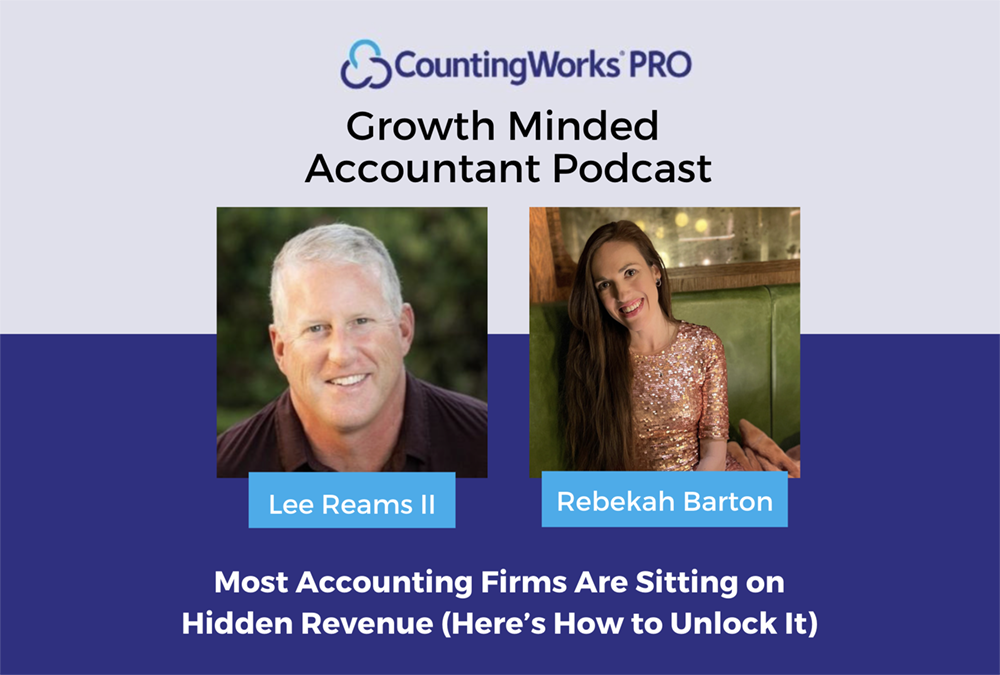
Every tax season, accounting firms uncover valuable insights that could lead to stronger client relationships, better planning, and thousands of dollars in advisory revenue.
And then they lose them.
Not because the opportunities weren't important. Not because clients weren't interested.
Because there was no system to capture them.
In this episode of The Growth Minded Accountant, Lee Reams II and Rebekah Barton explain why most advisory opportunities disappear after April 15 and share a simple framework that helps accounting firms turn everyday client conversations into future advisory engagements.
The discussion focuses on a practical approach that doesn't require longer meetings, additional software, or more work during busy season. Instead, it helps firms capture the signals they're already hearing from clients and turn them into meaningful follow-up conversations after tax season ends.
Whether you're a CPA, tax professional, enrolled agent, bookkeeper, or advisory-focused firm owner, this episode provides a practical system for increasing advisory revenue, improving client outcomes, and building stronger client relationships without adding complexity during busy season.
The opportunity isn't finding more advisory work.
The opportunity is stopping the loss of the advisory opportunities that are already happening right in front of you.
Discover where operational friction, advisory opportunities, visibility gaps, client experience issues, and growth bottlenecks may be limiting your firm.
Get your free assessment here:
https://www.countingworkspro.com/start
Thanks for listening to The Growth Minded Accountant, the podcast for growth-minded accountants, tax professionals, CPA firms, and advisory-focused firm leaders.
We know that everyone digests information differently. That’s why we’re now sharing the full transcript of each episode of The Growth Minded Accountant right here on the CountingWorks PRO blog. Whether you’re short on time, like to scan and highlight, or simply prefer reading over listening, you can catch up on every conversation at your own pace.
Each week, we cover topics that matter most to tax and accounting professionals—from AI and automation to marketing strategies, firm growth, and client relationships. Scroll down to read the full episode, or subscribe to the podcast to listen on the go.
Lee Reams: If you hear the phrase, "capture advisory insights during tax season," and your immediate reaction is, "I don't have time for that," then this episode is for you.
Let's be honest: no one wants more work in March. Your head is already spinning. You're working long hours, and you're completely maxed out. But here's the shift: this isn't about doing more. It's about not losing what's already happening right in front of you.
Recently, we've been talking about open-ended questions you can ask during the tax interview, how to start an interview, and how to close an interview. At this point, we're going to teach you how to collect the insights from that interview and then make them a revenue opportunity after tax season.
Every tax season, firms surface dozens of opportunities. Depending on how many clients you have, you might surface hundreds. Many of these are advisory opportunities, and then you watch them disappear after April 15 because you didn't make notes, you didn't follow up proactively, and there was no system to bring them back together later.
This isn't because those opportunities weren't valuable. It's because there was nowhere to put them. What do I do with this? Where am I putting the notes? There was no time to act on them, and, more importantly, there was no system to bring them back together later.
Let's be clear: the problem isn't insight. You already have that. You're meeting with clients, and the appointment or interview is probably the closest you're going to be to them all year. The problem is capture. This week, we're going to talk about how to capture those insights.
Let me give you a couple of examples. A client casually mentions that they're hiring later this year. Another is thinking about selling a property. Another says, "I wish I had known that sooner." In that moment, you think, "That's important. I should come back to that." But then it's the next client, the next return, the next fire to put out. Even if you remember the insight, you may be asking yourself, "Wait, was that Joe or Susan?" And then it's gone.
Multiply that by hundreds of clients, and that's lost advisory revenue. More importantly, it's lost client impact and lost positioning, which is Rebekah's favorite part. Rebekah, say hello. I started this whole thing and didn't even say, "Hey, Rebekah's here with me."
Rebekah Barton: Hi, everyone. This is going to be a good one. I'm looking forward to it.
Lee Reams: So, what are we actually listening for? It's not just numbers. You're listening for change: growth, hiring, expansion, AI integration, R&D, risk, selling, restructuring, and frustration. You're listening for phrases like, "I didn't know," "I wish," and "next time." You're also listening for opportunity: new income, investments, and transitions.
Here's the key: you don't need to solve it in the moment. You're in a compliance meeting, not an advisory engagement. You just need not to lose it.
Let's start with a few techniques that can help you surface more opportunities and, more importantly, follow up after tax season. If you want to surface more of this naturally without slowing things down, tweak your questions. Ask, "What's changing this year?" "Is anything coming up that we should plan ahead for?" "What decisions are you thinking about that we haven't talked about yet or haven't gone through thoroughly enough?" You're not extending meetings. You're simply unlocking signals.
Here's the rule: one sentence, one place, one tag. That's how you can start capturing this information.
For example, write, "Client hiring in Q3," or "Considering selling rental." Where do you put this? Put it in your CRM. For CountingWorks PRO and our CRM, we have a notes section inside the client hub. Any information you add there can be followed up later with technology.
We use a tool called Max, and I'll show you later how a playbook in Max can automatically follow up and present your proposal, create your outbound email, time when it will go, and determine when it triggers. You can also add a follow-up tag, such as "planning after tax season." There is no new system here and no extra time. You just don't lose it.
If you're not using an AI-enabled client hub like CountingWorks PRO, you can still do this manually. We'll talk through how that works.
This is where the process starts compounding. Notes that live in an AI-native, secure system don't just sit there. They become searchable. They become context. They become actionable insight. Now you can ask, "Who mentioned hiring?" "Who is thinking about selling?" "What planning opportunities exist?" Instead of guessing, you're responding to real client intent.
That's what turns compliance into advisory, and that's what tools like Max help organize and surface. But the real win here is the habit: capture, store, surface, and act.
Rebekah, this is where I want to bring you in. Is this an opportunity, if people are asking the same thing, to turn that into proactive outreach content and blog articles? That's where visibility and growth really intersect. We talk about marketing all the time, so I'm setting you up. I'm sure you're going to have a great segment here.
Not all firms have time to do this, but that's why you listen and pay attention to the conversations that are happening. After tax season, you can come up with a game plan. If you're using technology, it makes it much easier to deliver on. Rebekah, what do you have to add here?
Rebekah Barton: I have a few things. One of the biggest missed opportunities I see when I talk to clients is that they're sitting on a massive gold mine of information and insight from their clients. They don't realize it, they don't do anything with it, and it's all piecemeal. It may be floating around in their heads, as you said, Lee, because there's no system for organizing the information.
Once you have the data and you're tracking it in a meaningful way, even if it's just a tag, you will see patterns emerge after tax season. This doesn't have to take a long time. It can be one sentence. It can be a single tag.
Every time a client says something like, "Wow, I wish I'd known that earlier," or asks, "What do I do about this?" you may start to notice clients asking the same questions. That creates an opportunity to build marketing materials, content, and videos. It shows you what your clients are looking for from an advisory standpoint.
Capturing it ensures that you don't lose the language they're using. You don't lose the topics they want to talk about. Without that, you go back to writing generic blogs, generic emails, and generic website copy because you lost the insights instead of capturing them and putting them into a system.
What you're really doing is creating a marketing plan that GEO engines and SEO engines will pay attention to. The more you pay attention to your clients, the more you can create niche content and begin owning spaces that have high search demand within your clients' demographic.
If you target medical professionals, for example, and they're asking the same questions during tax season, those notes can show you exactly what to follow up on from an advisory standpoint. You could have built-in content for the next three months or the next six months based on that data, those insights, and the information you're collecting.
This is a great way to start building a desired niche and expanding your client base. You're not only upselling existing clients; you're also reaching other people in that market who have the same needs, are asking the same questions, and need the same types of advisory services. This simple way of tracking insights can turn into a huge opportunity from a positioning and marketing standpoint.
Lee Reams: The goal here is to reflect your clients back to themselves. That's what visibility is all about. Just like algorithms discover trends in the broader culture, you're discovering trends inside your own client database.
By tackling those topics in your blog content, email campaigns, advisory services, and niche positioning, you're not necessarily becoming louder. You're becoming more relevant. That relevance comes from listening to your clients.
When you feed those insights into content for Google, AI search, and, more importantly, your clients, you expand beyond the small number of things that surface directly through your current client base. Think about the medical professional example. There are many medical professionals asking the same questions. Where do they go? ChatGPT. They ask the question. Who gets surfaced or referenced? Lee Reams and Associates, because I wrote about it and became the expert in it. If there is a problem to be solved, the chances of them reaching out to me are much higher.
This is important, and it's also an easy way to answer the question, "What do I write about?" What should I put on my website? What should I put on social? What should I put on LinkedIn? This is a great source of ideas that does a lot of the thinking for you, and then you can use it in many different ways.
Rebekah Barton: One thing to remember is that if people are asking it in a sit-down meeting, they're probably searching for it online. Those same questions are being asked on the web. By addressing the questions you're getting in person online, you're setting yourself up for success because those are likely to be high-value searches, especially if they're timely or connected to things happening in the culture.
What you're hearing in person can translate well to the internet. That's something where there is sometimes a disconnect, but those two things really do tend to align.
Lee Reams: Absolutely. I always like to talk about ROI because I know the first reaction is, "This makes sense, Lee, but I don't have time," or, "Is it really worth it?" So, what is the ROI of advisory?
All you're hearing now is advisory, advisory, advisory, and that compliance is going to die. I saw another tech startup come out with an AI tax prep product. I believe the future is about your client relationships. I don't know which tax software is going to win or whether an AI tool will ever be 100% accurate. I still have a lot of doubt. But I do know that your job is to protect the relationship you have with your clients, no matter what underlying technology you use to deliver the services.
The more advisory opportunities you can find, the better the ROI will be for you. Let's say you capture 20 meaningful insights during tax season. Out of those 20, you follow up with 10. Out of those 10, just three turn into advisory conversations. Each one turns into a $1,500 tax planning engagement or a $3,000 annual advisory relationship. That could be $4,500 to $9,000.
I think the opportunity is much higher. If this were CFO advisory and you're talking about $2,000 per month, and you get three clients, the math becomes significant. That's where this can become very profitable.
This is not a new marketing campaign. It's not a new lead-generation campaign. You don't have to hire a consultant to brand it, position it, or write it. There are no extra meetings in March. Just capture it and follow up with it. That's the ROI. This is where most firms leave many opportunities on the table every single season.
I see it myself. I just went through my own tax interview. I was leading the conversation by telling my advisor what I'm doing, but the questions weren't coming back to me.
So, let's get practical. How can you use this as insight? What do you actually do with it? At the end of a meeting, use a soft verbal close: "This sounds like something we should revisit after tax season. Do you want us to circle back on that?" That's it. You've acknowledged it, positioned the value, and received permission to follow up.
If the client agrees, schedule it. It's a strong signal. Get something on the calendar for May. Now it's not a note anymore. It's a future advisory meeting.
From there, inside your CRM, create a simple task: follow up on hiring plans. Tag it "post-tax advisory." Assign it for May or June. That's it. No long notes. No complexity. Just capture, tag, and assign. Now your future pipeline is building itself.
At CountingWorks and Max, we created a workflow where you create a tag, such as "post-season advisory," and put the note in the notes section inside Max and our CRM. I would want a little more detail than one line, maybe two or three notes. The more detail we have, the more Max can turn it into a full narrative.
From there, a playbook can auto-assign a start date. It can create an outreach email, perhaps with your calendar invite in it. It can create a proposal based on the client's question. It can also create the questions you should ask and even a tax plan or financial plan around the specific notes you took during tax season.
What does that do? It prepares you for the meeting. It helps you monetize what the meeting is about. It sets expectations for your client. And it makes it easy for them to say yes, move forward, and pay you. You're not creating more work. You're capturing future revenue and future impact.
Advisory doesn't start in May. It starts in March, when you're actually meeting with clients. That's when what clients tell you really matters. If you don't capture it now, it won't feel important later. And if it doesn't feel important later, it won't happen.
Keep it simple. One sentence. One place. One tag. One sentence today can mean thousands of dollars, tens of thousands of dollars, or, for larger firms, hundreds of thousands of dollars. More importantly, it can mean better client outcomes tomorrow.
That wraps up another edition. During tax season, we're trying to keep these episodes fast and focused, with practical ideas that have a high ROI if you follow them. We'll continue this through April 15, and then we're going to get into some really exciting topics that can move the needle after tax season.
Hopefully, you're having a successful tax season. We've heard some really positive things from our client base. Until next week, thank you for the comments, thank you for subscribing, and thank you for being part of our community here at the Growth Minded Accountant podcast. Until next time, we'll talk soon.
Q: Why do so many advisory opportunities disappear after tax season?
A: Most firms don't have a process for capturing client insights during busy season. Valuable conversations happen, but without documentation and follow-up systems, those opportunities are often forgotten once tax season ends.
Q: What types of client comments should be captured for future advisory opportunities?
A: Comments about hiring, expansion, selling assets, retirement, new investments, business transitions, AI adoption, cash flow concerns, and future planning goals are all examples of potential advisory opportunities.
Q: What is the One Sentence. One Place. One Tag. framework?
A: The framework encourages firms to record a simple note, store it in a consistent location such as a CRM, and assign a tag that makes future follow-up easy. The goal is simplicity and consistency rather than complexity.
Q: How does capturing client insights improve marketing?
A: Client questions often reflect the same topics people search for online. By documenting recurring themes, firms can create blogs, videos, email campaigns, and educational content that directly addresses client concerns.
Q: Do firms need AI tools to make this process work?
A: No. The process can be implemented manually using notes, tags, and follow-up tasks. AI-powered tools can make the process more efficient, but the core habit of capturing insights is what creates results.
Q: What's the biggest mistake firms make with advisory opportunities?
A: They assume they'll remember important conversations later. In reality, busy season creates information overload, and valuable opportunities are often lost unless they're captured immediately.
Listen to other podcast episodes or read other related blog articles with relevant information and insights.