Pricing has become one of the biggest competitive advantages—and one of the biggest missed opportunities—for today's tax and accounting firms.
Many firms still rely on outdated fee schedules, hourly billing, or pricing guides that fail to account for the unique value they provide or the specific needs of each client. The result is inconsistent pricing, reduced profitability, and firms that unknowingly leave significant revenue on the table.
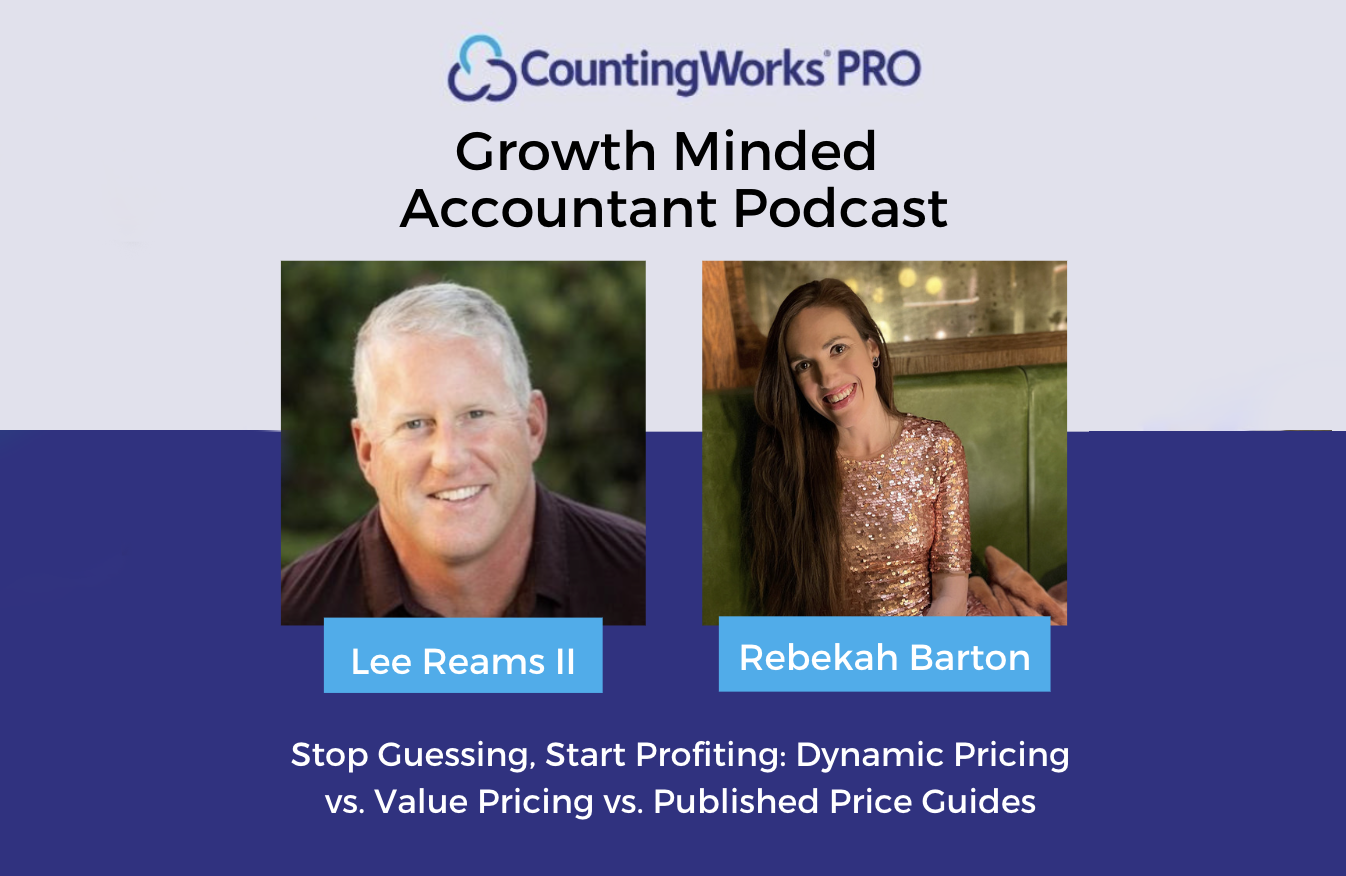
In this episode of The Growth Minded Accountant, Lee Reams II and Rebekah Barton explore the evolution of pricing strategies for modern accounting firms. They compare traditional published price guides, value pricing, and AI-powered dynamic pricing, explaining where each approach succeeds, where it falls short, and why personalized pricing is becoming increasingly important.
The discussion also examines how AI can evaluate client demographics, business complexity, geography, market conditions, service scope, and historical pricing data to recommend smarter proposals that improve both profitability and client trust.
Whether you're questioning your current pricing model, looking to improve proposal conversions, or searching for a more scalable way to grow your advisory practice, this episode offers a practical framework for modernizing how your firm prices its services.
Get your free Firm Growth Blueprint and discover where your firm can improve its visibility, pricing, client experience, and long-term growth.
We know that everyone digests information differently. That’s why we’re now sharing the full transcript of each episode of The Growth Minded Accountant right here on the CountingWorks PRO blog. Whether you’re short on time, like to scan and highlight, or simply prefer reading over listening, you can catch up on every conversation at your own pace.
Each week, we cover topics that matter most to tax and accounting professionals—from AI and automation to marketing strategies, firm growth, and client relationships. Scroll down to read the full episode, or subscribe to the podcast to listen on the go.
Welcome to the Growth Minded Accountant podcast where our experts will share best practices on running your firm in the digital age. This podcast is brought to you by CountingWorks Pro. Let's get started.
Lee Reams II: Welcome back to another episode of the Growth Minded Accountant Podcast. My name is Lee Rees. I am the founder and CEO of CountingWorks and our sister company TaxBuzz. And today I'm joined with Rebecca Barton, our chief visibility officer. Rebecca, if you can just say hello and we'll get into this topic.
Rebekah Barton: Yes. Hey guys, excited to be back this week talking about dynamic pricing. Yes. And everyone who follows us knows we've been experimenting with some I'm going to call it continuing education like uh kind of nano CPE courses. And yes, we've been using AI to help us put that content together. And I swear I am not an avatar. This is my voice. I'm a human. you are seeing humans today. So hopefully you appreciate it. We've gotten some good feedback, some poor feedback, you know, of the new uh the new style. But what we're able now to do is to uh educate clients at scale with the new uh format. So it's great. But today, humans are talking about a nonhuman uh way to price your firm. So uh as we talked about, we're going to literally talk about how to transform the bottom line of your practice. Okay? and that is dynamic pricing and the power of AI proposals. So, if you are like many, if you've ever secondguessed your pricing, wondered if you're undercharging, overcharging, or just leaving money on the table, you are not alone. Okay? There's many of you, uh, most of you actually that are still guessing when it comes to pricing, right? And that guesswork is costing you thousands. uh you may be relying on a price guide, you may be relying on, you know, what you've read in a survey results, but uh the reality is there's a very good chance that client A and client B um will probably pay a lot different pricing if it was presented to them properly. So, that's what we're going to talk about today. Growth Minded accountants, smart professionals, how they're using modern tools, whether that be ChatGPT, Claude, Gemini, or Max, uh to finally put an end to the guesswork. So, we're going to cover how Max's new uh proposal playbook works, why dynamic pricing is more than just a feature, and how these tools are reshaping the future of our profession. So, Rebecca, I'm going to jump in and before I go into the the whole idea of what dynamic pricing is, I think we need to define dynamic pricing versus value pricing versus published pricing uh guide. So, in the past, we've even talked about surge pricing where demand goes higher and uh you know, obviously there's things dear to your heart like Disney and the way they price their entries and and there's a lot of different airlines do it. Uh hotels do it. You know, there's there's uh device uh sensitivity when it comes to pricing. If you're on a Mac, uh you might be given a higher price than, you know, an Android device, for example. So, there's a lot of ways to do this, but let's talk about uh the key things here. So, what is a published price guide? It is what most tax and accounting firms use today. It's a flat, perhaps it's a public menu of services and fees. Perhaps it's hidden, but the example, a 1040 is $350. A small business return is $1,200, schedule C, etc., etc. K1's X dollars per um pros, easy to understand for prospects, easy for your staff to put together, too, right? Builds transparency. Clients know exactly what they'll pay. uh simplifies quoting for staff which I was just saying so makes it really easy right cons doesn't adjust for complexity or client demographics and we're going to get into what the client demographics means in more detail uh as we go through this podcast but basically think a is a firm that is a manufacturing company that is in San Diego that has $7 million in revenue and 65 employees uh going to spend more for a virtual CFO uh service than a firm that is uh you know under under a million dollars of revenue, right? So the the idea that I have a package price um doesn't always apply and it doesn't maximize your your profit. So that's kind of where we're going to. So at times if you're using this type of pricing, you're leaving money on the table. When a client is willing to pay more for higher touch service, right? And it could also backfire if a competitor decides to undercut you. It's good for volumedriven firms but highly limited uh for professionals who want to scale profitably. Uh let's get into value pricing. So, uh and that's been all the rage for the last few years. What is it? Pricing based on the perceived value to the client rather than the hours worked or a flat fee. For example, charging $5,000 for a tax plan. When a client saves $30,000, they're willing to pay $5,000 to to get $25,000 delta, you know, return, right? Um, really easy for the pros. Aligns with your client's uh outcomes, right? Hey, you know, I I'll pay that if I get this more back. That's kind of a no-brainer, right? That's the greatest return on my investment ever. It appeals to advisory first firms. It moves you away from hourly billing. Uh, clients love that. No one likes that black hole. And more importantly, with AI technology, automation, the amount of time it takes you to do things is much shorter. Uh, and if you're relying on billable hours and it takes you 15 minutes for something you used to bill 3 hours for, uh, that's a little bit of a red flag, right? Uh, the cons here, subjective. What's valuable to one client may not be to another. It requires strong sales skills to explain and defend perhaps a really robust website funnel. How you communicate your services, you back it up. um you know and that's obviously we do that for our clients accounts pro but not all accountants are you know they don't want to be salespeople right it can be timeconuming to calculate and often uh inconsistent across clients okay so bottom line there powerful for experienced advisors with confidence in sales ability but difficult to scale consistency all right so what is dynamic pricing it is an AI powered pricing u technique or technology that adapts in real time based on client demographics, service complexity, market benchmarks, and proposal history. For example, so I gave you that example, but now let's think of uh you know bookkeeping versus virtual CFO, right? Uh I have documents of my client's financial statement. So I know uh maybe I have an intake form or a questionnaire results that I'm also able to scrape. If you're using a tool like Max and our client hub, we're able now to scrape all that data plus the AI input. So the research that AI has from this vast knowledge base of um cost of living and you know San Diego versus Kansas, right? There's going to be a difference there. There's a reason gas costs X here and and and that there homes and etc. Right? Um but what happens is now if you have all this client hub data uh scrape data from your client and now you can combine that knowledge base that AI has access to it is able to come up with an optimal price for each client and service. We've taken a step further in our tool. We allow you to actually upload your pricing scheme. So, let's say you have a standard pricing um format and that tax return for small business does cost $1,200 or you have, you know, different schedules and whatever. Um we're actually able to take a suggested price from your standard pricing and then compare it to what Max or AI suggests. So, this is what the marketplace says. So, for example, you might be it might tell you you're 20% underpriced for this service. You might be right at the market conditions. You might be overpriced, whatever. So uh it makes it really really uh personalized and data driven. So datadriven p uh precision. Okay. So you know exactly when you're undercharging or overcharging and you can adapt right before you sent that proposal. Uh scalable. Every proposal is consistent, professional and optimized. No manual guesswork. It builds confidence. You present uh prices based on market data intelligence not just your gut instinct. Did I wake up in a good mood or not? Do I, you know, I do I need to build I have a a goal or something I need to hit. Um, it really helps. So, it bridges value pricing and transparency. Clients see personalized proposals that justify the fee. Of course, the cons here, it requires a buy in to technology. Uh, it can feel uh less set in stone to pros who are used to static price sheets, right? So, it's a little bit of the uncertainty. I've always done it this way. This is a new way. So, the bottom line is it's the best of both worlds. All right? It combines the profitability of value pricing with the consistency and clarity of published pricing. Uh but AI-powered by AI intelligence that adjusts for each and every client. So Rebecca, that was a mouthful, but I wanted to start us there so people understand kind of, you know, what we're talking about and what dynamic pricing actually looks like. So I want to start this discussion bringing you in here about what is the number one mistake you see when it comes to pricing for our tax and accounting pros. like how are they doing it? How are they are they transparent or not? Um or do they believe in their pricing? Is it just kind of like throw it against the wall and see what six you know what is what is what is it when you talk to our clients? What are you saying the most? For a lot of them it is spaghetti against the wall. They don't really have a strategy. They don't really have a plan. They might look up what their competitor's pricing is, but half the time it's not even listed. So they're just kind of guessing based on what they think clients will pay. And that really is the biggest mistake they make. uh there's no strategy to it. There's no plan. And what you need to be doing is pricing yourself based on the value you provide. You're not a commodity. Um we talk a lot on this podcast about how AI has allowed you to actually provide more value by taking some of those tedious tasks that used to take hours. So now you can devote those hours to really providing advisory services, things like that that only you can do. So you need to be pricing yourself based on that. It's also important to remember that people are not leaving, the right clients are not leaving based on price. They're leaving when they don't see the value that you're providing. So, as long as you're communicating that value and delivering on it, you should be able to price yourself based on a dynamic pricing model that takes all of these incredible factors into account. So you're truly delivering a customized plan to every single client that makes sense and is priced correctly based on, you know, your area, the demographic there in all of these different factors that you could not really sit down and calculate on your own in a quantifiable fashion. And I think more importantly, you're able now to personalize the proposal. And we talked about the demographic side, but tools like Max, we're looking at what are the intent words that people are are googling, for example, when they're looking for a certain type of service. Um, what are the terminology that a restaurant versus a dental firm would want to see in a proposal? And all this context is added into your proposal uh when you're using AI and tools like Max because it already knows, you know, a dental firm is going to care about X things. Let's use technology, not technology, terminology that speaks in their language. Why is that so important to get higher conversions to get people to pay perhaps a little bit more? You know, maybe it's that people think, "Oh, they really get me." Why is that so important at this stage? The more you speak someone's language, the more likely they are, one to convert and two, to become a longtime client because they feel comfortable with you. There's trust from the start that you really understand their industry. You really understand who they are. you brought up my Disney love a few minutes ago. I'm going to be a lot more likely, for example, to use a travel planner who understands Disney terms, who's using, you know, the the acronyms we use for things or talking about, you know, different things that only a Disney person would understand, as opposed to a generic travel planner who's just saying, "Hey, I can, you know, book you a restaurant reservation." and they don't understand the the term ADR, which is what Disney people call advanced dining reservations. Those kinds of terms exist in every work industry as well. So, if you're using terms that a restaurant tour or a dentist like you brought up, Lee, or someone in manufacturing, anything people do, if you can speak their language, there's going to be an immediate bond there that you can't fake and that other providers are not necessarily offering them from the proposal stage. So there's kind of an instant trust there that's going to entice them to pay more money. Yeah. And I think the the takeaway and I'll start moving on to a couple different things on like what are the demographics and things that that people use, but it creates a ripple effect in some ways. Meaning if you're undercharging, you're not just hurting your revenue. You're obviously your time. You're, you know, head spinning trying to get all your work done. Uh but you're also training your clients to undervalue your expertise. Um it makes it harder then for you to upsell. um harder to retain and harder to build an advisory first practice. More importantly, the referral types that they're sending you are maybe the same mentality. Oh yeah, really cheap. That's the last thing you want to think. And then you're now trying to uh introduce some higher pricing to new clients versus what your your existing clients are receiving. It's going to be harder to convert at that point. So, uh you know, there's a lot of reasons really to to step up and do this. So, what are the demographics? like what is the client information that you need to be feeding in order to get the best outcome for your proposal in a dynamic proposal, right? So, we talked about this a little bit, but what does AI analyze? Uh filing type, for example, is this an individual? Is it a small business? Is a corporation, a nonprofit, uh income ranges, business size, right? No branders, vertical industry, uh, real estate medical, uh, lawyers are used to paying more than perhaps a someone that's a copywriter, um, or a Disney lover, a, you know, I don't know. I'm just getting ADR, I'm learning all kinds of stuff. Geographic location, right? Cost of living, regional pricing norms, why this matters. Pricing expectations vary dramatically by client profile. So a business owner in California for example maybe uh you know PaloAlto would expect a different fee structure than a retiree in Kansas. Okay I know it's all common sense but you've never really had tools that would enabled you to do this right so aligning with demographic data prevents underch undercharging affluent clients or overcharging perhaps price sensitive ones. Okay, what is the service complexity? What is AI able to ann uh analyze? How many forms, schedules, entities? So that's why I was saying a tool like our client hub. It will read the last tax return and it will see exactly what was there. You can add prompting language. It says, you know, this client now is making twice as much. But it takes that as context to feed the AI to create the proposal language and the suggested service price. Uh so again, our tool at Max allows you to upload your current pricing if you like and then have a comparison. Um this is what Max suggests. You know, the market conditions should say your 15% too high, too low, just right. Here's some language we suggest. Um versus perhaps your generic standard pricing. Okay. Um and I think this is really important. So, uh you know, do they have multi-state issues? Do they have international filings? businesses with international sales, uh, advisory services requested, what types, is it tax planning, is it a combination of virtual CFO and payroll, right? Are you going to bundle this? And that's the whole idea where the one-sizefits-all doesn't really work. Okay? Is this a recurring client versus a one-off? So, you might be discounting or you might price it differently. Um so AI will look at the service scope and so the pricing actually refle reflects your energy level your expertise in order to handle it right and then of course the liability not just a flat fee guess of what should be uh in addition it can ring in market rate benchmarks so current pricing from surveys that have been published on the web from peer firms in the same region perhaps same size niche uh fee surveys from you know all the different societies Perhaps there's pricing on tax buzz or Yelp or Thumbtac. Why this matters? It it ensures you're competitive without being the lowest price option. And then it'll also flag you when you're significantly below or above. Okay. Um and then it comes into the client value and profitability. So tools like RAI will actually look at um you know the client's history. Uh are there potential upsells or cross sales services that we should be offering here that you just haven't done in the past? You know why? because we do it the same way we did it last year and we're not going to say hey are you looking to sell your business in a little while etc. Right? Um so I think that's really important. Now Rebecca I know you've been sitting there we're going to talk something that you love and that's search language and positioning intelligence. So what AI and Max will do and is it will know if people are looking for virtual CFO services for that dental firm what are the phrases that they care about? What are they describing when they're typing in a Google search? And then why would it be so important now to use that language in a proposal for um conversion right so why is that matching what the client's intent is with your proposal um so important that the client feels hey they get me you know uh it immediately reduces price sensitivity. So kind of explain that from a psychology side how we do that on our websites and now we're bringing that into an actual proposal. Right. So, there's a lot here um that we could kind of dissect, but I'll try to keep it short for the sake of time on this podcast. So, the first thing is this language, as we already said, is going to connect with them. The more you can connect with someone's search intent within a proposal, the more trust, the more authenticity you're going to build from day one. That's important. It's not only going to entice them to pay more money, but it's going to encourage that person to stick with you for the long haul because they really feel like you get them. You get their industry. you understand what's going on. From a secondary standpoint, using this language can kind of have a trickle down effect into everything else you do. If you're trying to niche down, for example, into real estate and you're writing proposals that really align with search intent, take those same terms that you're seeing in your proposals that you're utilizing there and then use those in blog posts, use them on social media because those same clients are still going to connect with that as part of your wider marketing strategy. So, it can be a really great way to sort of build out your growth strategy on different channels, not just within your proposals. That's something I think is really important is that this doesn't have to stay limited to just a proposal. Also, the proposal is a story. It's a narrative. It's starting your chapter, if you will, with this particular client. So, it's not just a number. This is a way to really show them that you get them, that you understand their industry. And like Lee was saying a minute ago, this can ripple out. It can lead to more referrals within the target demographic that you're working with. It can lead to, you know, more upsells. It can lead to a wider pool of people who fit your target audience as opposed to just kind of frantically grasping at any person who walks through your door. So, there's a lot of good things that can come from using this specific language. Even though it seems like kind of a small part of the puzzle, it can have really farreaching positive effects. You're painting a picture, I could just see it, of an enrolled agent or a CPA like walk watching people walk down the street and they're running at them and tackling them and dragging them into their office. That that's so yeah, we're not doing that. We're saying, "Hey, you select client this, you're our target audience. We have a service that's going to make you a better, you know, a better financial outcome. Use us." And uh I think the personalization there's kind of a a term about you know people are going to care about your expertise when they can tell that you care about them right so that's the whole thing we always talk about it as the relationship layer and that's why this is so important okay um you know a a proposal is very personal to them you know if the if they don't feel this has been copied and pasted that they're just one of many they're more likely to say yes right personalization shows effort even if AI is able to do all this personalization in seconds but it's showing understanding it's showing confidence uh clients will reward that with trust so uh I know there's uh times when I've talked about this it's like why is this accurate how can I trust it well there's kind of four parts to this one is multi-source intelligence so the max is an AI chat GBT whatever it's not relying on one data set okay it's cross referencing demographics market benchmarks uh and your own client history. I think this is really important. Uh market rates change, you know, things go up and down, prices in inflation. Um and AI is able to update continuously, right? Un unlike a static fee schedule that is here's my pricing for the year and then next year I'm going to increase it 5% and that's my pricing for next year. Um I think this is a better way. It also allows for firm specific uh calibration. uh you know it learns from how whatever information you put in how you think you should be pricing. It will follow your lead. It will price the way you like to price. So it's not saying hey you have to do this type of pricing. Um it will adapt to whatever you want but it's still going to be able to integrate and compare you um to the benchmarks. Okay. Uh so no more guessing. I think this is really important. I think this is also we kind of talked about this a little bit on the client experience and trust and we'll kind of walk away from this but when you feel confident in like your proposal and you know when you're doing a like a a new client or or for example like a partner uh proposal but you really don't know how far you need to go the question is you know in a negotiation do I start at X when I'm going to end up at Z um perhaps this gets you right at it right you know much faster right I think this is going to be uh an important thing important tool uh in the future specifically as AI continues to grow as more tools are out there. So, you know, in the next 5 years, I bet you everyone's going to be using tools like Max um to do this. And I think the sooner you do this, the the sooner you're going to see reflection in your own billing. Um I think that's really important. I mean, Rebecca, you're see you're talking to more and more clients. I think we're hearing that they're not as scared as AI as they were, let's say, a year and a half ago. um like kind of what is your experience so far in getting clients kind of adapting and and moving with where technology is going? I would say more people are open to it for sure. Um I think a year ago last summer we were seeing a lot of hesitation, a lot of fear, a lot of is this going to take over my job? Am I still going to be needed? And I think now people have kind of moved on to understanding that AI is here to stay and there is a place for it in their workflow. There is a place for it in their firm. We see differing degrees of usage. Um, but I think something like this, people can really see the value in it. This is a way to make sure that you are converting more clients. It's tangible. It's not just kind of this ethereal AI working behind the scenes. You really can see the proposal in front of you. It's a concrete thing that you can print out if you want to and look at it and see exactly where the value is coming into play. So, I look for things like this to really become not only commonplace to but to be something that people are excited about. This is a way to build your firm. It's a way to assess how your pricing is in comparison to other people in your area, other people nationwide even who are targeting your niche. And that's exciting. That's something that we were really not able to do at a scalable level before the existence of AI. So, I'm excited about it. I think it's really cool. I think our clients are going to think it's really cool and I think it is something that we're going to see get a lot of increasing usage as the months and years go by. Yeah, I think uh you know when you charge based on data then every yes becomes more valuable. You're optimizing your ROI and then this is something that you can see this year um you're not necessarily working harder. You're just earning more for the same work. I think that's a kind of a takeaway from some of the surveys we've done, some of the response rates to some of the offerings that we're doing. Um, I think it's a big deal. Accountants have a hard time hiring right now. Hard time keeping people around. You need to be paid for the value you're providing, the expertise you're providing. And specifically now, uh, with one big beautiful bill, all sorts of sunsets, your your value is more important than ever, right? And u, I think this is a gamecher for the accountants that are jumping in. So, I think we've covered this pretty well. We've talked about what dynamic pricing is. I've given a bunch of reasons why you should trust it. How you can integrate your existing way you price with tools like Max uh to personalize that experience even more. So you're not just saying, "Hey, I'm just trusting the AI to do it." If you don't feel comfortable, here's your pricing, standard pricing. Here's Max's uh suggested pricing, right? Uh so I think it's really important uh for the firms that are they want to take advantage of the new technology and get an ROI today. Meaning, if your firm can go from 500,000 to 750 by charging correctly, that $250,000 growth without getting any new clients, I think would be a game changer for most of you, right? Um, so that is it. We are, this wasn't supposed to be a salesy thing. We do have our own tool that we've developed. Uh, it has launched. It is live in our accounting pro uh.com platform. So, if you have any questions about it and want to check it out, please visit our website. Um, but I think you don't need necessarily Max. There's all these different AI tools, your own databases. There's ways to put this all together. So, I've given some general idea of why, how it works, why it's more important for you. Uh, and I think the shift to datadriven AI powered pricing is here. So, until the next growthminded accountant, again, we thank you for listening, um, sharing. We've added, I think over a hundred followers just even on our, uh, YouTube community in the last week. So, that is awesome. Thank you very much. Keep spreading the word to none of your competitors obviously, but to other other professionals that you enjoy and we'll continue uh talking about things that are changing the industry and this is just one of them of many that are coming up here in the future. So again, thanks for listening to the Growth Minded Accountant podcast. We'll see you soon.
What is dynamic pricing for accounting firms?
Dynamic pricing uses AI and data analysis to recommend engagement fees based on factors such as client demographics, business complexity, geography, market conditions, historical pricing, and service requirements.
How is dynamic pricing different from value pricing?
Value pricing focuses on the perceived value delivered to the client, while dynamic pricing combines that philosophy with real-time market data, client characteristics, and firm-specific pricing intelligence.
Why are published price guides becoming less effective?
Flat pricing cannot account for differences in client complexity, regional pricing expectations, business size, advisory opportunities, or willingness to pay.
Can AI determine accounting fees automatically?
AI can recommend pricing based on multiple variables, but firms always retain control over the final pricing decision.
Why does proposal language matter?
Using terminology that reflects a client's industry and business challenges demonstrates expertise, builds trust, and helps prospective clients feel understood before they even become clients.
Can firms increase revenue without adding more clients?
Yes. Improving pricing accuracy across existing engagements can often increase profitability without increasing workload proportionally.
Who benefits most from dynamic pricing?
Tax preparation firms, bookkeeping practices, CAS providers, advisory firms, virtual CFO practices, and firms transitioning toward higher-value services can all benefit from more personalized pricing strategies.
Listen to other podcast episodes or read other related blog articles with relevant information and insights.