Many accounting firm owners are facing the same problem: there simply aren't enough hours in the day.
The common solution has been to raise prices, reduce client counts, or accept that burnout is part of running a successful practice.
But what if the real problem isn't too many clients?
What if it's too many manual processes?
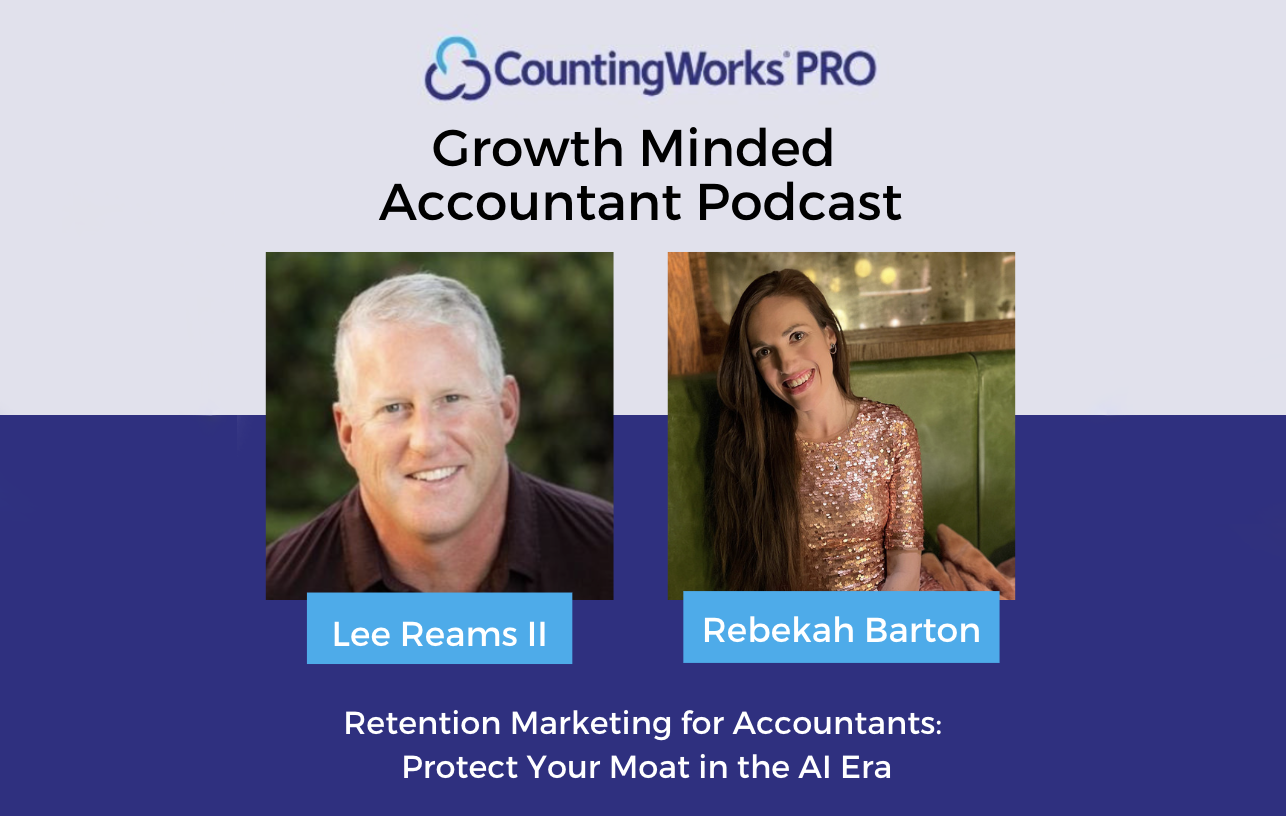
In this episode of The Growth-Minded Accountant, Lee Reams II and Rebekah Barton challenge one of the biggest trends happening in the accounting profession today: firms cutting clients instead of cutting inefficiency.
While large firms and private equity-backed organizations are investing billions into AI, workflow automation, and technology, independent firms have a unique opportunity to compete—not by becoming bigger, but by becoming more efficient.
Lee explains why technology should be viewed as leverage rather than replacement. Instead of eliminating relationships that took years to build, firms can use modern tools to automate proposals, onboarding, client communication, document collection, marketing, and advisory preparation, allowing accountants to spend more time delivering value instead of chasing paperwork.
The conversation explores why simply raising prices without modernizing the client experience often backfires. Clients don't mind paying premium fees when they receive premium service, proactive communication, and a seamless digital experience. What they resist is paying more for outdated processes.
Throughout the episode, Lee and Rebekah discuss how tech-enabled firms are creating better client experiences through automation, personalized communication, AI-assisted proposals, workflow management, and continuous engagement that extends far beyond tax season.
They also examine how technology impacts firm valuation. Buyers increasingly look for firms with scalable systems, documented processes, modern client experiences, and operational efficiency. Firms that embrace technology aren't just saving time today—they're building businesses that command higher valuations tomorrow.
Whether you're considering raising prices, reducing your workload, or simply trying to find more hours in the week, this episode offers a different perspective: don't cut revenue when you can cut inefficiency.
The future belongs to firms that combine trusted relationships with modern technology—and that future is already here.
We know that everyone digests information differently. That’s why we’re now sharing the full transcript of each episode of The Growth Minded Accountant right here on the CountingWorks PRO blog. Whether you’re short on time, like to scan and highlight, or simply prefer reading over listening, you can catch up on every conversation at your own pace.
Each week, we cover topics that matter most to tax and accounting professionals—from AI and automation to marketing strategies, firm growth, and client relationships. Scroll down to read the full episode, or subscribe to the podcast to listen on the go.
Welcome to the Growth Minded Accountant podcast where our experts will share best practices on running your firm in the digital age. This podcast is brought to you by CountingWorks PRO. Let's get started.
LEE REAMS II
Welcome to another episode of the Growth Minded Accountant Podcast. The podcast for tax and accounting professionals who know the old way of running a firm isn't enough anymore. My name is Lee Reams II. I'm the founder of CountingWorks PRO and our sister company TaxBuzz. com. And for the last several decades, I can't believe I'm saying this, I've been helping firms just like yours transform from overworked and undervalued to profitable, scalable, and future ready. So, every week on this show, we cut through the noise. We unpack what's really happening in the profession and give you practical, proven strategies to build a firm that grows with you, not around you. So, if you're here, it means you're not satisfied with just surviving another tax season. You want to grow. You want to lead. You want to save time.
You want to be the type of accountant who clients trust, competitors respect, and buyers pay a premium for when it's time to sell. So, that's what this podcast is about. Uh, that's what we're here to build together. And today's title is cutting clients versus cutting hours. Why tech-enabled firms win every time. As usual, I am joined by Rebekah Barton, our chief visibility officer. Rebecca, if you can say hello.
REBEKAH BARTON
Hey everyone, I'm excited to get into this with you today.
LEE REAMS II
And I took this concept from just, you know, as I was saying to Rebecca before we started this uh recording, I've seen, you know, some surveys, some LinkedIn comments. Um, I'm seeing some experience and hearing feedback from business owners on kind of what's happening right now, uh, in the industry. uh you see a lot of I would say mid-size uh accounting firms starting to rack up their pricing. Um not just coming out with advisory services, but you know their bank reconciliation fees went from 1,500 to 2500 a month. Uh their tax return fees went from $3,000 to $8,000. And I think a lot of clients are like whoa what is happening? And I think a lot of this with the surveys and some of the things I've read online is the easiest way to get more time because everyone is impacted with the amount of work is to cut clients. How do you do that? Let's ra, you know, rake up our pricing.
Um or just start deciding who we're going to work with and who we're not going to work with. Um I think that is a dicey scenario to say this the least. And you know, you hear a client who's spending $40,000 a year with their accounting firm and now you have all this AI automation and tools to make things even easier to do, but then they're jacking up your pricing to 80,000 a year. Um, that's going to make a lot of people pause. So, we're going to talk about a lot of the issues here. We're going to talk about kind of how I see the tax and accounting profession as a crossroad and then some different strategies on kind of option A is you cut hours, option B, call clients, whatever. So we'll kind of talk about a lot of this. So uh on the one side today you got the big four in private equity pouring billions into technology. They're rolling up firms and betting the future uh that will belong to what AI can do.
It's going to enable firms to scale. It's going to enable them to automate a lot of uh uh onboarding services the way they do work and they believe also it would be an insight into now selling other financial services right. Uh well that's great. uh you know some of these firms are putting over a billion dollars into their AI um development but what does that mean for the independents the small medium-sizeded firms u the ones grounded in their communities right the you are the ones that are trusted by your clients okay you're built on relationships and judgment not billboards and buyouts right so rollups are like what is happening I'm now proud of a private equity rollup so here's the truth independent firms like most of our clients are under pressure. Uh, and we're starting to see it some in financial pressure. Um, their clients now expect more, they expect faster. Talent is obviously harder to find.
Margins are shrinking in some respects, specifically if you're staying in kind of the compliance commodity space. And now you have AI, which for some of you feels like a lifeline. I've seen some of the oldest preparers in the world who no one ever would thought would use AI are absolutely addicted to it. Some of our users, people that I thought would have been huge doubters are in it every day doing 20 30 queries a day, right? But then others you have feel it is a threat. It's not accurate. It can't help me. It will put me out of business. U and I think there's two really far sides here. And obviously as usual, you know, usually the truth is somewhere in the middle. Um but let's be honest, every disruption creates two groups. Those who adapt and thrive. Hopefully, those are the people I'm talking to here today. And those who cling to the old ways until it's too late. Um, you know, I'll just go back some examples.
When e-filing came out, um, cloud accounting, you know, that was just a fad obviously, right? It's not. The firms that leaned in early just didn't survive. They dominated. And I believe that's what's happening today. Um, you know, someone said to me, you know, like with just the whole disruption that's happening, what's happening in the economy, the uncertainty, you know, you're gonna have to break some glass is what someone said. I think that's what's happening right now. Uh, so firms that are thriving, they're the ones that are using tools like Max, our AI assistant, not just for the big four, okay, or the big whatever they call themselves, not just for Wall Street, you know, we have built this technology for independence, for the firms that want to leverage, leverage without selling out, for firms that want to stay independent but scale like the big guys. So, you are not alone here. U, there are lots of technology tools.
I know the biggest issue I see is most of the VC-backed firms that are going into the AI space, they're building these applications for enterprises. I totally get it. They don't understand how a small medium-sized firm works, right? And they're just shoving in, well, this is the way you should do it. This is better. And I see a lot of friction to that, right? But here's the thing. You don't have to become an AI firm. You just have to become a tech-enabled firm. Okay? a firm where proposals write themselves, where onboarding runs itself. Client communication, uh, ranking in the AI world, it feels effortless. Okay? The kind of firm that your clients stick with because you're not only trusted, but you're also modern. And if you're losing that modern feel or kind of that disruption or being that tech-enabled where all of a sudden more and more alternatives are offering it, that's when you become replaceable.
You don't want to be replaceable. Your moat is your client relationship. Um, you have that tight you people know you, they know your I mean you know their stories, they know you. It's personal. Um, other than doctors, I think even more than doctors, accounting firms, CPAs, EAs, you have better relationships, more personal relationships with your clients than almost any other profession. So, at this point, you kind of have a choice. you know what it means to compete in a world where some firms have billion-dollar budgets and others just have grit clients and the right tools. I'm betting on the small and independent. So, uh we're going to get into a lot of different things here about how the future of accounting doesn't belong just to the big firms just to the VC-backed startups just to the private equity uh rollups. I believe it belongs to firms like you.
And with tools like what we do at Counting Works and there's other vendors out there um you really can compete on a level playing field. That's the beauty of what tech-enabled allows you. So we're going to talk a little bit here um about uh you know how this all works. Um I hear you know right now the biggest issue is I don't have enough time. Um you know so the question is if you're trimming clients that means you're trimming revenue. That means you're trimming opportunity instead of trimming the hours it takes to do the work. Um, you know, think about that. There's a reason KPMG has invested what is it I think 1.2 billion dollars in AI and workflow automation. Um, that's in a remarkable investment, right? Because they know that two weeks of work can now be done in one day or even hours. You know, that's not hype. That's a fact. That is what AI tech-enabled firms are doing. So the question is where is the disconnect?
Why are small tax and accounting firms, mid-size firms clinging on to the same way I did it last year, the old way, uh, you know, when the math in the future was so obvious. But you can't cut your way to growth, and you sure can't cut your way to a seven-figure exit. So, we're going to talk about a bunch of things. So, our first talking point, Rebecca, is not enough time. You talk to our clients all the time. They have too many clients, not enough hours. Staff is stretched thin. They can't hire good people. But the reality is probably the partners are the bottleneck, right? They're not managing their complexity as they grow. So as more IRS changes happen, more client demands, more competition, you know, they're they're thinking they need to work harder, not necessarily um smarter. So if your strategy for next season is just to buy more Red Bull and grind harder, you don't have a strategy, you have a survival mechanism.
So Rebecca, kind of just give some, you know, when you're listening to people about the time issue and you start talking about these alternatives, why do why are some so reluctant to actually jump in and start saving their time through tech-enabled technology?
REBEKAH BARTON
I think a lot of it is just we've always done it this way that that old mindset, the old adage of this is how we've always done things and it's what worked for people sometimes for decades. And they are reticent to shift gears. They're reticent to jump into the AI age. They're reticent because they don't understand it or they're concerned about it taking their job. So, a lot of what we do is just walk people through it. We explain to them that it's not here to take your job. It's here to save you time on the things that you don't want to do. It's here to save your staff time on the things that they don't want to do or the things that are just tedious. Um, you know, perhaps answering emails. it can write an email response in seconds compared to the 15 or 20 minutes it might take a person. So just little things like that that may not seem major can actually free up hours and hours over the course of a week.
And if you free up multiple hours for every person in your office by automating basic things, we're not saying here that you have to dive in head first and automate every single thing that you're doing. But even automating a few small things saves three hours a week for every person in your office. If you have five staff members, that's 15 hours a week that you've gotten back that they can devote to more advisory, more high-value things, things that need to be done that only they can do. So, I think realizing that this isn't an all or nothing situation is something that I really want our clients to realize. They can dive in and they can use bits and pieces of it and find what works for them.
LEE REAMS II
Yeah. I mean, AI isn't here to replace you. It's here to give independent firms the leverage that the big firms and these private equity roll-ups are already buying, right? They're investing in it. They see the future. They're already leveraging this technology. And now you're like, well, wait a second. You know what? if you're doing it the old way and now they're able to be this much more optimized um you're at a competitive disadvantage. So option one the thing about cutting clients. So I guess it feels good. Yeah, I got rid of these people. Um it means fewer emails, fewer last minute docs, fewer headaches, but guess what? The clients that you keep aren't necessarily lowering their expectations. They still want this Apple-like onboarding experience. They want the ability to communicate you securely and easily uh through your client hub or portal or what however you're sharing documents and communicating.
Um they want faster responses than ever. One of the biggest things we see in when on on the tax marketplace on onear reviews is my accountant is not responsive. So cutting clients I guess makes you have more time to respond. But I honestly don't think the accountants that aren't responding to their clients today with 100 now that they have 80 probably not responding either, right? So cutting clients is just basically cutting revenue, but it doesn't cut the demands that people are are looking to do. So I you know I kind of say you can trim your client list, but you can't trim the fact that every client now expects a you know an Apple-like a TurboTax level digital experience and white-glove uh uh touch points on top of it, right? So they're now expecting all of their expectations, you know, what they see in their daily life are now being felt in other industries. So I think that's kind of a a bad solution.
Maybe cut those clients who don't pay you, um don't answer you, don't respect you, or adversarial. I think that makes total sense. But the idea of just cutting clients as the answer to your time issue to me is just kind of backwards. It's like, well, wait a second. What if I can just as Rebecca said, cut 20% of my time, open up 20% of my time because I'm using tech-enabled solutions to make my life easier. The next option is which is the same way of cutting clients. You raise prices and work with fewer clients. This 100% can work if you're positioned as a premium firm. So, let's talk about branding here a little bit, Rebecca. So if you're a, you know, you're dealing with smaller businesses, for example, and mid to upper middle class clients, they're going to be really price sensitive to raising price prices.
So this is like a bucket that says, "Oh, just go raise your prices." If that's your current client mix, you're probably not considered a premium firm. They're going to go look elsewhere. They're going to find someone else that will do it for less money. uh specifically with you know new data coming out you know the for the over a year before perhaps the economy wasn't humming along like the government said it was right so there's a lot of people struggling out there so kind of explain that premium branding and positioning versus where most clients are there's only going to be so many premium vendors right so
REBEKAH BARTON
premium premium branding is what you were just talking about Lee a lot of companies do it really well Apple is one of them perhaps one of the best uh there are some cruise lines. You look at Seabor, Silver Sea, these types of places that really focus on high-net-worth, affluent clients. They want people who want a frictionless experience, who are willing to pay more to not have to do anything themselves, to just not have to worry. So, you want to position yourself in that same vein that you're going to handle it. You're going to make sure that problems are handled before they even really arise. You're going to be proactive. You're going to help them save money. Perhaps they're even going to save more in taxes than they're actually paying you over the course of the year, in which case your services pay for themselves. One thing to note here is that you may lose clients if you pivot your branding.
If you want to become kind of an ultra premium firm, you may lose some of those lower paying, more commodity types of clients. In the long run though, generally what we see is that people make up for that in the quality of the clients. They're getting more money from fewer clients who are looking for higher value services. They're looking for more advisory. They're looking for additional touch points. They're looking for, you know, fractional CFO services that maybe your commodity once-a-year type of clients were not looking for. So, you really want to position this as an exclusive type of offering, something that isn't available to everyone, but for those who can afford it and are willing to pay for it, it's going to be more than worth what they're paying.
LEE REAMS II
Yeah. I'm going to go a step further and kind of add to what Rebecca's saying. So, I don't think you have to lose these clients. You can raise your prices, but you need to change your model. Um, you know, raising prices without modernizing doesn't do anything, right? That just says, "Wait a second. I'm paying more for the same outdated processes. You're faxing me things. You're emailing me things. You're not saving me time and gathering my documents, scraping my data, reminding me what's missing. Uh, but yet you still want more money. That's where you get in trouble." Okay. So, you can't slap a premium price on a broken process and expect clients to smile and say, "That's, oh, this is great. I'll take it." You know, that's not a pricing strategy. That's delusion.
But I do believe that you can take that same client base, modernize your client experience, make it easier, take the stress off of your clients, um, present your material, your workpapers, tax returns, uh, in a new light. Use technology to summarize things, communicate better, um, use technology to help you write responses so you're not waiting two weeks to respond to a client or you're even able to automate a lot of this stuff. That is where tech-enabled firms are winning. Um, so now I'll move into option three, which is do nothing. I think this is probably the most common path. You know, every year you scramble, same staff turnover, same stress, right? Do nothing means staying in the same. Uh it means falling behind as others move forward.
I had a conversation with my financial advisor actually yesterday and we were just talking about what they're seeing in the economy, what they're seeing with AI disruption kind of you know their goal or not goal but what their forecasts are and what's going to happen and they're like this is one of the biggest disrupt disruptions in our lifetime. So whether you call this, you know, kind of like the beginnings of the internet, u, you know, black and white to color TV, whatever, we can go on. There's a few big episodes that happen. I think AI is one of the biggest ones yet. And the reality is, as he was saying, hey, there's certain people for whatever reason, they're older, they don't want to do anything else. They don't want to change. It's stressful. You procrastinate, right? I don't want to deal. It's like you see the Titanic going for the iceberg, but no one wants to yell and say turn left, right?
And there's and all you need to do is we see it and we can we can miss that iceberg if we develop some new ways of thinking. It is not as painful as you think. Okay. Um and I think what I'm trying to get people to think about is like, you know, doing nothing is like sitting in the back of a taxi with a meter running, right? You're paying the price whether you move or not. you're just sitting there and and you're going. And I think the do nothing approach is basically we're seeing way too much evidence and it makes me sad. I have clients um and we sit there, we communicate all the time with our client base where we do these podcasts, we do I do product updates, I do emails, um I try to post on LinkedIn. I try to communicate like I'm your partner, you know? I'm not sitting here trying to scare people. I'm trying to tell them, hey, this is what's happening and this is what you need to do and your life could be a lot better.
So, I'm trying to like kind of shift the narrative a little bit. Um, and get, you know, the smaller firms or those that don't want to, you know, learn new tricks. Um, I want them to start embracing uh tech-enabled efficiency. Okay? And this is where this really it flips the script on you. So, what do modern tools actually do? And I don't want you to be scared of them. I had a a guy on LinkedIn who basically said, "Hey, I don't trust AI at all. It's not accurate." And I'm like, "It's a tool. It's there to think of it as your virtual assistant or a junior analysis that you can't find anyone good enough to hire right now. U but think of them sitting in your behind you with 10 of you behind you um for a really low cost point.
So they're going to be able to do so much of the underlying work and then you as the trusted expert with the expertise can kind of analyze, fine-tune where it's going, where it's not, you know, where it's right, where it's not. So what are some modern tools? Automated intake and onboarding. So no more chasing docs. And let's start uh Rebecca just even with the proposal tool. Um we created a new tech-enabled because if I say AI enabled, people will lose their mind. But it's a tech-enabled tool that allows you to create one-to-one proposals for clients in seconds. Basically, it scrapes data and context about the client. You can write some instructions to the proposal tool. Hey, this is a dental firm. They have six offices. They have this many employees. I want to create a virtual CFO proposal for that uh market.
They are located in San Diego. the AI will be able to put all that together professionally written in a language that a dental owner would get and really value what you're offering to that client. So even in that saving, you know, think about the old way of doing things, Rebecca, kind of explain just from, oh wow, I can automate the proposal process and then I can kick off a a personalized engagement letter. So let's talk about one the time savings, but more importantly the added benefits of personalizing this one-to-one marketing and what that means to your client base and results.
REBEKAH BARTON
So it's going to just make the whole experience for your clients better, more authentic. It's going to draw them in. It's going to make them feel special. It's going to make them feel cared for. It's going to make them feel like you really understand who they are, what their business is, and that everything is tailored to their specific needs, which is something people really want in this day and age. I was recently reading something in ad age about how personal marketing is the wave of the future. It's already here really. We see everything from personalized ads on Instagram and Google and everywhere we look to personalized experiences when you go to a store. Personal shopping for example has become very widespread, not just something for the ultra wealthy anymore.
So, everybody wants a really hyperpersonal experience, and that's what this tool and other tools like it are allowing you to provide at scale without spending hours and hours of your day putting together a personalized proposal. You could spend an entire day putting together one or two proposals and get nothing else done. With systems like this, you're able to provide that really tailored, really hyperpersonal experience that everybody wants without wasting days of your life. So it allows you to still provide the highlevel services that you want to provide while simultaneously providing the client experience that you want to provide which is really a win-win not only for you as a professional but for your client base.
LEE REAMS II
Yeah. And if you tie them all together in workflows where you have your proposal kick off an engagement letter that kicks off an intake form that kicks off perhaps a to-do list uh for your client and your staff. Now you're seeing the beauty of tech enablement, right? So you can see, wa this whole process saves my client time. It communicates better. It communicates automatically. Processes kick off. So I don't need as many administrators following and tracking this stuff. That is the beauty of a tech-enabled firm. Uh tech-enabled firms also spend smart reminders. Clients get nudged automatically based perhaps on their profile. You know, are they a dual income? What are the things they need to worry about? Am I able to create content that speaks specifically to these different audiences on my blog, on my social media uh accounts? Wouldn't it be nice, Rebecca, if tech-enabled firms could do that automatically, which they can.
So, kind of explain a little bit of what we're doing for clients and why it's so important uh to communicate your value now in this AI competitive landscape and keep I want you to build moats around your client base. I want them going nowhere. I want them to trust you. And how is this constant communication getting in front of them with life events and talking to them directly about issues that they care about? Why is that so important in client retention?
REBEKAH BARTON
So, the more you integrate yourself into someone's life, the less likely they are to leave. Um, the more you're going to become something they feel like they can't live without, you're going to become a service that they rely on not just once-a-year for your taxes, but every time something happens in their life. So maybe once a month they want to do a check-in with you because something occurred or they want to double check something with their business or they're thinking about buying another house or they have a child who is about to go to college and they want to make sure that they're on track with savings. There are so many financial things that happen in people's lives. And if you are constantly in front of your clients, you're at the top of their inbox. You're reaching out to them. You're making sure that you're integrating into their everyday life.
Then you're going to be top of mind. they're going to think, "Oh, hey, I should reach out to my adviser. I should reach out and ask them what they think, where their head is at with this, what the right decision would be." So, I think the more that you integrate yourself with constant communication, not constant to the point that it's annoying, but communication that matters to people, high value communication at times of year that make sense and when life events occur that make sense, things like that. You are showing them that you really do care about what's happening and that you are in fact an indispensable part of their life. And you're also building trust. You're building you're building a relationship with them that exceeds a once-a-year tax preparation scenario, which is what a lot of tax professionals fall into. They prep taxes once-a-year. They file the return.
They say, "See you next April and everything's done." You don't want to be that. You want to showcase the fact that you can provide higher value services, that you're here for them throughout the year, and not only throughout the year, but year after year after year, and perhaps even into the next generation. So, this communication kind of snowballs and it starts to build relationships that not only span years, but that span multiple generations of a family. And that opens up an entirely different can of worms in, you know, family financial planning and family offices and all of these other things that we could do and have done entire podcasts about on their own.
LEE REAMS II
Yeah. I mean, basically, you don't want to open the door for competitors, you know, to to showcase a a planning strategy, for example, QSBS stock, and then someone else kind of opens the door and they come back to you and said, "Why didn't you tell us about this? I had no idea." Well, if you're utilizing a tech-enabled firm, you're going to be able to push that content out, different types of content depending on your target audience automatically. You don't need to stress about how do I get enough time to write about these issues. Um, you know, these platforms are smart enough to be able to do it on their own. I'm going to pivot a little bit more to data scraping and analysis. So, um, obviously now you can import client hub doc or documents to your client hub. AI technology can scrape them, scrape the data. It can organize them in binders. It can summarize data.
U and then it can also use that as context to proactively suggest different scenarios or planning strategies or even creating a proposal for a group of clients that might need there might be a hole in what they're doing with you today. Right? So that's another great way to use tech-enabled firms the way they're they're they're growing. and then advisory insights. And that's kind of where I was alluding to is AI now surfaces strategies that you can use to upsell clients. So if you have all this data in your ecosystem, that's the beauty of AI. It's able to analyze and take all this context in instance and come back to you with a, you know, there's no way you could sit there and go through all your clients information to try to figure this out.
And I'll give another example of a way to use uh like tools like Max is drag a tax return in the last year's tax return into Max and say, "Hey, can you create a interview question and answer uh outline for me so when I meet this client, I know what to ask." And AI is going to be smart enough to look at their tax return and know exactly what questions to ask. They're going to see their ages, do they have dependence, do they own real estate? It will be able to curate that entire experience. So, you know what you're able to do now? Each client could have a one-to-one interview versus kind of this oneway, one questionnaire for all. That's the beauty, highly personalized. Okay. Um, so this isn't just ChatGPT with a calculator. I want people to understand I'm talking about tools that are trained on the tax code. You're starting to see more of them marketed tools like Max, there's Tax GPT.
There's a bunch of different tools out there, but they're trained on the tax code. Okay? They're tested by pros and they're tuned for accuracy. They're updated daily, right? They're human verified data that kind of puts a knowledge layer on top of what a normal model would have access to. So, it's not just searching the web maybe for someone at Forbes who wrote an article and then says, "Well, this is now a strategy and then it's incorrect." Okay. Um, so a couple little stats just to kind of get you over the finish line, I hope. Intuit did a study. They said 80% of firms using AI tools rep report higher client satisfaction and faster turnaround times. That's a pretty good ROI. I don't know what the other 20% are doing to be honest with you. Maybe they don't know how to use the tools. U KPMG they came out and said they're cutting uh things that took two weeks to one day with workflow AI. Um so AI is not here to replace you.
It's to replace that 17 hours you wasted this week chasing a client for their W-2 missing W-2, right? You know, your clients don't want like a Wall Street accounting firm. They want you. They just want you to be tech-enabled enough to deliver faster, smarter, and better. Um, and I think this kind of ties into my next thing, which is the long game. Many of you are boomers or you're nearing retirement, and you're thinking, I'm I don't care about this. I'm going to sell soon. Well, you know who cares about this? It's your buyer. And it's the valuation g uh you know angle. So, um your firm's future resale value, your multiple um will be much lower versus a tech-enabled firm. If I as a buyer can just roll your technology in and your clients are used to it and you have processes in place, they're not these manual tasks that only Joe knows how to do, right? So now I buy it and Joe's not here anymore and everything just breaks, right?
Uh, you know, and the difference depending on the size of your firm can be, let's just say the difference between a.7 multiple to a 1.3 times multiple times, let's say you're just doing a million dollars in revenue, 700 versus 1.3. Hm. Which which exit sounds better to you? Um, I you know, if you're a larger firm, this could mean millions of dollars. So, you know, it kind of it's like, would you rather sell your life's work for pennies on the dollar or cash out with a multiple that rewards you for building a future-proof firm? This also ties into your branding and positioning um how you're perceived in the marketplace. So, Rebecca, let's talk about how important having a modern narrative is as well and why that's important because the old ways of referrals is kind of being broken down with AI. People are using ChatGPT to ask about who's the best tax accountant. Uh Google with their AI search uh results.
So kind of explain how a narrative falls into this.
REBEKAH BARTON
Yeah. So this is actually going to be one of the most important parts of building your brand. Uh whether you're selling or not, if you want to rank in the in the tech-enabled age, um having a really solid narrative surrounding your firm is critical. This is something I talk about all the time with our clients. It's actually one of my favorite things to talk about with people. I'm really passionate about it. So, what you're gonna want to do is make sure that you have a cohesive narrative, and that's going to not only be more appealing to younger buyers who understand the importance of authenticity, of transparency in marketing and branding, but it's also going to help you rank.
So when ChatGPT for example is trying to help someone find a firm to help them if they have a very specific question like I have you know three kids and I'm interested in finding a tax firm that also does financial planning so that I can set aside money for my children so that they can go to college or you know inherit x amount of dollars for me when I pass. That type of query is what is getting entered into ChatGPT. People talk to it like a person. and they tell it their life story. So, if you have a narrative out there that tells the story that you are the firm in your area that's able to help people with these types of scenarios, planning for retirement, planning for the future while also, you know, saving them money on taxes now and helping them live the life they want, then you're going to rank. ChatGPT is going to pick up on that.
That that is your narrative and it's going to recommend you. the same with a lot of the other generative search. We call it geo now, generative engine optimization. So, that is something that's top of mind and your story is the most important thing when it comes to ranking within those search systems. Um, I know that was a lot. I kind of went a little deep there, but suffice it to say that it's very important to have a cohesive narrative and to really let people know what makes your firm different because you are different. Not every firm is the same and there is something that sets you apart. So, make sure that that is coming through when you're posting things in all of your content and on your website. And
LEE REAMS II
and I'll give you the summary of what she just said. A solid narrative, a modern website, and a modern client experience will mean that you've developed processes that can scale without you. So, you can sell that part of the business. That's part of the selling point to a buyer. They're going to look at that. They're going to look at, are they showing up on search? How many inbound leads are they getting? How are they converting these? How do they handle their processes and scale them? That is why it's important. So, this leads me to what is the disconnect? You know, why are small firms saying tech isn't tr, you know, trustworthy? AI makes mistakes. It's too expensive. That's my favorite one. It's too expensive. And I'm like, the cost of labor is too expensive. An AI tool that costs you 300, 500, or even $1,000 a month is pennies compared to what an employee costs, right?
You know, and the reality here is AI is is trained on the tax code. Workflows that run from AI models that are trained on the tax code. they're actually more accurate than a staff, you know, at 11:00 at night on, you know, on April 14th, you know, you know, with their coffee and they're falling asleep. So, the tools pay for themselves in both time saved and clients retained. So, I would argue not adopting is the most expensive choice of all. Um, so the biggest risk here isn't AI making a mistake. The biggest risk is you making the mistake of ignoring AI. Um, I think there's a couple things too. I'm really bullish obviously on the independents. Uh, we love you guys, but you have one thing that these big billion-dollar firms can't buy. That's trust, right? So technology is just the amplifier. You already if you're if you have your moat up, you have that client relationship layer dialed in.
So you're communicating via newsletters, social media, you're responsive to clients. They're not going anywhere. All you're able to do now is with technology, you're able to amplify your messaging, right? So it's not about becoming an AI firm. It's about becoming a firm that runs itself. So you can finally focus on advice, not necessarily the medial task, the paperwork, things like that. So I'm going to kind of recap here. I've gone through a lot. Um I'm coming off my bully pulpit. Uh but I really believe in this. I'm passionate about it and I think it's important that we communicate the messaging to as many that we can kind of wake up as possible. So what are the four paths right now? You can cut clients, you can raise prices. Um there's a hybrid there. You can raise prices and modernize your tech experience. That's kind of the one I see is the best path forward. You could do nothing. You can stay in compliance.
You can continue to lose clients to AI tools, to TurboTax, um to lowcost commodity players, or you can embrace technology, right? Um you know, only one of those paths scales and I would say that's probably the tech-enabled, right? Um only one preserves your sanity, only one doubles your valuation at exit, right? So those are those are big things. So I'm going to kind of close this up. Um you know the bottom line the profession is changing whether we like it or not. Uh we as CountingWorks had a completely I just redid our platform three or four years ago and in the last two years I have completely changed our model to be tech-enabled first AI first. So take the advantage of this incredible engine we've created at max um to power all of these user experiences right and the results are incredible. Um, each time we run out a new feature, it's just like, wow, this is so cool. This is so nice.
It's something like I dreamed of doing an agency-l like experience for clients at a price they can afford. And we're doing that now. And if we're adapting to it and seeing the payoff, I guarantee you guys will see the same benefits, right? Um, and you know, the big four, the private equity, the tech first firm. So, you have all this money rolling into our vertical. I mean, I'm sure you don't appreciate when some tech wiz 19-year-old Stanford dropout claims they created the new AI agent for accounting. Um, and they're going to, you know, disrupt everything and blah blah blah. You know, I honestly think, woo, they don't totally get it. But the reality is they're all moving now, right? There's a ton of ton of things going on. So disruption doesn't mean independents lose. That's the biggest thing. That's the fact. It's the opposite. Uh, independents have what? No billion-dollar firm, no VC-backed firm can buy. Guess what that is?
Trust your relationships and deep knowledge of their clients lives and businesses. You know what they need is leverage. So I think you have a competitive advantage here. So that's what technology and yes I'm using the word AI really gives you. It's not replacement. It's not risk. It's just leverage. Leverage to take the busy work off your desk. leverage to scale advisory, which is obviously the big buzzword that everyone's talking about. Uh, more importantly, without adding staff, I understand how hard it is to find quality people right now. Um, a lot of younger people are actually starting to see the opportunities in the accounting space, so hopefully that kind of backfills. Um, I know the numbers expected in growth of the number of accounting professionals needed in the next coming years is quite large. So, I think there's huge opportunities here.
So what we do is we are able to leverage to compete in against the firms with deeper pockets. You don't have to spend $1.2 billion to act like the same, you know, be able to do the same type of services, have the same capabilities, right? Uh some firms will still sit this out. I could sit there I mean, and Rebecca knows I get so frustrated in our company scrums and and I'm like, why don't they get it? And that's the reality of every wave of change, right? the ones who lean in or now are going to define the next day the next decade of tax and accounting. Um, so the question I think is will you let the market change around you or will you step forward, stay independent and scale like the big guys on your terms? And I think that's the beauty of what tech-enabled firms and associate that with some new narrative perhaps raise your pricing. I think you're going to love what this industry can and and I'm very bullish on your future.
So your clients want the future, your competitors are building it. The only question left is do you want in? So, I hope this was a this kind of felt like a a long- winded coaches like a Super Bowl speech that just went on for too long. But I think it's important just to talk about these issues. You know, we've we've been talking about trends. We've been talking about concerns. I'm seeing it. I'm seeing, you know, some accountants who are still doing the old ways. They're struggling right now. You know, hey, we're having cash flow problems. Um, so there's ways to backfill this. There's ways to adapt here and that you can be very successful. If you have any questions, um, please feel free to reach out to either of us on LinkedIn. You can visit our website at countingworkspro. com. Um, if you have any questions though, please feel free to add comments. We'll add this podcast to YouTube channel as well.
If you're not following us, go to CountingWorks PRO on YouTube. Uh, we're putting out a lot of good content like this uh, every week. So hopefully you will continue to kind of follow our advice. Maybe at some point you're going to go, "Oh my, I get it." That aha moment comes in. Uh, so I'm really bullish on where things can go for you, uh, especially the independent. So again, thank you being a subscriber and listening to the growthminded accountant. Until next time, thank you and have a a great September 15th deadline. Uh, you're almost for a little break and I know one more and then break and then obviously ready for tax season. So again, thank you.
Why do many accounting firms consider cutting clients?
Many firms reach capacity and believe reducing their client list is the fastest way to reduce stress and workload.
What's the alternative to cutting clients?
Automating repetitive work through technology allows firms to save time while maintaining or growing revenue.
Does AI replace accountants?
No. AI handles repetitive administrative work so accountants can focus on advisory services, strategy, and client relationships.
Can small firms compete with larger firms using AI?
Yes. Modern technology gives independent firms access to automation and workflow improvements that were once only available to enterprise organizations.
Should firms raise prices?
Raising prices can be effective when paired with a premium client experience, stronger positioning, and higher-value services.
How does technology improve the client experience?
Automation creates faster onboarding, quicker communication, personalized proposals, proactive reminders, and smoother workflows.
Listen to other podcast episodes or read other related blog articles with relevant information and insights.