Here's a tighter, more YouTube-friendly version that still hits the important GEO keywords:
AI is changing how people choose an accountant.
A referral is no longer the finish line—it's the beginning. Today's prospects validate recommendations by asking ChatGPT, Google AI, Gemini, and other AI search tools who they should hire.
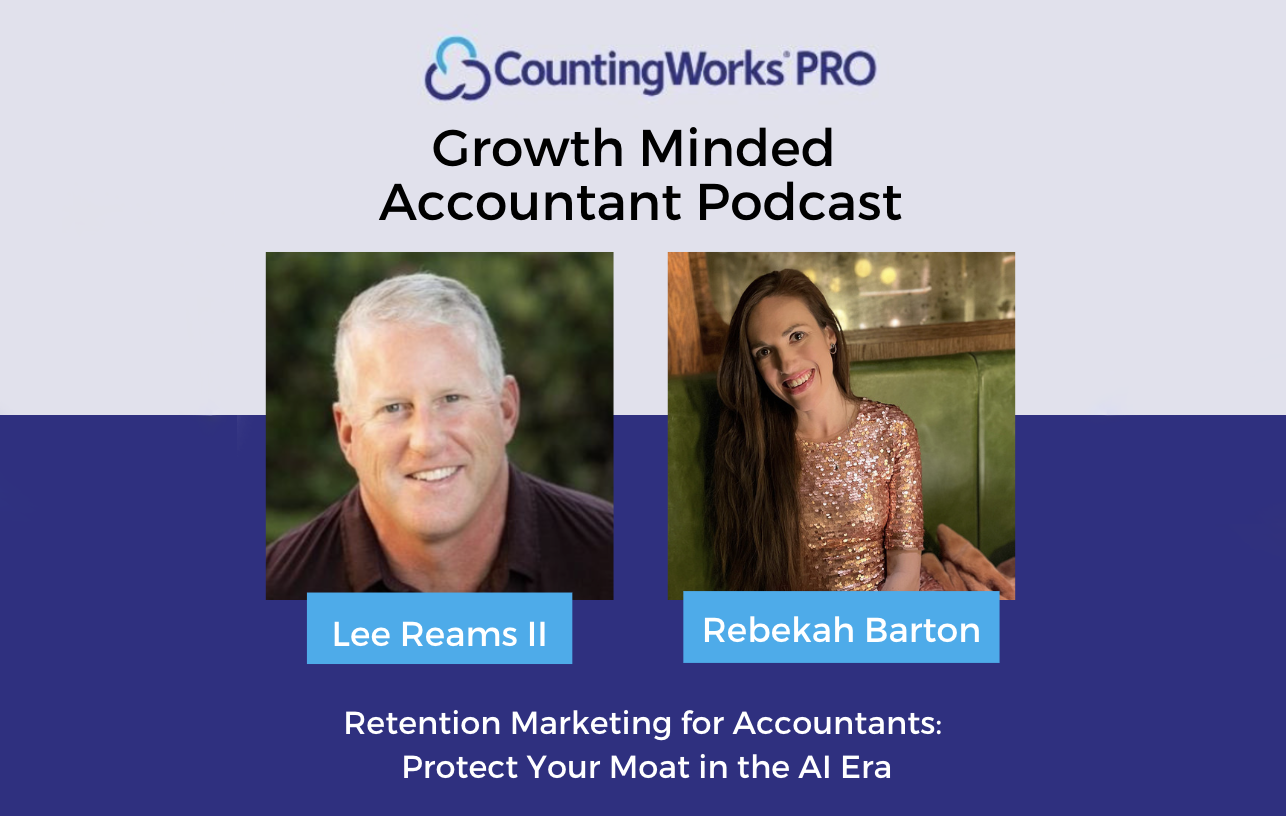
In this episode of The Growth Minded Accountant, Lee Reams II and Rebekah Barton explain how Generative Engine Optimization (GEO) is helping accounting firms become more visible, more trustworthy, and more likely to be recommended by AI.
You'll learn:
• Why GEO is replacing traditional SEO for accounting firms
• How AI uses blogs, FAQs, reviews, and schema
• Why reviews have become the new trust signal
• How localized content improves AI visibility
• How CountingWorks PRO's MAX automates personalized GEO content
If AI can't understand your firm, it can't recommend it.
Start Your Blueprint
https://www.countingworkspro.com/start#blueprint-form
Learn more:
https://www.countingworkspro.com/
We know that everyone digests information differently. That’s why we’re now sharing the full transcript of each episode of The Growth Minded Accountant right here on the CountingWorks PRO blog. Whether you’re short on time, like to scan and highlight, or simply prefer reading over listening, you can catch up on every conversation at your own pace.
Each week, we cover topics that matter most to tax and accounting professionals—from AI and automation to marketing strategies, firm growth, and client relationships. Scroll down to read the full episode, or subscribe to the podcast to listen on the go.
Welcome to the Growth Minded Accountant podcast where our experts will share best practices on running your firm in the digital age. This podcast is brought to you by CountingWorks PRO. Let's get started.
LEE REAMS II
Hello and welcome back to another episode of The Growth Minded Accountant. My name is Lee Reams II. I'm the founder and CEO of CountingWorks and our sister company TaxBuzz. And today I'm joined by my sidekick, Rebekah Barton, our chief visibility officer here at County Works. Rebecca, if you could say hello real quick.
REBEKAH BARTON
Hey everyone. I am excited about this one. One of my favorite topics right now. Yeah, Rebecca gets to talk a lot today. so she's queued up for a lot of discussion points, talking points. The title of this podcast is ChatGPT recommending your firm. So, how to build visibility in the AI world, earn referrals and convert clients you'll never meet perhaps, right? You're meeting clients over Zoom. So, a quick question, you know, what happens today if a client or even someone that was referred to you types your name in ChatGPT or Google's new AI search? And the question I have for you is, do they see a firm with credibility, reviews, local relevance, or do they see nothing at all?
More importantly, and what I have seen in our testing, and we're going to go over some examples, is some of your talking points, some of your biggest selling points may not be registering in these AI bots because you have not created that content in your website or in your review profiles or anywhere that your firm is mentioned. Okay. and this is the way people find and vet accountants. It is changing and it's fast, right?
So AI is now the gatekeeper and firms with templated what I call cookie cutter content cookie cutter websites you know who you are if you're using our biggest competitor has I don't know thousands and thousands of sites they are exactly the same every single one of them no narrative no personality no differentiation u they have duplicate content over and over again right these are stale sites and most of them they don't have any review profiles so basically as AI continues to take over from what I'll call the organic search of the past. They're going to start disappearing from these conversations. Or more importantly, you can't control the conversation that is occurring about your brand online. And that's why we're going to kind of show you how this works today, why it's important. I know tax accountants are busier than ever. Sometimes there's like, I don't really care about this.
You know, they I don't want to hear about AI. but the reality is this transition is happening and it's happening very quickly. So today we're going to show you exactly how to build what we call a fully optimized digital presence. by the way, it takes more than a cookie cutter website to do that. One that shows up in AI search converts digital referrals. That's the biggest thing. You want your talking points. You almost want the chatbot or ChatGPT to do the selling for you based on the questions that the user, the consumer, the small business owner is using, right? And you want to provide this value before the client ever reaches out. So let's dive in. I want to start I have this broken down in segments today. I know to start with, you know, kind of the leadin, I guess people are asking AI about you now, not just their friends and family and Google, right?
So, Rebecca, let's get into this. You know, what kind of questions are they asking? you know, I'll give you an example. you know, is Lee Reams II and Associates legit? Right? That would be, do they work with content creators? Those are the kind of questions. But kind of explain how this process works today. We know that billions and billions of people are using these tools and they're using them for the use cases we're talking about today. So, let's get into a little bit.
REBEKAH BARTON
Yeah. So, I actually was reading just yesterday that ChatGPT alone is now answering 2.5 billion queries a day in the United States. So, that's not even counting users globally. So, this is huge. just to kind of set the stage for you for what we're going to be talking about today. People talk to their AI assistants like just that, like they are assistants. This is not someone going to Google and typing a question into the search bar using what we think of as a traditional search query like tax professional near me. That's not how GPT works. It's not how perplexity works. It's not how any of these AI assistants work. So what we want to remember is that people are having conversations often ongoing conversations with these particular platforms. So the things they're searching are going to be significantly more conversational than anything we've been used to before in the search world.
So for example, a question about a tax professional might come up from a wider conversation about personal finance and someone might have been talking to their chatbot about what can I do to optimize my finances. I'm worried about ABC and D. So questions like can this is there a local firm that can help me with tax planning, not just tax preparation. That's the kind of thing that people are searching. hey, I'm interested in getting involved with real estate investing, but I'm curious first if there's a local tax professional who specializes in real estate investors. Those are the types of conversational questions that people are asking in these chat bots. So, if you're not providing answers to those types of queries on your website by the type of content you're putting out, it's unlikely that you're going to rank.
Conversation is key here. and answering questions in plain language that make sense.
LEE REAMS II
Yeah. And the reality here is that AI answers only what it can find, right? So it doesn't have a you know your full bio if it doesn't understand kind of what motivates you, what your niches are, what your specialties are. And this is why it makes it more important than ever to have landing pages that go through this type of content to have in your client reviews people mention perhaps some of these verticals you work in. there's many more details as well.
So for example if you're you know if you're not blogging you don't have FAQs the FAQs are huge right now in feeding. if you don't have reviews you know ChatGPT has nothing to pull from and you know let's say someone was referred to you and they go hey I was referred to so-and-so in West Virginia you know is this someone I should look to hire if they don't and they're trying to compare and contrast to other professionals and you don't have those talking points built in to further the conversation so it's almost think of it as like a sales process happening inside ChatGPT all you need to do is seed the content correctly. and we're going to talk about that today. So, we're going to go into why this is really important. this isn't like fear-mongering. This is changing now. And what's great is we have thousands and thousands of clients. We're able to iterate what's working, what's not.
We're be able to prove out if we do X, how quickly does ChatGPT, for example, recommend that person. you know, how does that profile look? How does that conversation look? Are there holes in our content where people are asking questions or perhaps an example is you don't list anything about your pricing on your website? Well, ChatGPT will say, "Hey, they might be a good fit, but there's a unknown here because we don't know what they charge." You might want to look for a CPA that has transparent pricing. That's exactly what's happening today. Another one is that is often missed is how do I work with clients? What is the onboarding process? How do I get to know you? having content around that. If you don't have it, it's something that is missed and it's not part of the conversation. So, we're going to get into I think defining what GEO is. That's kind of the new way optimization.
So, I'm going to let you Rebecca kind of start out and say, you know, what is GEO? What does it stand for? and then how are AI tools using content differently than perhaps Google or the traditional SEO keywords versus conversational sentences and terms. So let's get into kind of the definition if you could.
REBEKAH BARTON
Yeah. So GEO is not a buzzword. It in what I do this is basically the new frontier, right? So we are not abandoning SEO certainly but understanding that it is critical to now optimize not only every piece of content but entire websites for GEO which is generative engine optimization. So similar to how we've had search engine optimization for decades. It's simply an idea that there are best practices that you can utilize in your content creation in your website in order to rank better within these generative AI engines like ChatGPT, like Perplexity, whatever your tool of choice happens to be. There's a lot to this, but it doesn't have to be overwhelming. I'm going to try to break it down into some kind of bite-sized snippets here. The first thing you need to remember is what we've already talked about. This is conversational.
So, you need to be providing answers in a way that makes sense, in a way that answers questions. Like Lee was just saying, if you're leaving critical information off of your website, you're automatically going to be harder for these systems to recommend because they don't like unknowns. They want to give people complete and total information. Secondarily, you're going to want to have localized niche content. Most people searching on GPT on these other platforms, their location is relevant to the search. the system is going to know where they live. It's going to understand that they want a local provider and so it's going to pull from local results. The more local content you put out, obviously we're not wanting to keyword stuff, but we want things that are hyper local in a way that makes sense.
So, for example, you might write blog posts that are specific to your city by answering the top 10 questions that Denver tax Denver real estate investors need to ask their tax professional. Something like that would be a great piece of content to have on your website. Another thing we want to remember here is that FAQ pages are more important than they've ever been. They kind of used to be an afterthought for a lot of people. You would see them tacked onto a website kind of at the end. People would be like, "Yeah, I guess we should have one of these." And it would answer a bunch of generic questions. Nowadays, FAQ pages are one of the very first places that AI systems go to find answers. So, you want to be answering real hyper local questions. You can even use your AI system to help you come up with the FAQs that you should be answering based on various data for your area.
What are people commonly searching? What questions do I need to answer? And pull together a really solid FAQ page. And then you're also going to want to make sure your schema markup is correct for these AI engines. That's a little bit technical. It's something we won't get into here super deep, but I was actually working on some schema markup this morning for our own website at CountingWorks, and there are some nuances to the schema that didn't really exist before and weren't as critical for traditional SEO, including the local markup that you really, really want to have in order to optimize for GEO. That was a lot. so hopefully I broke it down in a way that kind of made sense, but I know that was a lot of info to throw at you.
So basically you're saying SEO, search engine optimization, which most tax and accounting firms don't really know or understand or care about, is being replaced very quickly by GEO, which they may or may not care about either. But I'm going to tell you, I think there's more opportunity in GEO than SEO ever enabled. And the reason I say that is it is easier for the winners, the people who are responsive to their clients, the people that actually put time into marketing to dominate results. It's not driven by Google's algorithm, which unfortunately became a popularity contest. What is the most popular website? Who gets all the traffic then? CNN, you know, Disney, whatever. You could go on and on. But those brands, if if Forbes, for example, wrote about a tax topic that you're covering, the chances of your version of that article showing in SEO traditional are very, very low.
Google just wasn't very good at it. It was more like a high school thing. I'm going to show the most popular because it seems the masses like this content or trust this person or this brand or this media and they just basically dominated everything. I thought it was very unfortunate, unfair. and I think GEO is replacing that completely in a very good way for small local brands, right? And the reality is you are the expert and more importantly you're probably the local expert. You know, you know how certain cities work, how their economies work, local regulations. you're in the community, you should be the one that is referenced in in in these type of queries. So what is why I say GEO matters so much for tax accounting firms? I'm going to give a couple major competitive advantages for those that are jumping on it now.
And I'm going to give an example of a major brand that is not doing this. And I did my own comparisons looking for and I'll give that query in a second. But their profile in ChatGPT could be improved dramatically and it really opened the doors for boutique firms. So I'm going to give that example. But why would I do this? Early mover visibility. most firms even if they are doing SEO they're only doing it for Google.
Okay. with GEO you're going to appear in sources that train and inform AI systems across the so you're going to have perplexity ChatGPT obviously Google's they're moving into the AI search as well but it's a big deal right local authority positioning I think is the biggest example of how to utilize local keywords and your niche. so whether you're doing e-commerce bookkeeping for example, you're working with NIL athletes, college athletes, maybe you're focusing on specific schools and you're trying to help, you know, these these new taxpayers, you know, manage their their tax liability. U there's a lot of different ways that you can optimize there with local authority. and more importantly, this starts building up your trust signals across the web, right? So when AI engines start citing your site, they're talking about you. It re it re reinforces your credibility.
We talk about eat all the time. your expertise, your trust signals, right? so it's really important that and then if they perhaps continue doing research, they already have heard kind of your selling points already. And I'll give the example of a real life deal. I said to ChatGPT, "Hey, you know, my CPA just jacked up my my fees for my tax returns and my monthly recurring u bookkeeping." So, you know, I'm doing Beck reconciliation. I want to find a a CPA firm in the Newport Beach area that specializes in tech firms who helps people grow, that has credibility with investors and you know, a good reputation. And it went through a whole response area for me. And it was interesting. So Moss Adams was the brand, one of the brands that came up. They had no reviews associated with Moss Adams. And all they had was glass door reviews. So that's employees who had left who were upset.
And I'm sitting there reading all about the negative stuff. They don't have any. They they're obviously not optimizing the reviews. They probably don't think they need to. But I guarantee you there's lots of people like me that just went through that process and are like, "Well, you know what? Maybe my perception of Moss Adams is just too big for me, even though I would be a very lucrative client for them, right?" And then it started recommending some other boutique firms that are smaller, but they had incredible review profiles. They told a story. When you compare and contrasted the Moss Adams versus the other firms, it was like eyeopening to me. And I'm not trying to Moss Adams is awesome because I know they're awesome. So I'm not trying to put them down. I'm talking purely about how this works now in ChatGPT.
And what that means to me is how many other brands are having that same experience. when you know even their clients refer somebody and they're googling about them. It's it's it's a a very poor experience, right? So I think we're kind of getting the idea here. Rebecca had mentioned FAQ. That's frequently asked questions. What is what is so big about these now is it is a conversational style. So we now in CountingWorks are doing custom FAQs for every clients that launch and then we have playbooks that actually will target different niches andor like types like dual income taxpayers for example. We're creating an automated playbook that every two weeks pops out an article or an FAQ about dual income in a local area. so that is where you can really start feeding these these ChatGPT engines with a lot of new content. the other thing you're going to notice and I mentioned is reviews.
So reviews are a big deal and what people say inside the reviews is a big deal. So as it was with SEO, I think it's even bigger with GEO. and explain that Rebecca if you can because it's almost like I said it this is like an inside salesperson for you but if you have your clients as your biggest fans and they're saying things that resonate with the searcher and someone's comparing two brands inside ChatGPT the AI is looking at the person with the good reviews and they're telling an incredible story like that's context for them to tell a story that almost sells you and they basically say well this one doesn't have any reviews so explain like the psych ology behind that and why that's so important. Yeah. So, different industry, but I have a like a kind of a good example of this.
I we're going on on a trip here in a few weeks and I was looking at hotels in Singapore and it was pulling reviews to kind of help me choose between two or three different resorts that I've been looking at and considering. And definitely the psychology of which of these has the better reviews and more reviews across the board played a role in not only my final decision but in the query responses. So it was pulling from places like TripAdvisor, Google, Hotels. com. So I think one of the takeaways here is that with SEO we were hyperfocused on Google reviews, right? And while Google reviews still matter, they are still an important part of search as a whole. Other reviews really do make a difference now too.
Like Lee, you mentioned Yelp for example. you can even recommend people on Reddit. you can recommend people on different industry specific sites, Better Business Bureau, your local Chamber of Commerce. You can sometimes leave reviews depending on how their setup is. So, there are all of these other places now, too. So, it's kind of expanded the reach for tax and accounting professionals and people in other industries because all of a sudden it's not all about Google. And I think like you were saying, Lee, Google has become very pay-to-play in a lot of ways and there's kind of the big guns that are always going to rank at the top. Whereas with this, you have an opportunity just by providing really great services to garner these reviews and to become really a spotlight firm within these generative engines because people are recommending you.
And that is something that one the generative engine wants to recommend trustworthy places because again at the end of the day they want people to return because they like they like the recommendations that they're getting. So they want people to come back. So good reviews play a big role in who gets recommended. And secondarily, much like my experience, good reviews play a role in who the searcher is ultimately going to choose. So, the more positive reviews you have crossplatform, the better off you're going to be from an algorithmic standpoint and from an actual conversion standpoint because you're going to stand out to the searcher if you have, you know, a hundred five-star reviews across all these various trustworthy platforms.
LEE REAMS II
Yeah, perfect live example. Yesterday, preparing for this, I was just looking at some of our clients and I I went to chat and asked, "I was referred to Melissa Powers, CPA in Morgantown, West Virginia. Can you, you know, highlight their strengths and reasons I might want to consider hiring her?" And, you know, it went straight into listing all of her expertise and what she offers. It cited her website, let's say, five or six times. It had her CountingWorks. com profile three times. It had our taxp profile, TaxBuzz. com profile four times. It had two from the chamber of commerce. So it had like 10 different outside references. Luckily for us, CountingWorks, we control tax and countyworks. com. So for our clients, it's like spectacular. Our systems are already feeding ChatGPT and we obviously manage her website.
We're already feeding all of these signals to ChatGPT to provide just like this incredible, you know, response. and why you know why you should cons consider to hire. That was the next section. It says based on strengths and it went through the reviews to come up with strengths. It came up with local knowledge, good reputation. you know it said locality, closer GEOgraphically. you know there was a lot of really good reasons that it was recommending this person. What you'll see then is if you do that for your own brand, you'll see all of a sudden if it doesn't answer certain questions that you feel are strengths, that is your red flag to go create content about your firm across all these profiles.
So on your website is where I would start. and then pro, you know, review sites like Yelp, TaxBuzz, obviously one of the leaders, County Works is another big one. and this really helps feed all of these different talking points into it. So what AI actually needs to site you? So let's go through a little bit of a checklist here. This is what I consider segment three, Rebecca. So you know what is it that they're looking like under the hood? Let's start with structured content and kind of work down if you could.
REBEKAH BARTON
Yes. So I already went into this a little bit earlier while I was explaining GEO, but we'll do it here in a little more of a bullet list kind of way so that it's not so so overwhelming. So the first thing is going to be desk. It's going to be your FAQs using local business schema, author schema. These things are all part of the markup of your website that help these generative engines understand exactly what's going on on the page and how it's laid out. so that's really important. It is a little bit technical, but it's a critical part of things. Fresh blog posts, that's another really important thing that you've heard me harp on for years with SEO, but that remains the same. However, here there are some really important things to keep in mind. You're going to want to engage that conversational tone. You're going to want to answer in layperson's terms.
You're not going to want hyper technical jargonfilled blogs about taxes. You're going to want to answer the real questions that real people are asking. This is also where local content and niche specific content can really come into play and it can be really helpful in ranking within GPT as well. So, don't be afraid to get in there and start posting content clusters. Start taking advantage of all of those opportunities that are available to you in your local area through just very simple blog posting content creation. Very clear service breakdowns is also important. You're going to want to answer those basic questions. Who we are, who we help, what are our specialties, how much do we cost? Questions like that are the things that people want to know. So when I'm working with clients now, I typically recommend that they break their services down into like three to five core areas.
And then within those service pages, we can mention other things. So for example, you don't necessarily need a separate service page for bookkeeping and cash flow management. We can we can lump cash flow management into the copy on the bookkeeping page. And that can help because one, it's a lot cleaner navigation, which is important from a UX standpoint when people visit your website, but two, it's going to create more natural content for these search engines to draw from in GEO in particular. Third thing we want to do or fourth thing I guess we want to do is make sure you have those third-party profiles that are just really important for authority and for getting reviews. So, we've already mentioned a lot of them today. Trust Pilot, Yelp, Google, all of the major kind of brands out there that you know, that you've heard of.
You'll want to have a profile on those and get as many five-star reviews as you can. And then the fifth thing is probably the most important just across the board. You're going to want your NAP data to be consistent. Again, this is kind of a pullover from SEO, but it remains critical because what you don't want is having three different phone numbers floating around and ChatGPT doesn't recommend you because it has no idea which phone number to recommend. It doesn't know if you're a legitimate brand. It gets confused. So, it recommends one of your competitors who has consistent data across all of their profiles and across everything online. So, consistency is key. That's another area where we help. We do NAP audits for our clients here, but it's something that if you're not a CWP subscriber, you can do on your own.
Just make sure you're using a single physical address, email, phone number, and web address all across all of your profiles. So, Rebecca, you're saying it takes more than a website to be found online.
REBEKAH BARTON
Now, I am unfortunately saying that it does. all right. So, we haven't really gotten in gotten into the narrative side and understanding why the cookie cutter I do taxes is not what ChatGPT perplexity these tools are looking for. They want clear client focus. You know, we work with dual income families to build wealth as an example. Why is that so important both in Google now and I say to speaking to your audience, the people the type of clients you want to attract. But why is it that so many accountants are still stuck in cookie cutter land?
I mean I googled I did a Google versus my ChatGPT experiment and the same firms that came up with me generic content generic content gener one stood out in any way. the ChatGPT buying experience or search experience whatever you want to call it was so far superior to the traditional Google that more and more consumers are doing that but so kind of explain what that is a huge missing element that we see far too many times and I think it's because it's just I don't know I'm going to call it lazy but it's too much work I can't you know I I don't have time for this I don't know what to say but why is it so important so this is where everything starts I think that's why it's so important this is this is where your rankings starts. It's where your story of your firm starts.
And one of the things that I talk to clients about a lot when we get into kind of the narrative end of things and I'm doing this little interview with them to help us do their content and they're like, I don't know what to say. I remind them that they've put all this work into building a business. They've put all this work into this and they're not the same as everyone else or they wouldn't still be around, right? They do have differences. They do provide a level of service that people come back to year after year. So, what makes you different? What sets you apart? Your your story on your website should reflect the actual level of service that you provide, which for a lot of our clients is a very very high level of service and it's not reflected when you have this very generic cookie cutter content.
So, I think the reason that your homepage matters, your narrative matters, your about us page matters so much is that not only is it what's informing the algorithms about who you really are and what you do, but it's informing your potential clients of how you can help them and the value you provide. And the better your copy is, the more money you can charge because you're expressing the value you provide. the more likely you are to retain clients over time because they're going to really see your story. They're going to see that you are different than other local options. And it's also important for ranking because if you have the exact same content as 50 other firms, ChatGPT, whoever it is, isn't really going to care which one it recommends if you all offer effectively the same thing. But where you're going to stand out is if you do have those specific items. Like Lee, you were saying.
You know, we help dual income families build wealth. I recently was working on copy for a site where they specialize in real estate investors in Cornelius, North Carolina. And that is the focus of the website. That is all they do. All of the copy surrounds it. And those are the kinds of websites that we really see ranking well because they have a clear focus and they stand out to the algorithms as well as to the searchers. Yeah. I mean, think of it as an AI readable map, right, of your firm. you know, Rebecca said, who here's who we are, here's who we serve, here's where we work, and here's what we know, right? So, those are kind of like the four pillars of creating this content feed or whatever reference feed to the ChatGPT and all these engines. So, let's go in a little bit about what people are actually asking.
And I just want to give some takeaways and some examples of high-erforming FAQ titles that will get picked up. And this is what people are asking. Again, it's conversational. so, you know, I'll give an example. How much should a small business pay for tax planning in San Diego? Okay. Do accountants help with expat taxes? how do EAs charge compared to CPAs? Okay. you know what questions should I ask my accountant before selling my business. These are the questions they're asking and explain then Rebecca how you structure the FAQ. So this is a frequently asked question. This is a strategy we want all of you now to add to your websites FAQ sections. Localize these. How do you structure now the response because it needs to be conversational. In the old days, you know, all these SEOs when keywords stuff the hell out of this. that's not the way it works right now.
So explain how that response should be written and so it stands out conversational localized and schema tagged right. So schema is the technical side. If you don't know what that means or if your web person guru doesn't know what it means you probably need another vendor. So explain a little bit Rebecca how this works.
REBEKAH BARTON
So this has been a very pleasant change for people in my industry because we are no longer writing kind of this formulaic keyword laden content. It's been a lot of fun for me because I do get to really help people tell their stories. We're answering things in a way that is natural, that is more fun to read. So, you're gonna want to literally answer the question in a way that you would answer it when you were speaking to someone. So, if someone came to you, for example, and said, you know, do I need to pay municipal taxes in Jersey City? Your response on your FAQ could be something like, yes, Jersey City, New Jersey does have several municipal taxes. they include and then list the names of them and talk a little bit about each one. Say what it is in the exact same language you would use to actually sit face-to-face with someone and tell them about those taxes.
Same thing goes for any question. does you know, do any local Dallas firms offer wealth planning and small business advisory services? Yes, firms like your company name do provide both wealth planning and business advisory services. In fact, they can help you merge the two so that you are planning for your own future as well as your businesses at the same time. Answering things in that kind of clear language where you're actually saying yes, no, and just really laying out the answers in a way that's very layperson's terms. That's what people want to see. and it's the kind of content that ChatGPT and other generative engines want to draw from. As far as technical setup, you are going to want to make sure that you have all of that right schema. We've talked about it a little bit today. Local business is a a form of schema that you're going to want to have.
You're going to want to have author schema. You're going to want to make sure that the FAQs are laid out properly as far as headlines, H1's, H2s, H3s. All of that's going to be very important from a structural standpoint. Again, that's something your web person should know and likely said if they don't, you might want to look elsewhere because this is important and it's pretty basic stuff for anyone who works in this field. So, that's just going to be more of a technical setup thing. But, as far as you actually answering the questions, you're just going to want to answer them and not get too in the weeds with technical information or structuring it in a way that sounds academic or like it should be in a software manual. you want this to be a conversation with your client as they read through your FAQ.
So, think of it as that, as answering their questions and sitting down for a coffee with them and how you would respond.
LEE REAMS II
And I would add something easy. In fact, you know, Lee CPA, I just worked with a client in X city to help them save X dollars on their business exit, right? And that is even like it's a social proof that adds on to it. Again, it's conversational as Rebecca just said, like you would have a conversation inside a coffee shop. You want to have those kind of that kind of I guess format or you know structure in the way you answer questions. That really really helps. And once you see it in action in ChatGPT, you'll understand what I am talking about.
REBEKAH BARTON
just really quickly from a schema standpoint, those real life stories can be great. you can add a little H3 and say something like real life example, which is something these generative engines are going to pick up on right away. So, peppering those throughout your FAQ page can be good from both a content and a technical schema standpoint. Rebecca, this sounds complicated. we're going to do a little selling here today. We're going to talk about what CountingWorks is doing and how we are handling this at scale. I kind of look at it now as it truly is marketing on autopilot, personalized to your firm. one thing I learned from our own, research on this on our own brand is we're not doing a good enough job teaching ChatGPT how we personalize content for our users using MAX.
So, when we create content, this is a kind of our method. will create content that is human research curated that's written by professional copywriters and reviewed by technical tax and accounting experts right so let's say we have like context that we feed then max which is our AI tool built on top of ChatGPT and Gemini and it then takes context everything we know about your firm your biography your homepage the services you offer everything the tone you write in we have all of this stored in MAX and then MAX then will take our context and all these shared memories personalization and create a unique one to one version of that article localized to your niche or local area. So we have figured out a formula powered by our max tool but this isn't just like generic copy coming out of a a ChatGPT tool. This is curated content very specialized.
If it's for a specific vertical, we know all the talking points. We walk them through a journey. But what we've been able to do is now create a situation where we call them playbooks and we can say, let's go after dual income taxpayers, include FAQs, include blog articles, include social media posts, localized to your firm, and then be able to scale that. So, it's automated. You turn it on and it just runs. So, now think about this. all that content is automatically now feeding Chat GPT who becomes your salesperson, right? So, if you're hitting all the right points, you're articulating it well enough and like obviously we didn't cuz ChatGPT said, "Well, how do you know how, you know, how do they personalize this?" Well, we did not create content, I think, well enough to explain that, which we we're fixing right now. but those are the areas that I think apply to everybody.
But you know if if we say let's how do we create a fast path to do this right and even if you're not using a tool like max which we have our employee books we automatically publish blogs and we automatically do these FAQs and we're doing local plus niche and we're embedding schema and structure we're getting reviews for our clients on Google and tax buzz and counting works right we're adding clear content on how you work your pricing even if you don't want to show your pricing or commit to pricing explain Explain how you price, how do you charge? Don't make that a black hole and don't make that a a negative when someone is looking about you. What is your process? How do you have account managers? Am I outsourced to a junior? Who is actually working with me? Right? Who do you serve? Identify that.
And make sure, as Rebecca had mentioned, nap, make sure all your listings match. so your Google, your Bing, your Yelp, your Apple, your TaxBuzz, they all need to have the same address, same phone numbers, same city, you know, same firm name. I mean, it really matters. So, what we have done though, and Rebecca, you can kind of share this on how, we have allowed or created a basically like the greatest copywriter of all times, MAX, doing this for our firm where they basically have a an invisible team of SEO and GEO trained writers built into your front office. So kind of explain a little bit of the service we're offering. I don't want to go into too much detail, but I want people to understand there are ways to do this at scale. Yeah, definitely. So MAX's is our our AI assistant, our proprietary that we have at CountingWorks.
And we use MAX a lot to assist in building out customized content. It's something you can use to build out customized content as a subscriber as well. Like Lee was mentioning, it knows you already. It knows your firm. So, when we build out our content, you know, we're feeding it additional data about your firm, important notes that I've taken through conversations with our clients, that's all taken into consideration. We try to include little fun anecdotes. We try to make it very personal, very niche heavy, very local. and it's a really cool system because it does know you to an extent that, you know, other systems aren't going to know you. And so we use that to build out everything from your FAQ page to your about us page to, you know, helping you create content clusters on your own for your website that you want to publish.
We use it for your service pages so that they're all highly localized. So there's really no part of your website that is untouched by this system that is personalizing everything to be suited specifically to your firm. And it's something that we take advantage of when we're doing our end of things, but it's also something you can take advantage of as a subscriber as far as going in and like Lee was saying, doing, you know, different blog articles. You can use it to help build email campaigns. You can use it to help upsell your clients. So, it's kind of this system that touches every point of the CountingWorks PRO ecosystem and is customizing everything so that it suits your preferences and what your firm really does. Yeah, I would I would just go to the playbooks and turn them on.
So, you don't have to do anything and they just run because we've already written all the content that is being fed into the engine. We're doing the cadence. When does the blog post? When is the FAQ post? When is an email sent? When does social media look like? And then it just runs, you know, and all you do is a get found in ChatGPT. And b take, you know, inbound calls from clients that you're looking for. So, to kind of wrap this up, AI search is not only getting smarter, it's getting more popular and very quickly. I mean, this is one of the fastest, curves we've ever seen, right? But more importantly, it's getting more selective. So, it's looking for this unique content, the narratives, answering the questions people write want, right?
So, the firms that feed the machine will win. those that don't are going to slowly but steadily there's less traffic coming to your website because organic search is not as popular anymore. you know you're going to get replaced even by less talented firms that have better content. so you can't just sit there head in the sand kind of ignore this specifically if you were a leading firm an established practice you do not want to allow your moat to get overtaken here right so this is the way I would start go to ChatGPT today type in your firm name and say what kind of services does you know Lee Reams II associate in Newport Beach offer if it comes up really thin with very little information you got a problem you should also ask would you hire this firm for this type of use case.
See what it says because you might think the ideal client, let's say that is the, you know, movie producers, for example, you have no content there. It's going to say, well, I don't see that they work with movie producers, even though that's your biggest audience. But if you haven't created content, if you don't have reviews that mention that, it's you're not going to be in the narrative, okay? You're not going to be in the conversation. so I hope this has resonated. there was a lot here I know but I think it's super super important to understand what has changed and how quickly it's changing. you know we we use the AI word but we call this tech enabling your practice. So AI is a component of it but they're human in the loop. How do you use technology to scale these things to automate these things and to help you stand out?
I think that's what we're doing here at CountingWorks and we're trying to spread the word that you need to be aware of GEO and what it's doing to your referral pipeline to the way you get new clients and the way you're going to grow. So, I appreciate everyone attending or listening to another episode of the Growth Minded Accountant. We will as usual, we try to do these weekly and try to find topics that are really resonating right now. this is really important as we're coming into the next tax season. Obviously, we got October 15th coming up, but the months after that are be a really good time to analyze and audit your own web presence, you know, and really start looking at it. You know what? Yeah, maybe that website that's 15 years old that looks and sounds exactly like everyone else is time to be replaced. And it's not that hard.
So, if you have any questions on how to work with CountingWorks PRO, visit our website at countingworkspro. com. reach out to us through LinkedIn or whatever. And thanks again for following and listening. We look forward to seeing you again next week.
What is Generative Engine Optimization (GEO)?
Generative Engine Optimization is the process of creating websites and content that AI platforms like ChatGPT, Google AI, Gemini, and Perplexity can understand, reference, and confidently recommend.
Why is GEO important for accounting firms?
More prospects are validating referrals through AI search before contacting a firm. GEO helps ensure your expertise appears accurately during those conversations.
How is GEO different from SEO?
SEO focuses on ranking webpages. GEO focuses on helping AI systems understand your firm's expertise, services, narrative, reputation, and authority.
Can ChatGPT recommend accounting firms?
Yes. AI assistants regularly recommend firms using publicly available information such as websites, reviews, business listings, FAQs, and published content.
Why do reviews matter so much in AI search?
Reviews provide independent evidence that supports your expertise. AI systems frequently use review content to explain why one firm may be a stronger recommendation than another.
Listen to other podcast episodes or read other related blog articles with relevant information and insights.