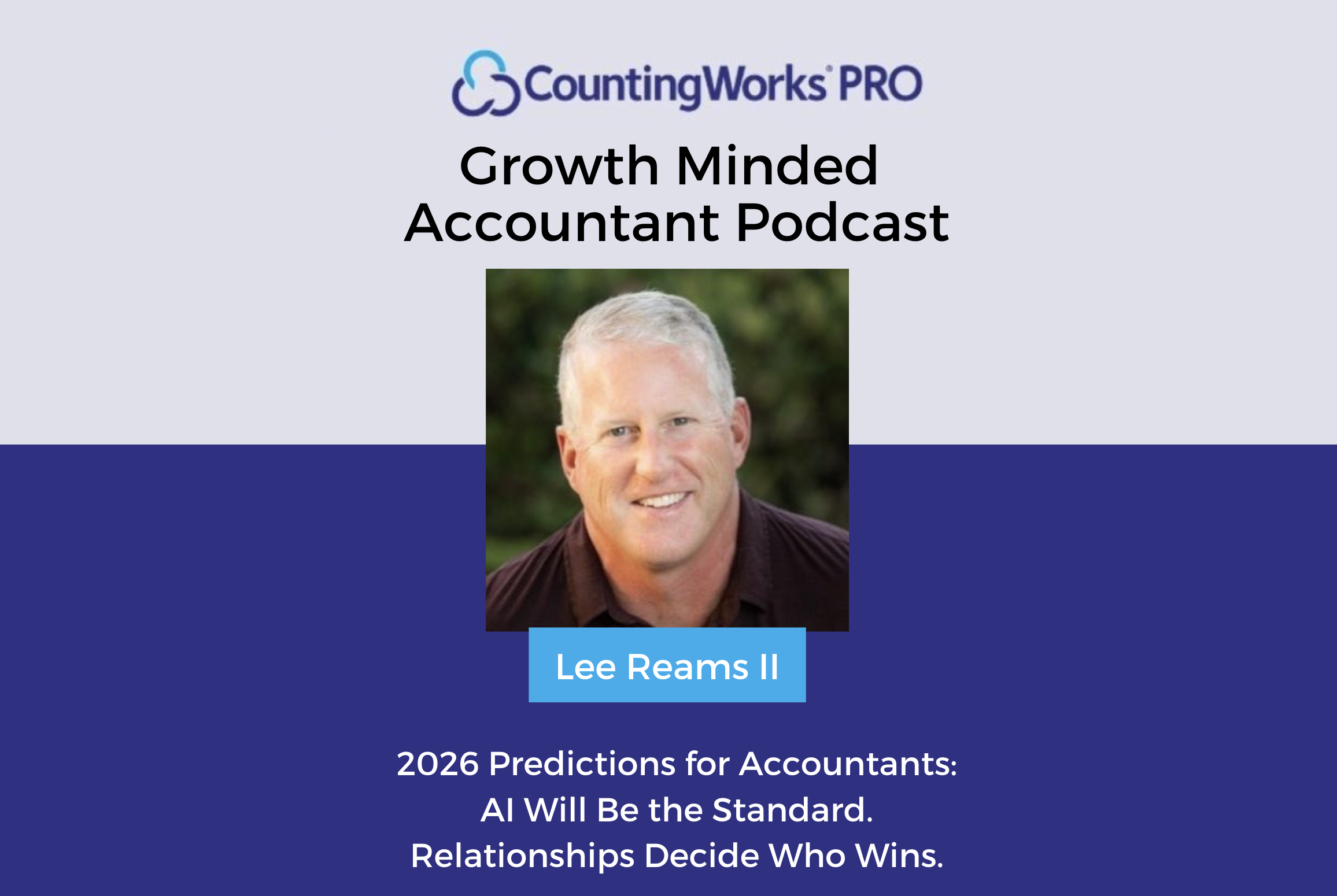
Artificial intelligence is no longer the future of accounting—it's becoming the baseline.
In this episode of the Growth Minded Accountant Podcast, Lee Reams II shares his outlook for the accounting profession in 2026 and beyond. Rather than focusing on headlines predicting the end of accounting, Lee explains why AI will become standard across the profession while human relationships become the true competitive advantage.
Drawing from a Forbes article he wrote in 2016 about AI and cloud accounting, Lee revisits many of those early predictions and explains how they're unfolding today. He also explores why advisory services are expanding beyond high-net-worth clients, how automation is changing the economics of firms, and why trust will become increasingly valuable as technical knowledge becomes widely accessible.
If you're preparing your firm for the next generation of AI, advisory, and client expectations, this episode provides a practical framework for thinking beyond technology and building long-term competitive advantages.
Get Your Free Firm Growth Breakdown
We know that everyone digests information differently. That’s why we’re now sharing the full transcript of each episode of The Growth Minded Accountant right here on the CountingWorks PRO blog. Whether you’re short on time, like to scan and highlight, or simply prefer reading over listening, you can catch up on every conversation at your own pace.
Each week, we cover topics that matter most to tax and accounting professionals—from AI and automation to marketing strategies, firm growth, and client relationships. Scroll down to read the full episode, or subscribe to the podcast to listen on the go.
Lee Reams II
podcast where our experts will share best practices on running your firm in the digital age. This podcast is brought to you by CountingWorks PRO. Let's get started. Growth Minded Accountant Podcast. My name is Lee Reams II. I'm the founder and CEO of CountingWorks and your host. Today we're going to do something a little different than our usual episodes. Don't get too upset. I am the only person who's going to be presenting, just me. And since it's end of the year, I wanted to do one final episode. I know the last episode I said I was done for the year, but I wanted to step back and talk honestly about where I think the industry is going, what's happening next year and in the future. So, not just repeating headlines, you know, fear mongering, you know, what the experts are saying at CNBC, uh, but I want to actually see what we're experiencing on the ground. So, if you've been paying attention, there's no shortage of predictions right now. You know, AI is replacing accountants. Tax prep is dead, right? If you don't adopt everything right now, you're already behind. And look, some of this is very true, but a lot of this I would say is somewhat incomplete. So, I I found very interesting. I wrote in October, and I actually just pulled this up, October of 2016 an article titled, "Will artificial intelligence and cloud accounting replace the accountants of tomorrow?" Uh, and I'm not saying I was right on everything, but I cannot believe if you read this article, and I'll include it in the description here, uh, I'm not a fortune teller, but a lot of this played out pretty closely to what I thought, and it's just because of experience and kind of seeing, you know, hype cycles and what happens. But I thought there was an expert excerpt that I'm going to read that I thought was interesting and I'm going to lead into my discussion today. So I'm going to have a bunch of different kind of predictions, things you can debate, uh things you can embrace or where you can, you know, say no way, but you know, let's just get into this. So in 2016, I wrote that consider the important role that the accountant of tomorrow will play just by being willing to embrace cloud accounting and value pricing with open arms. In this not too distant future, businesses will be able to afford powerful CFO advice without the cost of a full-time employee. All of those menial time-consuming tasks that used to eat up hours of a day will be gone. A victim or virtue, depending on your perspective, of the automation process. So, this doesn't eliminate the need for accountants, but rather empowers them. It frees up time in their day to work with clients in a more effective way. And I can't tell you how much that resonates today. I could probably just repeat and republish the article and it would actually almost be completely accurate but the reality is advisory the big theme that we're going to talk about AI um moving accountants from menial task to real value added things are really important so uh what we're going to do here is we're going to talk about not hype uh not fear I'm not here to I I actually really bullish on our profession but patterns okay specifically what I believe will happen starting in 2026 AI will be the standard um it's already there where the tools we're developing the tools that I use every day I think are you know it's going to be like second nature right but the relationships will be the thing that decides which firms actually win so think about this if technology becomes so and knowledge becomes so much commoditized meaning almost anyone can access it it's going to be your mode is really your client relationships do they trust you do you have years of experience do you know them inside and out that is going to be the big deal So I broke this into segments. So we're going to go through them. Segment one is what I called the AI misread. Uh so this is the first thing I want to talk about because I think it's very important in 2026. Not using AI will be a problem. Oh, surprise surprise, right? You've been hearing that. But using AI won't be impressive. Okay, that's the part I think the media gets wrong. Everyone is framing this as AI versus humans or AI versus firms. And I don't believe that's actually the way this will play out in professional services. I think what actually will happen is AI becomes what I'll call table stakes. Everyone gets access to similar tools, right? If you're not penny pinching, you're actually using these tools that are saving you huge amounts of labor. Everyone starts automating. Okay? Everyone starts sounding smart. Knowledge, raw expertise starts to become cheap. Okay? And when that happens, the value starts shifting. So clients will assume you have the right answers. Okay, they'll assume your software is competent. They'll assume your workflows are modern. They're used to an Apple, you know, kind of experience. Uh but they won't assume is that you uh understand them and that's the gap that matters. And I think that's where I'm getting about this relationship and the and the mode side. So, you know, when knowledge gets cheap, trust gets expensive. Okay? And what do I mean by that? So, every time technology makes something easier, something else becomes more valuable. So when tax software got better, planning started to matter more. Right? When filing became digital, experience mattered more. When answers became instant, trust mattered more. So AI is accelerating the same shift. So in 2026, clients won't be impressed that you can produce a return quickly. Okay? That's going to be expected, right? They'll be impressed that you understand their business, their goals, uh, and their trade-offs. Right? Now you're starting to dig much deeper into the numbers versus just doing a historical compliance review. You're actually starting to proactively start recommending things, right? So this is where relationships stop being a soft skill and they start being a competitive advantage. And I think this is the big thing in a lot of firms who are still stuck in that cookie cutter world, commodity world. I, you know, I don't position my firm. I don't position myself in a niche. I don't have my own copy that different from anyone else. I just look like every other CPA or enrolled agent, right? So, this is where relationships stop being a soft skill and start being a hard competitive advantage. So, the firms that win won't feel like vendors, okay? They're going to feel like partners. And I think that resonates with most of you with your relationships with your current client base, a lot of them consider you friends. They trust you intimately, right? They'll the pros that are going to be successful. Think about that. They're going to communicate year round. They'll anticipate questions because they're using AI that's analyzing the data. their clients of being able to proactively say, "Hey, you should be doing X based on these trends." Okay? They'll proactively guide clients instead of reacting once a year. So, that's not old school. That's the future. I think that's the now. So, what will happen here is advisory starts moving down market. I've been talking about this a lot with different blog content that I've done. Um, we've talked about this in the Growth Minded accountant, but there's another myth that needs to die. And I think that advisory is only for high netw worth clients or sophisticated businesses. I disagree specifically with the complexity of the tax code. But just think about all the life events that everyone goes through. Instead of just looking at your business as a one time a year consultation, think about this as a lifetime relationship. How can I enable my clients to understand what the time value of money is? How I can teach them to save for clients or college educations, right? How can I get them to understand if I start investing when my child is born again grandparents we could build a significant nest egg that's if social security is gone it doesn't matter right so that advisory um is is used to be what I would say uh was the delivery of that was expensive okay uh but I don't think that is true anymore so that's why I said you know people think oh I only can do it with high-end businesses I only could do it with my high net worth individuals but with technology and AI I don't think that is true So the AI lowers the cost of delivery of these type of advisory services. So and automation increases the leverage meaning I can work with more clients because I'm freeing up my time on onboarding, you know, tracking uh documents, right? So AI lowers the cost of delivery. Automation increases your leverage which means guidance becomes accessible for many more people. So in 2026, the fastest growing firms will be the ones that expand advisory down market, not just up market. There's only so many high net worth people, right? And you hear that all the time where people are pushing advisory advisory CFO advisory and you charge two $3,000 a month. There's only so many clients that fit that need. Uh there's a whole new market that you could do like a junior version, a base level uh that's not in the up market and you could do really really well because technology will enable you to do a lot of these uh calculations and strategies very quickly. So um not complex strategies for everybody but clarity. Okay. So, helping clients understand what decisions matter. Okay. What trade-offs they're making, what's coming next, right? So, advisory doesn't replace tax prep. It wraps around it. And the firms that don't make that shift will get squeezed. I believe they'll get squeezed on price. They'll get squeezed on experience and eventually on relevance. Uh, and I think the beauty of the the new opportunities is almost anyone can stand up a really elegantlook firm very quickly nowadays. and actually start getting referrals from ChatGPT and other tools, social media without having to work 20, 30 years. And what happens too is some of these firms that are 20, 30 years old, their clients are all set in the hourly billing rates, right? Or they're used to paying X dollars. So anyone who's start trying to move the needle with them actually has a harder time than someone that's new that's just trying to, you know, reinvent how tax and accounting services and advisory is uh is delivered. So definitely something to think about. Segment four here is AI doesn't replace you, it frees you up. Um I I know the hype machines and Elon and everyone is basically saying uh Palunteer there's a lot of people um you know all programmers are going to be gone and yeah is there pressure? Yes. Um but you'll be able to do things and create new tasks, new value that wasn't there before. So yes, will certain things disappear? I 100% agree that that will be replaced. Um, but on the top of that, it opens up all these new windows and I think that's where the opportunity is. So, this is where I think the hype goes too far. In the near term, AI won't be the best at fully automated decision-making. I say a rule 95% accurate in accounting is still 100% wrong. Uh, running firms without humans. I don't believe it. Even you'll need assurance that an a bot that's running stuff is accurate as well, right? Uh, you know, who's going to do that? There has to be humans in the loop, right? So, I don't think you're going to replace all this professional judgment is where I'm getting at. So, AI will be incredible in freeing up your time and your staff's time. So, tasks like onboarding, data organization, OCR, scraping of data, financial statements, tax returns, whatever. Uh, and then being able to analyze this and do intelligent recommendations based on it, summaries of uh documents that are sent in, drafts of emails, right? follow-ups, automated follow-ups. You're missing information. You haven't responded. So, the invisible, what I'll call busy work that eats your week, you know, every week, and you may even have staff that's doing this, right? But you're still paying labor. You know, think about it. AI costs a fraction of what this labor costs, right? So, the firms that win will be the firms that reinvest that time wisely, not into more volume, but in better client relationships. Okay? And that's how AI turns you into a superhuman, not by replacing you, but by removing friction, which leads into kind of the big fish and what's happening uh in the tech world, I would say. Uh I'm going to talk specifically about in it, but you can have there's all kinds of pressure. There's new competitors coming in. Uh platform pressure, I'll call it apps. You got private equity. Private equity learned a a lesson last year, right? They learned, "Oh, we're rolling up and we're taking all the relationships out of it. We're going to automate it. We're going to make this a machine." And then they realize, whoa, staff leaves, clients leave, they don't feel valued anymore. They don't feel recognized anymore. Um, I think that's a big deal. And that goes back to my whole moat item about your client relationships, right? So, let's talk about in it. Uh, because I think that's where your pressure will show up first. And that's with the AI technology. They just did a hundred million dollar deal with OpenAI. If you're checking how QuickBooks is working and reconciling and bringing in like Plaid, bringing in accounts where accountants used to do a lot of this reconciliation. Um, I think QuickBooks isn't just evolving visually, it's changing who does the work. Okay, so reconciliation is increasingly automated. Bank feeds are real time. Uh, Plaid style connections organize uh data automatically. Uh, rules learn faster than staff. uh and and this isn't into it replacing accountants outright but it's more subtle. Okay. So they're absorbing the work that used to you used to justify your hours and your headcount into the platform itself. Right? So which means that if your value is data entry cleanup work historical report reporting I think you're going to be 100% exposed. Okay. So if your value is interpretation advisory right planning and trust you're protected. So software software can reconcile transactions. Uh it can't sit across the table and say hey this is what this means for your life. Um and this is where the really human side of how I think the profession is going. So definitely something to think about. Uh and even when you choose your vendors be be careful out there. Right. Uh I think there's another issue that I don't feel most absorb. Uh those on the hype machine they're raising money. You know, there's a reason Elon's out there telling people or Nvidia or whoever they need data centers built. They need to use water, right? They need electricity. Power rates are going up, but they're selling something. Okay? But I do believe just like anything, this is a monumental shift in the way the world will work. We all agree or I at least agree. Maybe not all of you agree. U but I think it's going to move slower than people think. And I'm I this might be contrarian to you know the influencers and the CNBC experts but you know despite all this noise I actually think adoption will be slower than headlines suggest. I see this personally in the tax and accounting space. It's taken us years to get pros to start trusting just even basic AI tools. And it's not because AI isn't powerful but change takes time. Okay. So a lot of firms still haven't touched it. Uh, I know there's companies that won't touch it at all. Big, huge, publicly traded companies. They're like, I don't know what to do with this. I think they're going to get uh, you know, circles around them. But a lot of professionals also don't understand it yet. They don't trust it. Uh, a lot of clients don't demand it yet, right? Uh, but once they see it and experience it, game over. Okay? So, there's a lag between awareness and action. And that lag, I believe, is the opportunity. So the firms that start now without panic with a plan that quietly uh build in their infrastructure their systems their platforms uh that quietly will compound not overnight but sustainability uh over time. So I think that is the biggest thing people need to consider. It's not where you have to change everything you're doing right now. Compliance is not going to disappear in the next 3 months but you're going to start seeing the differences. You're going to see differences in the way clients refer you, how people ask questions to chat GBT first if you're not communicating ongoing with your clients. And you know, my greatest thing that I always hear is, "I don't need to market. I'm so busy." Well, most likely you have a really bad uh, you know, client profile segments that you have clients all over the place. You're just doing a lot of busy work. You didn't think about how to grow your firm sustainably. Those things will change and you're going to start seeing uh, winners and losers. And we're seeing it already. We're seeing firms that are retiring because they can't handle the technology. Uh we're seeing firms that are dying and not getting enough work. And then at the same time, I have firms that are saying, "Oh, I just walked away from $34,000 of, you know, client work because they didn't fit my profile." Okay? So, that's the real divide that you're going to see in 2026. So, it's not AI versus nonI. It's not big firms versus small firms, though I would argue that small firms now are more empowered than ever. It's not humans versus machines. It's this. If firms that treat AI as the standard and relationships as a differentiator versus firms that hope the old model holds, it's not. Uh knowledge is becoming cheap. Okay? Trust is not. So the firms that win won't just automate more. They'll connect better with their clients. Okay? And that's what I wanted to leave you with as we close out this year. Uh this is it. Our last episode 2026. I already have planned a great lineup. I actually have all of January already planned. So, super exciting things that are really going to move the needle for you. So, I hope this episode has helped you think a little bit differently about where to focus um and get really, you know, get ready uh to get busy in 2026. I think it's a very good time to be a tax and accounting firm. Your practices are more valuable than ever because of private equity moving in. AI is going to make you be superhuman. you're now able to move into advisory much more lucrative versus you know the your window is no longer closed in the amount of money you can make. You're not stuck now with uh you know my hourly rate. Um and if you do the the practice mix correctly I think you're going to be really successful. So thank you for listening and hope to see you in 2026 again. Thank you.
Why does Lee say AI will become the standard?
As AI tools become widely available across the profession, clients will increasingly expect firms to use them efficiently. Competitive advantage will come from how firms apply AI, not simply whether they have access to it.
Will AI replace accountants?
Lee argues that AI will automate repetitive work and increase efficiency, but human judgment, trust, interpretation, and client relationships will continue to differentiate successful firms.
Why are relationships becoming more valuable?
As knowledge becomes easier to access through AI, clients place greater value on advisors who understand their personal circumstances, goals, and long-term financial decisions.
Why is advisory expanding downmarket?
Automation reduces the cost of delivering advisory services, allowing firms to provide meaningful guidance to a much broader range of clients instead of focusing only on high-net-worth individuals.
How should firms prepare for 2026?
Invest in AI thoughtfully, improve client experience, strengthen relationships, develop advisory services, and build systems that allow technology and human expertise to complement one another.
Why does Lee reference his 2016 Forbes article?
The article demonstrates that many long-term trends—including AI-assisted accounting, cloud technology, and advisory growth—have developed gradually over time rather than through sudden disruption.
Listen to other podcast episodes or read other related blog articles with relevant information and insights.