The quiet after April 15 can be misleading.
For many tax and accounting professionals, busy season ends with exhaustion, burnout, and a desire to move on as quickly as possible. But the weeks immediately following tax season may be the most valuable strategic planning opportunity your firm will have all year.
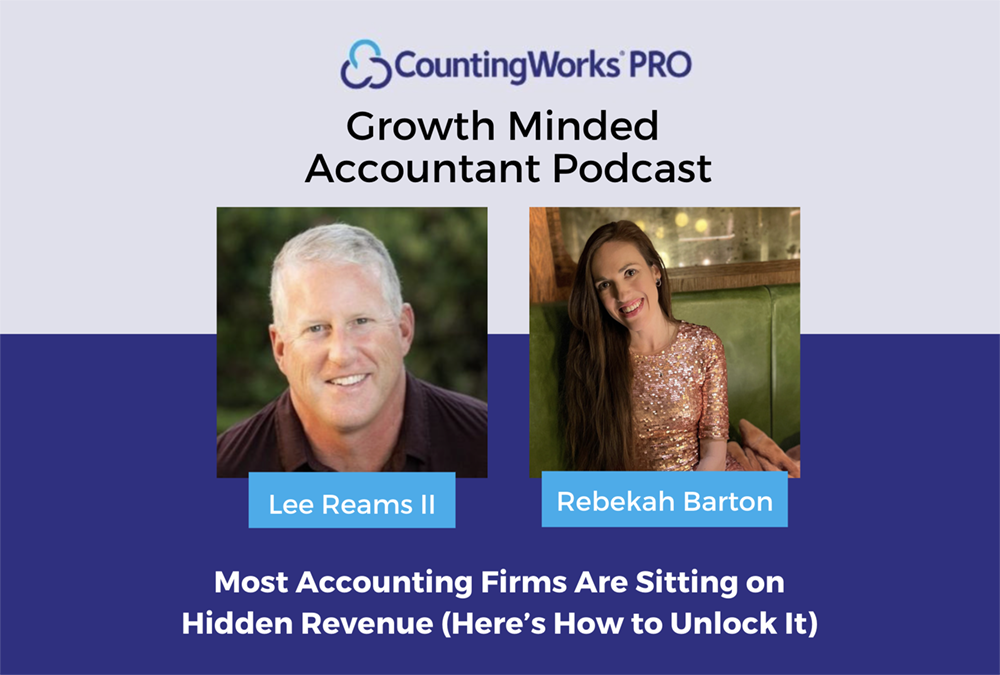
In this episode of The Growth Minded Accountant, Lee Reams II and Rebekah Winters Barton explain why the period immediately after tax season contains critical operational insights that can help accounting firms, CPA firms, enrolled agents, bookkeepers, and advisory-focused practices improve efficiency, reduce burnout, increase profitability, and build a better firm before next busy season arrives.
Rather than treating burnout as something to simply recover from, Lee and Rebekah walk through a practical post-tax-season exercise designed to identify bottlenecks, uncover advisory opportunities, improve client experience, strengthen positioning, and create systems that save time and reduce stress.
If you're a CPA, tax professional, enrolled agent, bookkeeper, or accounting firm owner looking to improve operations, increase advisory revenue, reduce stress, and build a more scalable practice, this episode provides a practical framework for turning tax-season frustrations into meaningful business improvements.
The firms that improve the fastest aren't necessarily the firms working the hardest.
They're the firms that learn from what just happened.
Discover where operational friction, advisory opportunities, visibility gaps, client experience issues, and growth bottlenecks may be limiting your firm.
Get your free assessment here:
https://www.countingworkspro.com/start
Thanks for listening to The Growth Minded Accountant, the podcast for growth-minded accountants, tax professionals, CPA firms, and advisory-focused firm leaders.
We know that everyone digests information differently. That’s why we’re now sharing the full transcript of each episode of The Growth Minded Accountant right here on the CountingWorks PRO blog. Whether you’re short on time, like to scan and highlight, or simply prefer reading over listening, you can catch up on every conversation at your own pace.
Each week, we cover topics that matter most to tax and accounting professionals—from AI and automation to marketing strategies, firm growth, and client relationships. Scroll down to read the full episode, or subscribe to the podcast to listen on the go.
Lee Reams:
Welcome back to another episode of the Growth Minded Accountant podcast. My name is Lee Reams. I'm the founder and CEO of CountingWorks. Today, I'm joined by Rebekah Winters Barton, our Chief Visibility Officer. Rebekah, if you can say hello.
Rebekah Winters Barton:
Hey, everybody. Happy April Fool's Day.
Lee Reams:
Oh, it's going to be a happy April Fool's Day. I'm already thinking about how many times I could have gotten nailed. Every Slack message since I started work at 5 a.m. this morning, I've been very careful. I'm like, okay, be on guard.
Lee Reams:
As we get closer to April 15, things get quiet. All of a sudden, there's a pause. You take a few days off. That quiet can be dangerous because right now, unless you're superhuman, you're probably exhausted. Your team is exhausted, and your brain is telling you to just move on.
Lee Reams:
But here's the reality. We've seen a bunch of different studies. FloQast came out with something saying that 99% of accountants experience some level of burnout. If you've been on LinkedIn or Reddit, I'm going to say it's 100% of accountants experiencing some level of burnout. The reality is that three out of four accountants are dealing with burnout coming out of busy tax season. Whether you believe 99% or 75%, it is there. It is real. You're feeling it, and that's not just you. It's the profession. It's our industry.
Lee Reams:
That's where most firms miss the opportunity. This is the moment when your firm or your practice is sitting on some of the most valuable data it will produce all year. If you capture it now and analyze it instead of simply resting, recharging, and getting ready to go back on the same hamster loop as last year, hopefully you won't repeat some of the same problems.
Lee Reams:
I'm going to start here: most firms don't have a discipline problem. They have a timing problem. Right now, you're in the middle of the end of tax season. You remember what broke. It's fresh in your mind. You remember which clients asked the same questions over and over again and where you had to keep responding. You remember where the stress hit. You remember where you became the bottleneck, such as approving every proposal. You realize that people aren't doing engagement letters like they're supposed to because you don't have an automated system. You also remember that some clients created complete chaos for you.
Lee Reams:
But in two weeks, maybe you go away for a little while, have a couple margaritas, come back rested, and forget. Time does that. That's how firms, specifically in the tax and accounting space, get stuck. These are firms that don't like change and may feel risk at times. They get stuck not because they don't care, but because they waited too long and missed the opportunity.
Lee Reams:
I also believe there is another challenge that is making things break more often, and that is the labor shortage. This isn't getting any easier. The demand for services in tax and accounting, even with AI and disruption, is going up. A recent survey said 87% of firms say talent shortage is their biggest challenge right now. Demand is rising, capacity is shrinking, and that means what you just experienced is likely the easiest version of tax season you're going to have going forward. In other words, it's only going to get harder.
Lee Reams:
At the same time, client expectations are rising. I think you see that as well, Rebekah, even in website creation and the way we're doing branding for our clients. We're basically an ad agency now for tax and accounting firms. In the old days, you put together a cookie-cutter site, put it out there, and did business as usual. Now, your word-of-mouth referrals may be going to ChatGPT. If you're not targeting an existing audience, you may not be mentioned in SEO or GEO anymore. There are a lot of things that have changed, and firms need to start reacting to them. Can you give a few examples before I get into this exercise?
Rebekah Winters Barton:
Yes. It's a major shift, even from a couple of years ago, as AI has become increasingly important and gained market share within search. We want to tell stories. We want to put narrative out there. We're niching down in a way I don't think many tax and accounting firms were before.
Rebekah Winters Barton:
The more I talk to people recently, especially over the past six to 12 months, the more they want to choose a niche, even if they never have before. They're starting to understand the importance of offering hyper-niche services where they can provide great value to people within specific demographics or industries.
Rebekah Winters Barton:
That's been a massive shift from what I'm seeing on the marketing and branding side, along with not having cookie-cutter websites anymore. We don't want the same terminology everyone else is using. Telling your story matters. GEO engines, including ChatGPT, Perplexity, Gemini, and other generative search systems, want to know who you are. They don't care if you do taxes well. Everybody says they do taxes well. They want to know that you do taxes for small retail business owners who make less than $10 million a year. Having that kind of specific language has been a big shift from the marketing and branding end of things.
Lee Reams:
The reset isn't just that ChatGPT wants that. Your customer wants that. Your prospect wants that. They want to connect with you. They want to see that you know their vertical. They want to know that you can sit in their shoes and understand them. I think that's the big takeaway here.
Lee Reams:
Let's go through a quick exercise. If you're at your desk, take some notes. Write this down. Over the next five minutes or so, we're going to talk about the steps you need to take to do what we'll call a pain audit.
Lee Reams:
We'll go step by step through the exercise I would suggest you do. You can go to a tool like Max Intelligence and say, 'I want to audit the last tax season. Here are all the questions. What would you do?' It will walk you through the same kind of audit. I didn't create a download for this, but I did a mental exercise.
Lee Reams:
Start by asking: what were the three to five moments this tax season where you thought, 'This cannot happen again. I do not want to repeat this'? Pause there, and don't generalize. Be specific. Think about the client who delayed everything, the process that broke, chasing documents from clients, clients no-showing appointments, or the point in tax season when your team hit a wall. Was that March 7? Let all of that come up. Write it down and start looking at it.
Lee Reams:
Then look at those moments and ask what repeated, not just once, but over and over again. Maybe there were common questions inside your client hub or email. Maybe the same questions were about tips or overtime. Maybe there were the same delays because you didn't have a system in place to respond with the research and get things done quickly. Maybe there was the same confusion. That's not random. That's your system and your processes talking to you. That's feedback.
Lee Reams:
The next question is: where are the bottlenecks? Often in smaller firms, it is the main partner. Did you become the bottleneck? Were you approving every proposal? Were you reviewing every email? Were decisions waiting for your judgment? Were client responses slow because you had to approve them? Where was your team waiting on you? Growth stops wherever you slow things down.
Lee Reams:
This is more appropriate for smaller firms. A lot of firms now are doing pod formats, where they have smaller, more agile teams. But there's a lot you can learn just by looking at this.
Lee Reams:
The next question is: where did you give advice that didn't get charged properly? This is scope creep. We talked about this in a previous podcast a couple months ago, and it is a big deal. Surveys say it could be 20% of revenue lost because firms didn't charge correctly, didn't have the proper engagement letter, or didn't have the details in the proposal. What are you responsible for? What is the firm responsible for? If work goes out of scope, what do you charge?
Lee Reams:
Think about those quick questions, last-minute calls, extra guidance, or advisory consulting without an advisory agreement. That's not admin work. That is true revenue potential. We see this commonly in bookkeeping or accounting clients moving into CFO advisory. You may be planning for an exit, and most firms simply miss the revenue opportunity.
Lee Reams:
Now look at this: if you could fix just one of those things, which one would make the biggest difference? Let's say you had a tool like Max Intelligence write a pre-written, pre-researched response to every client hub message. When you came in in the morning, all 10 of those messages in your client hub had already been researched, cited, and referenced. It included the research, the answer, and a strategy. Would that by itself make a big difference in time? Would it save time, improve responsiveness to clients, and improve the quality of your advice?
Lee Reams:
We don't have to fix everything. Let's start fixing one thing at a time. If you could fix one thing and save dozens of hours per week, that sounds pretty good. Would it reduce stress across your team? Probably. Would it completely change next season? Yes. It opens you up for more advisory, maybe earlier evenings, and going home at a reasonable time.
Lee Reams:
Once you go through this, you'll probably notice something. Your problems aren't random. They point directly to your biggest opportunities.
Lee Reams:
Now I'm going to talk about what I believe are the biggest opportunities. I consider three of them to be low-hanging fruit. I know there's a lot of noise and people are telling you that you have to revamp everything and go all in with new, bulky software. I'm saying maybe you don't need to do that much. Maybe there are just a few things you can look at that really move the needle.
Lee Reams:
The first opportunity, and we already glanced at it, is to fix your positioning. I think this is really important for setting expectations for you and your clients. It helps you attract the right kind of clients, the people you actually want to work with. I think that makes the firm more profitable. It may not mean more volume; it may mean better alignment.
Lee Reams:
We're seeing this across the industry. Firms with clear positioning attract better clients. We see it in our own client base. There's no question in my mind that positioned firms attract better clients, charge more, have waiting lists, and experience less friction. They have set expectations. They don't have as many bottlenecks. Clients know, 'I need to get my documents to you. I know these are the deadlines. This is my responsibility. We're partners.' But you have to articulate that through your marketing and messaging.
Lee Reams:
I often hear accountants say, 'I don't do marketing. I don't need marketing.' Everything you communicate is marketing. Think about this: who were your five best clients this season? Who were the easiest to work with and perhaps had the best ROI? Who did you value and enjoy working with? Who valued your expertise? Who didn't push back on your fees? That's not random. That's your signal.
Lee Reams:
This is where you can start understanding that visibility today isn't just about ranking. It's about resonance. Let's talk about that a little bit, Rebekah. When I talk about setting expectations, let's go through a client's website and talk about how we work, how we put that messaging into a narrative format, and how that helps establish the rules of the road.
Rebekah Winters Barton:
From the start, your website is your calling card. It's going to tell people exactly who you are, exactly what you do, and exactly what they can expect from you. In today's world, you have a real opportunity on your website to establish a baseline for what your target audience can expect from you.
Rebekah Winters Barton:
It's also a great way for people to self-qualify. One of the things we hear a lot is that firms are getting calls from clients they don't want to work with. Having a really clear narrative is a great way to help people self-select. If you say, 'I only work with pediatricians who live in the Birmingham, Alabama area,' anyone who is not a pediatrician in Central Alabama is not going to be likely to call you. You won't have to field so many calls from people you don't want to work with. That frees up time in and of itself and reduces your stress level.
Rebekah Winters Barton:
When we go through website styles, we always tell people that the site should answer: who are you, what do you do, who trusts you, and how can I get in touch with you? You want the hero section, the top portion of your website, to establish right away who you serve and what you offer.
Rebekah Winters Barton:
From there, you want people to scroll down. They should be hooked. Show them the services you offer, whether that's tax preparation and planning, bookkeeping, or virtual CFO. Your homepage should take people on a journey of what they can expect when they work with you, not what they can expect when they work with a generic tax and accounting firm. Everything should be customized and personalized to exactly what you do.
Rebekah Winters Barton:
This is a great way to help clients understand what to expect. Like you were saying, Lee, proper positioning bleeds over into tax season because you won't be answering so many random questions. People will understand what they need to do and what you need to do. You're setting the baseline early, literally from day one, from the time they visit your website, about what you do, who you are, and what they need to do during the process. Everything on your website is crucial to establishing your position in the market and exactly who you serve.
Lee Reams:
That leads into the next big opportunity, which is advisory. This is also narrative. What we've been doing is putting what I'll call autopilot in place. We call them playbooks, but they are upsell campaigns related to a specific type of advisory service. That might be taking tax preparation to tax advisory, taking a bookkeeping or accounting client to CFO advisory, or maybe capital advisory, such as what type of lending tools should be used.
Lee Reams:
We've created a system, and this is low-hanging fruit. If you do not have a system in place where you're educating clients on the value of advisory, that is something I think a lot of people miss. Rebekah mentioned that many firms list their services, but they don't talk about the client's pain point, dream, desired outcome, or financial outcome.
Lee Reams:
If you can capture that in a story, a blog, social media, and outbound emails, and make that part of your process automatically year-round, now you have a system in place that will generate more advisory services. These are more lucrative services, they help your clients more, and they create better financial outcomes. Rebekah, explain what that process looks like, how often we set those up, and some of the results we've heard from clients who call and ask, 'Why is everyone calling me about advisory services?' Because we turned the playbook on, sir.
Rebekah Winters Barton:
Yes, these do work. That's a great example. We had a client who said, 'Wow, I've been getting so many calls for advisory,' and he had forgotten that on a marketing call, his upsell playbook for advisory services was turned on. But it works.
Rebekah Winters Barton:
When we create a playbook, we think through the drip campaign process and what will hook people. You can customize it within our system or whatever system you're using. When you're doing this, you want to take the client on a journey. You want them to be able to put themselves into the story you're telling.
Rebekah Winters Barton:
You want to address the pain points you've been hearing from clients during tax meetings this year. Take that information and put it into the emails you're sending out. Put it into the social media posts you're sending out. If that's what you've been hearing, those are the types of things that will resonate with upsell clients and with the people you're trying to reach to move into higher packages.
Rebekah Winters Barton:
For instance, we were talking about pediatricians and medical professionals a few minutes ago. Perhaps there's a pain point they are having repeatedly. Maybe it has to do with payroll or managing staff members and payroll taxes. If you've heard that several times, you could start addressing it in an ad campaign or social media campaign. You could start doing YouTube videos about it.
Rebekah Winters Barton:
The more you address these pain points across different channels, not only will you resonate with your viewers and followers, but you'll also resonate with the internet. Search algorithms will start recognizing you as an expert in this space. They'll start recommending your firm as people search, and that's how you get growth and reach beyond just your existing clientele. You can really start growing within your niche.
Lee Reams:
We're going to continue on. Opportunity number two is capturing advisory revenue. We talked about how to preload and seed your environment so people know you do advisory and understand the benefit of it. More importantly, we're working on tools that allow us to find these opportunities within your database.
Lee Reams:
I'll give you an example. I want you to understand that with AI and chatbots specifically, I see some people using public tools. I would not put your client data into the public GEO world of chatbots. I would use a closed system.
Lee Reams:
What we do is scrape data, such as tax returns, uploads, and correspondence, and build context in a memory that can be reviewed by our AI tool. We call it Max Intelligence, and Max will look at clients and surface advisory opportunities. Perhaps someone just had children, so let's talk about 529 plans or some sort of college savings plan. Maybe someone just started a business. There are all kinds of things we can do.
Lee Reams:
There are signals inside your client base that happen every day. You just don't necessarily have a system that tracks them. You don't follow up. You don't systemize it. That is the beauty of where technology is going. That is real value.
Lee Reams:
Firms that use tools like Max Intelligence can identify those moments and trigger automated follow-ups. Perhaps a proposal goes out that says, 'Here is what I suggest.' It could even draft the email and say, 'Congratulations on the birth of your child. One of the biggest things I see is that many people don't start early enough on education planning or involving grandparents. Is this something you would like to talk about?'
Lee Reams:
You can deliver these insights automatically. When a system is in place, that is a huge opportunity. That's where you may grow revenue 15% a year, perhaps more. If you take a bookkeeping client to $2,000 a month, now they're worth $24,000. If you get five clients to upgrade because you've been doing proactive outreach, finding opportunities, and personalizing them at scale, that's a big deal.
Lee Reams:
That is another post-tax-season opportunity I really think you should look at. It's not necessarily about doing more work. It's about not letting opportunities slip by.
Lee Reams:
That leads me to my last opportunity, and I think this is one everyone can relate to during tax season. One of the biggest constraints in your firm today is not necessarily demand. It's your time.
Lee Reams:
When we revamped CountingWorks from the ground up, I was creating all these tools. What I realized is that I was sometimes making more work for accountants instead of having everything work in the background and then come to the accountant with, 'Okay, what do you want to do now?' Instead of the proposal being made because the system found an opportunity, I had the professional go create the proposal. That creates friction. It creates more steps, more inputs for the tax and accounting pro, and more dependence on you.
Lee Reams:
The shift I'm seeing now, and what we're doing in our own system, is to look for a platform that removes work rather than adds to it. That's what AI enables. It can look at huge amounts of data and big, trusted knowledge bases to help you do your job better. It's not a replacement. It's relief.
Lee Reams:
I think this is a big deal, and there will be big opportunities. One thing I would caution everyone about is that there are big, bulky practice management systems built years ago that are adding little AI tools, but they are not AI native. What I have found is that those tools are part of the problem. They create more work and more places for things to get lost. Think about that before you make decisions about what you're going to do.
Lee Reams:
I just gave you three opportunities that I think are game changers and can move the needle. These are not huge, 'I have to change everything' decisions. But doing nothing is not neutral anymore. It's a decision. Do you want to repeat the same stress, the same hours, and the same problems?
Lee Reams:
Here's something you may not think about: your competitors who are making changes are going to be more efficient. They are going to serve their client base better. At some point, that will start eroding your business.
Lee Reams:
Your client relationship is your moat. Private equity companies are coming in and trying to commoditize accounting. They're realizing there are real client relationships here. People don't necessarily like some nameless accountant doing the work. You don't want to be that firm. You want to maintain that relationship. You want to maintain that moat. You want to be the most trusted advisor for a reason.
Lee Reams:
We don't want you to just survive tax season. We want you to thrive. That's the basis of this episode. I wanted to circle back and say: take stock. What worked? What didn't? What are a few little things you can do? Create a list. Go into ChatGPT or another tool and list all the challenges you had. Ask it what it would do to systemize them. Ask what processes it would put in place. That is how you'll grow and succeed after tax season.
Lee Reams:
Take about an hour. It might not even take that. Then bring your team in. Get them to give their own guidance. They may see things you don't. They have their own relationships. You might see different holes, and they might say, 'You have no idea what's going on or how we're rubber-banding all this together.' I think that's really important.
Lee Reams:
From there, fix one thing. Then go fix the second thing. I think you'll be much better positioned in the future. Tax season already gave you the answers. Let's make sure exhaustion does not erase them.
Lee Reams:
That is it for this episode. This is going to be our last tax-season podcast. Rebekah and I are both taking next week off for spring break. Quite honestly, this is the beginning before heavy education and thought leadership podcasts. We have a ton of stuff coming after tax season. That is when we are the busiest.
Lee Reams:
We hope you've had a very successful tax season. Hang in there. You're almost there. We look forward to re-engaging with you after April 15. Again, thanks for being a subscriber and listener to the Growth Minded Accountant podcast. Until next time, enjoy the final push. Thank you.
Q: What is a "Pain Audit" and why should accounting firms conduct one after tax season?
A: A Pain Audit is a structured review of the moments, processes, client interactions, and bottlenecks that created the most stress during busy season. Conducting it while those experiences are still fresh helps firms identify patterns and prevent the same problems from repeating next year.
Q: Why do so many accounting firms repeat the same busy-season problems every year?
A: Many firms wait too long to evaluate what happened. Once tax season ends, owners often focus on recovery and move on before documenting lessons learned, causing recurring issues to remain unresolved.
Q: How can firm owners identify whether they are the bottleneck?
A: Look for areas where approvals, decisions, proposals, reviews, or client responses cannot move forward without your involvement. If work consistently stalls waiting for you, that process likely needs to be redesigned.
Q: What is scope creep and how does it impact profitability?
A: Scope creep occurs when firms provide services, advice, or support beyond the original engagement without charging appropriately. Over time, these unpaid advisory conversations can represent a significant loss of potential revenue.
Q: How does positioning help reduce burnout?
A: Strong positioning attracts clients who are a better fit for your expertise and processes. Better-fit clients often require less hand-holding, create fewer operational issues, and are more likely to value your services appropriately.
Q: What's the fastest improvement a firm can make after tax season?
A: Identify the single process, bottleneck, or recurring issue that created the most stress during busy season and solve that first. Small improvements often create disproportionately large gains in efficiency and team satisfaction.
Listen to other podcast episodes or read other related blog articles with relevant information and insights.