.png)
AI is already changing tax and accounting firms, but not in the simplistic way the headlines suggest.
On one side, the hype machine says AI will replace accountants, eliminate compliance, and automate the profession overnight. On the other side, some professionals are still acting like nothing meaningful is going to change.
The truth is more practical and more important.
AI is beginning to remove real production drag from tax and accounting firms. Document review. Client follow-up. Meeting notes. First drafts. Research support. Workflow reminders. Repetitive explanations. Client education. Internal training.
That creates a bigger question for firm owners:
If AI gives your firm 10%, 20%, or even 30% of its time back, what will you do with it?
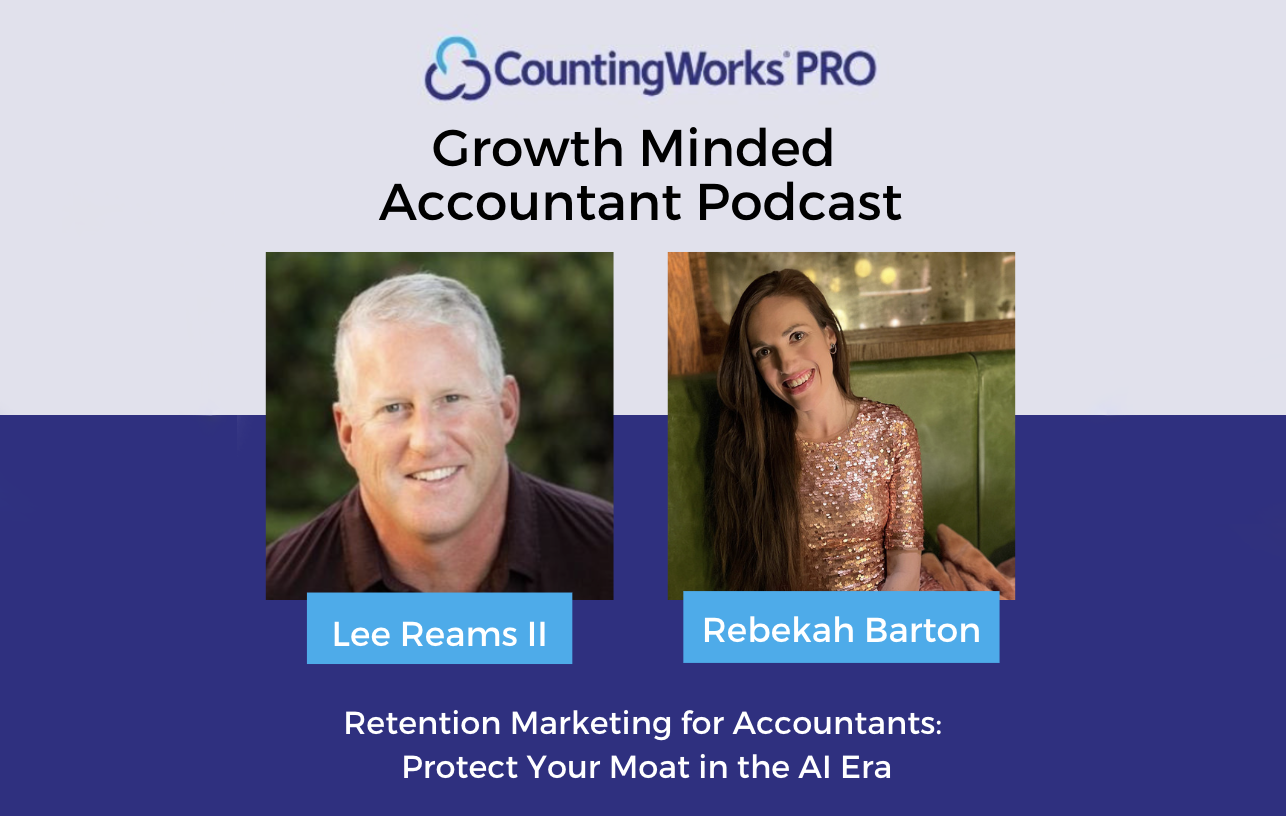
In this episode of The Growth Minded Accountant, Lee Reams and Rebekah Barton have a more mature conversation about the future of tax and accounting. They cut through the extremes, challenge the idea that every firm must become a fractional CFO practice, and explain why the real opportunity for many firms may be practical advisory, or what we call soft advisory.
Soft advisory is the advice that already lives inside compliance work.
Entity reviews. Tax planning conversations. Retirement questions. Social Security planning. Bookkeeping issues. Payroll problems. Cash flow concerns. Business transitions. IRS notices. Life events. Client decisions that have financial, tax, or operational consequences.
Many firms are already giving this advice, but they are often doing it inconsistently, reactively, or without billing for the value being delivered.
Lee and Rebekah discuss how AI can help firms surface these opportunities earlier, prepare client conversations faster, and create a better system for delivering advisory value without forcing every accountant into a CFO advisory model.
They also address the biggest strategic issue for firms in the AI era: protecting the moat.
The relationship is still the moat, but only if firms actively use it. If clients only hear from their accountant once a year, that relationship may not be as strong as the firm thinks. AI will make generic compliance work easier to compare, easier to shop, and easier to replace.
The future-ready firm will use AI differently.
It will automate the drag, then reinvest the time into communication, planning, education, client experience, and proactive advice.
The real AI opportunity is not replacing the accountant.
It is helping firms become the advisor clients thought they already had.
The future of accounting is not just about automation.
It is about what your firm does with the capacity automation gives back.
If you want to understand where your firm may be losing time, where advisory opportunities may be hiding, and how your digital presence, client experience, and technology stack compare to where the profession is headed, start with a free Future-Ready Firm Assessment from CountingWorks PRO.
We’ll show you what’s working, what may be holding you back, and what practical steps can help your firm become more proactive, more visible, and more valuable to clients.
Start your free assessment:
https://www.countingworkspro.com/start
1. The AI conversation in accounting has become too extreme
The profession is being pulled between two unhelpful narratives. One side says AI will replace accountants and automate everything. The other side acts like nothing is really going to change. The reality is more nuanced. AI will change the work, but changing the work is not the same as eliminating the professional.
2. AI is better understood as an assistant, not a replacement
AI can summarize documents, draft client responses, help with research, organize information, compare concepts, generate first drafts, and support staff. But it still needs human review. Faster is not the same as finished. Faster is not the same as trusted.
3. AI will remove production drag from the firm
The biggest early opportunity is reducing the low-value friction that consumes firm capacity. That includes chasing documents, reviewing uploads, drafting repetitive emails, summarizing meetings, organizing client information, answering common questions, and helping staff get unstuck.
4. Time-based billing becomes harder to defend when AI saves time
If AI gives firms 10%, 20%, or 30% more capacity in certain workflows, firms need to rethink how they price and communicate value. The firms that stay trapped in billing time may struggle as production becomes faster. The firms that learn to bill for outcomes, judgment, and advisory value will be better positioned.
5. Not every firm needs to become a fractional CFO practice
The industry often pushes the message that every accountant must become a high-value CFO advisor. That is not realistic for every firm. Not every accountant wants to do CFO advisory. Not every client needs it. And not every firm has the staffing, confidence, or business model to make that leap.
6. Soft advisory is the practical opportunity for many firms
Soft advisory is the advice that naturally exists inside the tax and accounting relationship. It includes entity reviews, tax planning, retirement questions, Social Security planning, bookkeeping issues, payroll concerns, cash flow conversations, IRS notices, business transitions, and major life events. These are not exotic consulting services. They are practical client needs.
7. Many firms already provide advisory, but fail to package or bill for it
A lot of firms are already answering advisory-style questions. The problem is that the advice is often reactive, undocumented, unpackaged, unpriced, or delivered for free inside compliance work. AI can help firms identify, organize, and deliver this value more consistently.
8. AI can help surface advisory opportunities earlier
The future-ready firm will use AI to identify client signals that may require a conversation. A revenue milestone, a bookkeeping pattern, a retirement age, a completed tax return, an IRS notice, a payroll issue, or a business transition can all become prompts for proactive advice.
9. The client relationship is still the moat, but only if firms use it
A relationship that only exists once a year during deadline season may not be as strong as the firm believes. AI will make generic compliance easier to compare, shop, and replace. Firms need to use the time AI gives back to deepen communication, education, planning, and trust.
10. Future-ready firms will reinvest capacity into client value
The winning firms will not simply automate work and pull away from clients. They will automate the drag, then reinvest the time into better communication, better planning, better education, stronger client experiences, and more proactive advice.
We know that everyone digests information differently. That’s why we’re now sharing the full transcript of each episode of The Growth Minded Accountant right here on the CountingWorks PRO blog. Whether you’re short on time, like to scan and highlight, or simply prefer reading over listening, you can catch up on every conversation at your own pace.
Each week, we cover topics that matter most to tax and accounting professionals—from AI and automation to marketing strategies, firm growth, and client relationships. Scroll down to read the full episode, or subscribe to the podcast to listen on the go.
Intro
Welcome to the Growth Minded Accountant Podcast, where our experts share best practices on running your firm in the digital age. This podcast is brought to you by CountingWorks PRO.
Lee Reams II
Welcome back to another episode of the Growth Minded Accountant Podcast. My name is Lee Reams II and as usual I am joined by Rebekah Winters Barton, our chief visibility officer here at CountingWorks. Rebekah, if you could say hello.
Rebekah Winters Barton
Yes. Hello everybody. You survived the Fourth of July weekend. I did. We had a really nice Fourth. How about you?
Lee Reams II
Um, we did as well. We had a lot of chaos here in Newport Beach. So, I I was home playing cards with my dad and family, but uh yeah, my daughter tried to go to the beach and actually turned around. She said, "I I I've never seen it like this here, Dad." So, Oh, wow. That was the good stuff. But anyways, I think our uh our town survived, which is good. Um, so we're ready to get back at it. Last week we did a very long form for those that stayed through the entire podcast. Um, I appreciate it and I think you learned a lot. We wanted to get into some real gritty details, things that you could actually utilize.
So I think it was really valuable information. So today I want to talk about a lot of the noise that I'm seeing. So whether that be from the media, whether that be on Reddit, whether that be on LinkedIn, you know, if you spend five minutes on LinkedIn right now, you're going to read some headline around AI. The conversation around accounting has become, you know, to me completely polarized. You know, on one side you have what I call the hype machine. Say I AI is going to replace every accountant. It's going to eliminate bookkeeping. It's going to wipe out tax prep and make compliance disappear by, you know, next week, right? So on the other side, you have professionals pushing back.
And those that are actually doing the work, you know, are saying, you know, AI may might replace some software that I'm using, uh, but it's certainly not replacing the human. And you know, I don't think you have to buy into either extreme, but the truth is almost always usually somewhere in the middle. And accountants actually doing the work know how messy it really is, right? So they know clients forget to send documents. They know bookkeeping is full of human errors, right? They know that the right answer u almost always depends on context and AI doesn't know that. And they know that one missing fact can completely change the recommendation. So, anyone using AI seriously knows this.
I I'm getting in arguments now sometimes with RAI, which is I guess good because that's how um useful I have found the tool and I I mean I use it daily. It has saved me tens of hours um and it can be completely useful, incredibly useful, but it also can give you the wrong answer with absolute confidence. Um and that is really uh a big issue, right? So today we're not doing hype. We're not doing doom and gloom. I want to have a a more honest conversation about where I think things are going. And Rebekah, you can jump in as we go and we'll just kind of have a dialogue about this. But I don't think the real question is will accountants survive AI.
I think the better question is this. Uh and I think this is really important and I took this from a bunch of conversations that I was having on LinkedIn. And if AI starts giving firms time back, what are they going to do with that time? And that is where the future ready firm conversation gets interesting. So Rebekah, I'll kind of lead with that and and let you jump in here and then we'll get going.
Rebekah Winters Barton
Yeah. So I do love that framing because I think the reality is most firms are not living on the extreme ends of this. They're not saying AI is going to do everything. We're going to be completely handsoff. But they're also not saying nothing's going to change. Right? AI has changed the world. It hasn't just changed accounting. People are now saying I'm going to GPT it instead of I'm going to Google it. which is just a cultural shift, right? People are using AI for everything from finding recipes to designing rooms to, you know, creating their to-do lists for the week. So, I think it's become such a part of the cultural conversation that firms know that it is going to affect their day-to-day in some way.
And now they're trying to figure out what to automate, what they need to review, what still needs human oversight, and really how to protect the most valuable thing that they have, which is the client relationship, which is a lot of what we talk about on the podcast with kind of enhancing the client relationship layer via automation. Yeah, I know we've had some internal discussions about this where we know um things are changing, things have changed, and for me, I think a lot of it has changed for the better, and that's what we're going to talk about today. The big push back we see and we talk about it, you know, in our meetings with success team and Rebekah, you and I have kind of gone over this is, you know, we get push back.
You know, accountants do not like change. They like to do it the same way they did it last year. And as this new technology is coming in and disrupting kind of the way they do things, um, you're seeing, you know, I don't want to do this yet. I don't, you know, even though I can, I I just I don't want to. I don't feel comfortable. what's new, you know, and what are you saying to get uh, you know, accountants kind of over that I guess that kind of like risk feeling or like the decision where I don't want to make that decision. Yeah, it's it's not the easiest thing, right? This is a riskaverse industry and sometimes it takes some time.
Sometimes it takes multiple conversations to kind of help them see the value that AI can provide. A lot of times that light bulb goes on when we actually start showing them what it can do. when we're like, "Okay, so let's think about how you need to respond to 50 emails in a day, especially during busy season. You don't have time. Look at what this can do." AI can respond to these, you can review them, and then you just hit send. So, it's kind of showing them the practical uses that are not taking them fully out of the equation. So, I think that's really important is for people to understand, and you kind of talked about it, Lee, in our 10XY yourself podcast.
I think that in ways kind of goes handinhand with this one. It's allowing you to do more with less time rather than replacing you. It's actually enhancing the value that you provide in your client relationships. And that's what we really talk a lot about is how AI can be used to assist you, not to replace you.
Lee Reams II
All right. So the the topic or kind of the frame of this uh podcast today is okay if you do start utilizing technology to free up more time for you. Um it does open up new opportunities. So the question really is what are you going to do with that extra time? Are you know if you're not able to bill for it? If you were billing hourly and now things take you a third of the time or a fifth of the time you know that becomes kind of an issue but it opens up new opportunities. And one of the terms we're going to talk about today is soft advisory opportunities. And we're going to explain what that is.
I'll just kind of set the table a little bit. We just did uh two different playbooks for our county works pro clients. One was on social security planning. The nuances and the amount of money at play. It was it was eye openening to me to be honest. So we created a like a an education side. So Mike Leon, our new director of tax intelligence and I kind of worked together and said, "Okay, let's educate tax pros. What does a social security planning engagement or advisory look like?" And we did a full education side on that. And then we said, "Okay, now how do you attract clients? How do you educate clients?" Because normally they just, oh, I'm old enough.
I just go take social security. They don't think about if was I married, who was the higher earner, all that kind of stuff. Um, and there's really important soft advisory opportunities. You don't have to be a virtual CFO to offer these. And then the other one Mike and I talked about and we just are building out this week is on uh loan uh student loans. I cannot believe just even how much money you make, how do you play off your AGI? Uh can you move money into retirement funds and the amount of money that's due with the calculations just even on your payments? It is a significant game and a significant amount of money there as well.
So there there's another soft advisory opportunity. So as we walk through this, we're going to talk about a couple things. So first of all, do I think AI will start replacing certain roles of software? Absolutely. I think that AI uh will help firms do much more work much faster. Okay. And the breakthrough is what becomes possible when repetitive work stops consuming your entire firm. And we also have seen like discussions about traditional let's just talk about practice management software and oh it's supposed to help me guide the client through the process of the engagement from the start to finish right delivery but then we're learning all the issues that happen and the the stops and starts and where it gets clunky and I think that is where AI can sit on top of these workflows and make them really really powerful.
Okay. So you need to ask yourself what am I going to do with all this freedom if now I have this you know this this mechanism inside that's doing a lot of the work that I used to have to do. So the question is not will accountants survive AI. The question is how firms reinvest the capital and the capacity AI gives back. So that is what separates what we call a future ready firm for a firm that becomes a little more automated or more importantly is kind of stuck in the old way of doing things. So I I do want to go into this. I don't want to be like, you know, all I read online right now is AI this, AI that.
I I want to set some boundary though. What I think the hype versus the reality of what's happening right now. So what can AI actually deliver, you know, and what is just pure hype at this point? Uh the hype says AI is the new partner at your firm. The reality is that AI is more like the ultimate intern. And I'm starting to believe more and more on that because I again I'm Rebekah you and I are heavy users. Yes. Um and we have dialed in our you know our tools and as you get better and better at it um you start seeing the nuances and the limitations and I mean and I I'm seeing a little throttling going on right now too.
So you know depending on what type of account you have if you're a heavy user you're going to start seeing oh I can't do that task anymore. I have to do that task in six tasks, six steps. You're like, well, well, you know, I'm talking to Chat GBT. I'm like, well, Gemini doesn't do that because Gemini is not throttling me yet. But you got to understand there's a lot of like incredible things that happen. But the reality is of what the tools and the the the monopolies or the duopolies of these technology, what they can do to you. So, I want you to start thinking about that when you start making decisions on how you're using it.
So, it can be extremely fast. It can summarize documents. It can draft explanations. It can help categorize information. It can compare concepts. It can generate first drafts. It can help with research. It can take meeting notes that then can be analyzed and summarized and even create to-do lists from that. It can help your staff get unstuck. I think these are all extremely powerful capabilities, but it still needs supervision. And that's where the hype masters I think kind of lose that you know and even this whole robots and you know robots can do a specific task but taking multiple tasks and piling them up one after another or making decisions is where you see that Whimo stuck you know at a fire hydrant that is going with water in the middle of the street right or stuck at a a street light and it doesn't move.
That is kind of the that's the limitation and that's where these hype hypersers you know that's where it starts to break down because faster is not the same as finished and faster is definitely not the same and this is the most important thing as trusted and that is what your clients are paying you for right Rebekah. Exactly. It's absolutely right. So, a client can really ask an AI attacks question and they can get a really nice answer, beautifully packaged, all tied up with a bow, but they might not know if it applies to them because there's no human being with knowledge guiding them based on their personal situation. So, there could be missing facts. They might have forgotten to put something in their prompt.
There might be information that the AI system doesn't know about their life. The answer might not be completely current. Maybe the IRS issued guidance yesterday and the AI system hasn't been updated with it. depending on what system you're using. Um, there may be risks involved, financial risks that the AI system isn't assessing. So, this is where human professionalism still matters. I was laughing a little to myself when you were talking about the robots because we have robots at our grocery store now. One of our grocery stores, Kroger, um, here in like the Midwest and South has started using robots and they kind of run around and restock things. Um, and they're very funny looking, but they do nothing else.
Like, you can't ask it a question. and you can't really get any information from it. It just kind of has been bowling people over as it goes to restock shelves because that's all it knows how to do. [laughter] Well, that's that's a good one. And then you're talking about mistakes and yeah I use again I have conversations I I'm overstimulated unfortunately and I'm trying actually not to solve all the world problems and right now I'm trying to solve the Lakers u new trades and what they're going to do and what is the line lineup going to look like and I cannot tell you how many times like all of a sudden a new you know a new rumor uh happens or a new signing happens and then I say okay well what will this look like what will the lineup be and how many times just keeps putting LeBron back into the starting lineup and I'm like LeBron isn't coming back, you know, and that's kind of and I've told it that five times now.
And that's kind of where this whole idea that uh you know, humans are still needed at this point to keep the uh the answers correct. So, when people say AI is going to replace accounts, I think what they're really trying to say, or maybe they're just confusing, I think task automation will be replaced um 100%. But that does not replace professional responsibility. So AI can help process information at scale. It can analyze data at scale instantaneously 24/7. That is hugely powerful. That helps you surface these soft advisory opportunities I'm going to talk about. AI can help me draft. AI can help me organize. It can help my to-do list. It can chase missing documents. It can tell your clients what is missing, right?
It can help surface issues, right? But the accountant still has to bring judgment, context, accountability, and most importantly, their experience, right? And that is where the conversation needs to mature. I know everyone's trying to drive business. Uh, you know, the the the AI models, they're basically trying to take every dollar in the investment community into their into their bank accounts. And that's what they do. They use scare tactics. Some of them are trying to use red cap. So they basically become complete monopolies and you know don't allow other uh competitors come in. That's not great, right? That's not what we're we're going for. U but the reality is let's be mature about this. You know it's not about blindly trusting a chatbot that that is accurate.
Sometimes you're already seeing this in your clients. Well chat GBT told me X and you're like well it's wrong for this this this and this reason right and that's the typical thing. So it's also not about pretending the profession will stay exactly the same because it's not just even that exact example I gave you. If knowledge is everywhere now the judgment isn't and that's where you need to step up. So AI is going to change the work but changing the work is not the same as eliminating the professional. So let's talk about a little bit. I just wanted to get in what I believe is getting automated. Rebekah we kind of talked about this a little bit.
um you know what is where is the opportunities for firms to get their time back and I think that's where this becomes very useful for firm owners. So the first area is one of the biggest time sucks in the profession and that is document collection and document understanding [snorts] and those are two different things. So software will request document collection, right? But it's harder to without AI to have software be able to identify. I mean, it's really hard to write software to do that. With AI, you know, you can now get that outreach for document collection. More importantly, when the documents come back in, AI can scan the document. It can tell you what the document is.
It can summarize the data. It can create an Excel sheet for that data, right? it could actually understand what that document is. And firms spend endless hours chasing paperwork right now, you know, reviewing what came in. AI can do that. Trying to figure out what is missing. AI can do that. And manually sorting through information. Obviously, AI can do that. That is where it's here to help. It can look across these incoming files. It can summarize what was uploaded. It can flag missing items. It can help categorize documents. It's not going to be 100%, you know, accurate every single time. Maybe it was something that didn't read right, but it can definitely move things faster along, right?
So, instead of, you know, what am I looking at to what needs to be reviewed and that does not mean that AI finishes the job, but it removes a ton of friction. The next area, Rebekah, is something you are very um excited to talk about, and that's client communication. All right. Well, let's talk about client communication. Yes, let's do it.
Rebekah Winters Barton
So firms tend to answer the same foundational questions over and over and over again. Where do I upload this? Why do I owe money? What's an estimated tax payment? What does this notice mean? You know, what documents do I need to give you? Can you explain this in terms I understand? Stop using tax jargon. Right? AI can really start drafting those responses, personalizing them, simplifying them, basically giving your staff a very good starting point that's going to be cohesive. If you've listened to this podcast, if you listen to it last week, even you heard me talk about the importance of cohesion in your brand. One really great thing that AI can do in regard to client communication is make sure that everything your staff sends has a similar tone, that it all sounds very professional, that it's using certain key terms or phrases that your firm wants to use, that everything is very cohesive and coherent when communicating with clients.
That's really important. having one person say one thing, another staff member say another thing, maybe they're using different tones, maybe someone's hyper professional, maybe someone's hyper laid-back and kind of more talking like they're talking to a friend. You need to set standards for your firm. And it's okay if you fall into any of those categories, but it needs to be standardized, right? Clients don't want to hear one thing from one person, another thing from another. So that's a space where AI can really help because you can train it across the board. Train the model that your team is using on exactly the tone, exactly the types of wording that you want to be used for emails, for posts, for social media, whatever it may be that they're putting out to communicate with clients.
And then you have something that you can trust is accurate and sounds the way you want it to sound even when you're not directly overseeing every email that gets sent.
Lee Reams II
Yeah, I think that the what term you use is standards. Um, and I it's interesting now my favorite soccer player in the world is Holland. And I I just love the guy now. And I'm just like I love the way he plays. I love the way he goes from 0 to 60. But I watched a few, you know, interviews with him and kind of some of the things he talks about. And it's like, you know, you don't become me by being undisiplined. I have standards. This is the way I eat. This is the way I prepare. This is the way I sleep. And I think that is really important that technology can now apply those standards across your firm.
So if you're a bigger firm with 30 people, every single communication is written consistently, right? And I also think this kind of helps start solving the blank page, you know, drag. It's like, okay, a a client response comes in, you know, a professional um may know the answer, right? But they still have to write it, they have to explain it, they have to format it, and they have to send it. and they may in haste or short period of time miss something and the beauty of AI is that it can take that first pass then you as a human you can review it you can edit you can make sure it is right um the another big one is meeting intelligence right so uh you have a 30 minute or 60 minute client interview strategy session AI can you know normally someone is trying to take notes or you're trying to save it all here um you know no one's well some people can But usually you're missing things and AI can now summarize this conversation.
Um, obviously you have to disclose this, right? Pull out uh action items, identify follow-up items, and even flag possible planning opportunities. You know, again, you as the human, you review it. You know, you decide, hey, this is a great direction. Can you continue with this? Can you expand on this? Um, and then the administration friction is dramatically reduced when you do that. Uh, and then I think it applies also to some of the business clients bookkeeping for example, Rebekah. I mean, you know, AI can spot anomalies, unusual transactions, maybe some uncatategorized item, maybe some missing data, uh, maybe a key, you know, a key error was like, whoa, wait a second, the expenses just increased 3,000%.
You know, maybe someone keyed in something, right? Issues that could eventually become tax problems, but maybe in the old days that was uh perhaps overlooked or not caught, right? So um I think what it does is enables firms to help see problems earlier, identify them in much quicker format as well. So I'm then going to add research support uh internal training. We're even able now our Max is able to create a complete training guide on any sub. You just type in some tax subject. It can actually create uh kind of an education plan for your clients, right? It can do workflow reminders. It can do content creation, client education, you know, first draft planning explanations. Um, you know, when you add it all up, we're not just talking about AI doing the entire job, but we are talking about AI stripping away low value production drag.
So hopefully this means less chasing of documents for you, less rekeying, less repetitive explanation, less manual follow-up, you know, less less staring at that blank screen going, "Okay, how do I start with this? How do I respond to this? I have to do research." The AI has already done that. Okay, you know, and and then it can really free you up from the admin work that you're doing. So now the question becomes u you know if AI gives your firm back it's not it's going to be much more than this 10% 15% or 20% more capacity in certain workflows what do you do with that extra time and I think this is where the fun stuff starts to get into so this is the whole long way we wrote we talked all the way through this because we wanted to set the stage of what's going on so one of the loudest answers right now is compliance is going to be automated that's what people are saying right so every accountant needs to be a highv value fractional CFO.
Guess what? A lot of you don't want to do that. You don't feel comfortable with it. That's not what you were trained in. That's not what you enjoy. Um, and I think that can be bad advice for a lot of firms. And that's what you're seeing every influencer say, you have to do this, you have to do that. Would I get into that? Are there a lot of opportunities? A thousand%. But I see it. I, you know, it might sound great in someone's LinkedIn post, uh, but it's not necessarily realistic for every firm. You have to believe in what you're offering in order for them to buy in, right? So, never not every accountant wants to do corporate financial modeling, for example, right?
Not every firm wants to build a CFO practice. And frankly, a lot of businesses clients do not need or want a fractional CFO. They can't afford it. But they can afford a lot of these soft advisories that we're going to talk about. But, you know, Rebekah, that creates a lot of pressure, don't you think? A lot of pressure. firm owners hear advisory CFO and they kind of think they have to reinvent their whole identity, right? And and we see this a lot when we talk to clients who are more like in small towns and they know everybody and they've kind of been the local tax preparer, local bookkeeping firm for decades, right? They don't want to have to position themselves in smalltown USA as a as a Wall Street, you know, analyst or or fractional CFO.
That's not what their clients need and frankly would not want that. That's not the type of work that these people are looking for. They're looking for someone where they can walk in the door on a Thursday afternoon because they've just made some financial decision and get advice about what they need to do, right? Or they can pick up the phone and call because they have a question about something they're thinking about doing for their business. Um, and while a lot of these firms are kind of stressing about if they need to become fractional CFOs, they're missing that opportunity sometimes to to be a trusted advisor to real people in their real towns who just need someone to help them navigate real life.
Um, financial decisions happen on a daily basis, whether it's understanding their tax situation at tax time or making smarter decisions with a business they're starting or helping them with a filing deadline or just really helping someone kind of connect the dots. Maybe they're taking over a business that their parents own. Maybe they're looking to buy their first investment property. There's a lot of things that happen on a daily basis that people need assistance with that aren't full virtual CFO or fractional CFO subscriptions, right? These people need proactive advice that they probably assumed they were already getting, but maybe they actually weren't. And that's where your opportunity really lies. Um, yeah, 100%. And I think what happens is these big, you know, VCback tech startups, they forget about middle America maybe.
I don't get it. It's like the flyover states and that's where a lot of business is done. And unfortunately, that's where these, you know, whether that be the software solution is shoved down your throat um or these new, you know, this is what you need to be doing. And I think that becomes a problem. So uh you know I don't think the answer is not everyone becomes a fractional CFO and you know the question is what is the better answer and I think that better answer is what I call soft advisory not because it is less valuable than CFO advisory but because it's closer to the decision clients are already trying to make okay so soft advisory is what I call high value guidance that naturally sits inside the accountant client relationship does not always require a 40page slide deck and some expensive, you know, presentation.
Um, but it does and it does not always require a massive new consulting package. And this is the, you know, the CFO package. You got the deluxe set at 5,000 a month, whatever it is, right? And we already are hearing back, you know, people all of a sudden trying to sell CFO advisory without educating the client, without explaining the value and, you know, having and maybe not even feeling comfortable with it. um having some issues, having some some push back. So, it often starts with a human conversation about the client's business, perhaps their family, what stage of life, their goals, um friction points, pain, risks, you know, and let's talk about this a little bit. So, let's give some examples.
I talked already about social security uh loan um side, but let's just go with this one. Entity optimization. So, a client starts as a sole proprietor, you know, then their business starts growing, right? They add employees. They add risk. They make more money. At some point, the entity structure may need to change. This is not exotic consulting. This is soft advisory. And it is directly connected to the tax return. And it is is directly connected to risk. It is connected how the client is actually operating. So um you know another example is the massive wave of business transition. So we were seeing business owners think about selling. we have this whole boomer u you know near retirement age.
We're going to have the biggest transfer of wealth ever, right? So what are they doing? They're selling a business. They're winding down a business. Perhaps they're passing the business to their kids or transitioning ownership over time. These conversations involve tax, cash flow, obviously retirement, social security planning, family dynamics, timing, valuation. You know, this is not something you need to plan ahead for this, right? So clients need someone to walk them through that. That is soft advisory. Um I gave you this the social security and retirement planning. Now a client approaches retirement and starts asking you know when should I claim social security? Do you need a full package high-end package for that or is that something maybe there is a a one-off fee for?
You know how does my retirement income affect my tax bracket? You know what happens with uh my required minimum distributions from my IRA? Right? Um should I be doing a Roth conversion? What happens if I sell my business a rental property? These are real questions and they are exactly the kind of questions clients want to ask a human being they trust, not a chatpot, right, Rebekah? Absolutely. And there are also a lot of everyday friction points in people's lives, right? Things like student loan repayments, um, credit card debt, cash flow with a business, payroll problems, maybe worker classification, they don't know if someone's a contractor, an employee, bookkeeping issues. Um, maybe they're getting married or they're getting divorced.
They have a child. They have kids going to college or they have little kids and they need to save for college. Perhaps they got an inheritance. Uh, maybe not even a huge inheritance, but they just don't know what to do with it or how to deal with it, right? Maybe they're selling their house. They're moving to another state. All of these basic life events that just kind of happen to people throughout the course of a general day can create financial and tax consequences that everyday people need help with. This isn't all, you know, people living on Park Avenue need help with their multi-million dollar investment portfolio. These are things that happen to very real people in very real towns and cities across the United States.
And so this is not a random add-on to offer these soft advisory services. There are moments where clients are very stressed or confused and they're trying to make important decisions and they don't have the knowledge to do it. That's where you can say here's what this means for you. Here's why it matters. Here's what we need to look at and this is the next step. At its core, that's what advisory is. I think it often gets packaged as this very New York City or downtown LA type of thing. And in reality, it's something that everyone, almost everyone, can utilize at various points in their lives, even if they don't need it on an ongoing basis. There are opportunities for advisory in nearly all of your interactions with clients.
No, I'm laughing at your examples. Um, yeah, the New York City Park Avenue person already got their advice from their clients and that's why they're moving out, right? So, they're already figuring out. I think the point is these are not random add-ons and if technology is now going to make us create more capacity more time it can also help surface these opportunities to proactively I call it predictive advising uh talk reach out to our clients be able to analyze those conversations through my meeting through my zoom call take that transcript you know these are the question it could set you up with the questions you need to ask and then give you all the answers from your client.
Let them talk and then come out with, "Hey, wait a second. These are the areas your clients are confused. These are the important decisions they're making. These are their goals." And then they need someone there to say, "Here, this is what this means for you. You know, here is what matters. This is what you should be doing. Here's option A. Here's option B. Here's the pros and cons for each one. Here's the next step." Right? That is advisory. And for many firms, that to me is the natural next move. And if you're utilizing technology correctly, if you're getting your time back and you're having a tech stack that helps you surface these opportunities, that is where the the future ready firm is really going to excel.
So become more proactive, become more consistent. These these tech stacks will help you do that. And become more visible with the advice you already are capable of giving. And I would argue and you're saying, "Well, I do this all the time now, but you're probably throwing it into it at the end of a tax compliance meeting, perhaps you're selling it as advisory." I don't know. But I would say to you, if you sat back honestly and looked at it, I think you're really seeing um you know, opportunities that you probably were just so rushed, so busy. I didn't have time to it. I thought about it during the meeting, but then I forgot about it two weeks later.
Right. Um, like Rebekah, I mean, this is kind of changing client behavior, is it not? It definitely is. So, people are using AI tools. They're experimenting. They're asking questions, and they're really trying in a way they never did before to understand things on their own before contacting a professional. AI has kind of given everyone this feeling that they have a personal assistant at their disposal 247. And in some ways, that's true, right? But in others, it's not. As we kind of talked about earlier, the AI might give a beautiful answer, but it might not be accurate for that particular client because it might not be taking all of the details of their lives into account. But I do think firms really need to be honest about the fact that clients may start saying, "Maybe I don't need accounting software the same way.
Maybe I don't need bookkeeping done the same way. Maybe I can ask chat GPT this question first." That's definitely happening. But what people aren't saying is I don't need accounting advice. Um that's the difference here. They might rethink some of the mechanics of it, some of the technical aspects of how they do it. The tools, the workflow may change, right? But when the issue matters and the money is real, they really have a real tax risk or their life is changing in a very real way. They want human advice. Um we always call it human in the loop. We talk about it a lot on the podcast, but people still want that human in the loop.
they still want that human interaction. And someone who can challenge the AI's answer and say, "Well, maybe this isn't exactly the way we need to go. Maybe we need to go this way because of X issue in your life." That's where accountants have a massive opportunity, but they're only going to be able to take advantage of it if they're willing to step into that more advisory centered role. Yeah. And I'll just give an example. I mean people probably health related questions or dental hygiene or you know what I'm eating uh you could get answers and even ask chatbt I mean you know are you biased and and you'll have arguments and they'll say well you know we we have nuance we get context from all areas and they'll define you know where they get that context from but if you look at the media so it's learning on everything that's published um a lot of that is already inherently biased so if you have a bias, you're going to get bi biased answers.
And you can see that and I think that's that's just one example, but that's how it makes errors that humans right away see through. Um, and if you're trusting everything to be done correctly through these responses, you know, you're in for an eye opener, right? And then I think that's true. You're already seeing, oh, I don't need software to do this anymore. I'm going to have, you know, Cloudbot do everything and blah blah And then all of a sudden they're like, "Oh my god, I just opened up all my client data to Entropic, right? Like the worst thing you could ever do." Um, or if something breaks, uh, or if it makes a mistake, what happens?
And then you're seeing people already pull back, right? So they went in all in. They followed that influencer, told them that, you know, this is the the future and this is what's happening. And I think you're going to see your business clients doing that as well. and then they're going to realize, whoa, whoa, whoa, whoa, this isn't working exactly because one mistake could cost them tens of thousands of dollars um where they're trying to save, you know, $500. It doesn't make any sense. So, um I think these are all important. I think I've given the soft advisory model. I think everyone already knows it, but I don't think they're utilizing it um at its full capacity yet.
So, what does it mean? You need to educate clients. So that what is that? Sending emails, writing blog content, posting on social media, getting your soft advisory messaging um out to chat GBT and Gemini answers so that they are now recommending you as a source for social security planning, okay, in your area. So that's a good example, but it all circles back to what is the most important asset in your firm and that is the relationship. That is your moat. And I think most firms are over the past have taken that for granted. Is that a good way to Rebekah? Is that a good way to say it? Like, you know, I don't need marketing. What the what are you talking about?
You don't need marketing. If your client relationship is your moat, it's everything. And kind of explain when you hear that from clients, you know, how you walk them off the edge and try to explain to them how it all works. Yeah. So I think one thing people don't understand is that they immediately think and we'll just go with marketing as an example. But firms who say I don't need marketing a lot of times they just take it for granted that people will return year after year and they don't understand that marketing isn't just for new clients. Um it's also the communications that you send to existing clients, right? And that's actually a massive part of your marketing.
So doing things like explaining to your current client base what soft advisory is in the in the context of this particular podcast that is marketing and it's very important marketing because it's how you're going to really get them to understand what it is that you can do for them. The value you can provide. Um any relationship where a client only hears from you once a year when it's two weeks until the tax deadline on April 15th that might not be as strong of a relationship as you think. Right? might be more based on panic than on them actually relying on you throughout the year. And that's not what you want. Um, if your relationship with your clients is totally transactional, you're very vulnerable to them leaving or even to them turning to the new Turboax integration with GPT or something like that, right?
Depending on how complex their needs are or how complex they believe their needs are. Because if they're not getting the right advice from you, they might not realize that their tax situation or financial situation is more complex than they need or they realize. So, if the client really only sees you as the person who produces their tax return or their financial statements, your output can start to feel generic. And so, that's where you want to do marketing. You want to protect those relationships. And I'm not talking about paying for ads on LinkedIn or on Instagram, right? I'm talking about sending personalized email campaigns that meet people where they're at. Um, hey, we realize that you have a kid graduating from high school this year.
Here's what you should be prepared for as they transition to college. Um, hey, we know that you got married earlier this year. Congratulations. Here's what you should be prepared for financially moving into your first 12 months of marriage. All of these things are technically marketing assets, but they're marketing assets that make a real difference in your current client's lives. And that's an absolutely huge opportunity um for any tax and accounting firm. Yeah, you don't want to be easy to replace. Um and generic work makes that you know it makes it easier to shop. It's like well you know if you know chat GPT and Turboax could do this for me. um you know that to me is the cold side of AI and that more importantly my example with you know if they have uh student loan debt that that experience that DIYer is not going to have any of those uh opportunities surface that you as the human is going to surface right it's just going to completely glance over it and I also think it's more than just upselling to your current clients it's more than just lead generation um it's part of protecting your relationship right so historically I think a lot of firms said, you know, I don't need marketing.
I get referrals. But guess what? The referral funnels are completely getting up thrown upside down. A little stranger things, the upside down. So what word for a long time um is changing. Discovery is changing. Clients are searching differently. They might not be asking Uncle S, right? They might be going straight to Chat GBT, Google, uh AI powered search tools for answers and recommendations. And if your digital presence, you know, again, we've done podcasts on this subject repeatedly. Our last episode was all about how to get not be invisible, right? Not how not to be generic. So, if you have the hour and 15 minutes that we talked, uh, definitely check that one out. But if you're not, you look like every other firm and that becomes a real problem.
So, um, you know, you need to protect your moat. So everything you're doing, your website, your educational videos, your your niche guides, your newsletters, your emails, your content, your service pages, that is how you scale your voice. You can start integrating. We have on our our road map integrating chatbt to our blog articles. Do you have questions about this subject? Right? And then it can now continue the discussion from an article that we wrote about a life event. Okay? And that really can move clients towards these soft advisory opportunities. So, you have to understand AI search tools are trying to understand who to recommend right now. They're looking at your reviews. They're looking at your area of expertise and you just need to give them something real and specific to understand.
And we've talked about this. We're just going to cover it a little bit if you haven't seen our other podcast. But who do you help? What do you know? What problems do you solve? More importantly, what makes you credible? Why should someone trust you? And what I'm seeing is generic firms are going to have a harder time standing out in that world. They're already seeing the the blue link traffic is going away, right? So it's like, wait, I'm not getting as many clients. I'm not getting as many referrals. You know why? Because these tools do not understand your firm. So the future ready firms, you're going to be very specific. You're going to have a story to tell.
You're going to be very specific on who you serve, specific about the expertise you have, specific about the advice you provide and how you provide it. You're going to talk about client experience so people understand how you work and that becomes part of your moat. So today's episode, I really wanted to kind of talk about where technology is going. It's not just about automating task. It's about ha helping your firm become more proactive. We have seen all these trends. Um, you know, I'm jumping up and down in excitement of what the future should look like for a tax and accounting firm in a a future that is more predictive. It's more proactive. It's more valuable to your client.
You're able to give this advice that you couldn't before. And more importantly, I don't want you doing it in a cold robotic way. and explain Rebekah kind of how AI actually makes things more personal because if you're using the right technology, AI will know your firm and your client better than anything you could ever articulate, you know, one off at a client. So, kind of talk about that a little bit.
Rebekah Winters Barton
Absolutely. So, if you're training your AI correctly, it's not going to be this cold robotic generic tone, right? We already talked a little bit about getting it up to date on your brand personality, on the types of terms you want used, on the tone you want used. You can also train it on specific clients, right? We've talked before on the podcast about uploading people's past returns obviously to a secure um system, but having it be analyzed, getting tax plans for people. So, for example, AI can do things like say, "Hey, client X just hit a revenue milestone. it may be time to review their entity structure and allow you to provide that proactive guidance that you couldn't before.
Um, it may say, "Hey, client Y is approaching retirement age. They may need some social security or retirement tax planning help. Client Z has bookkeeping patterns that could become a real problem when tax season rolls around, right? All of these things can come from your AI, from it helping you to analyze." when you said the ultimate internally, that resonated with me because that's really kind of how I use my chat GPT. Um, you know, it does the things that are just the busy work, the analysis, the things that I don't have time to do because I'm busy doing my actual job, right? And so that's where AI becomes really interesting. Not because it replaces the accountant or in my case the the SEO and geo expert, but because it gives the accountant better timing, better prompting, better insights, better first drafts, better ways to follow up.
So the human can step into the conversation, review, bring judgment, but the firm has a system in the AI that's helping them see opportunities they might have missed when they were absolutely buried in the tedium of the everyday, right?
Lee Reams II
And you just brought up something wonderful, the the idea of how we've transitioned at CountingWorks from, you know, we we were creating websites and we're doing blog content. We're now basically a complete agency, an AI native agency that now is doing custom stories, custom content, custom positioning. We're answering all these questions. We're serving all that content to chat GBT so you get recommended and we've created a platform that surfaces and looks at your client base 24/7 and surfaces these opportunities and says, "Hey, here are eight opportunities. Do you want to chase them?" Right? That is the improvement in the client experience, right? And what we could not do before because we just we we had to do all this manual work before, right?
So you had to optimize SEO for example for a client or writing content uh would take a long time. Now we can create an entire creative brief from the interview with the client. help AI we our agents our expertise our human in the loop then draft that into an incredible beautiful website and story and get that published much faster much more uh less costly and the the outcome for our clients is in instrumental it's 10x right that is the 10x so the same thing applies here for you and your clients right so instead of hearing only from your firm right when something is due the client starts hearing predictive proactive things that matter, a tax law change, a planning opportunity specific to them, a business milestone that kicks off who knows what, a bookkeeping issue that you would maybe not see for 60 days.
Now it surfaces day two, an upcoming retirement decision, you know, more demographic information about your clients, maybe a life event. And that life event means there's all these different angles that you probably didn't think of that AI would would surface, right? And that to me is a completely different type of a relationship. Um, and more importantly, that is the financial outcome we should be focused on. So if AI gives us our time back and firms use this to deliver better advice, offer this soft advisory, clients should now make better decisions, right? They're going to avoid more mistakes. They're going to plan earlier. They're not going to just walk in and, "Oh, I should have done this.
Oh, I should have done that." And you're saying, "Yeah, I told you so." You know, they're going to feel more supported. Um, I think this is overall better for the client and more importantly it's better for your firm because your firm is not just selling compliance anymore and the firm is you're really expanding and tightening that relationship. Um, so what should clients do now Rebekah? We've talked about a lot you know kind of how what would be the path how would you send clients through things?
Rebekah Winters Barton
Yeah. So if a firm owner is listening to this today and they're thinking okay I get it right. I don't want to become generic, but I also don't necessarily want to become a fractional CFO, but I do want to use AI to be more proactive. Here's where you should start. So, there are basically three diagnostic questions we'd like you to ask yourself. The first is where can AI remove manual drag in the next 12 months. Don't start with a five-year fantasy. We don't even know where the world's going to be in five years. Look how you told us we're all going to be sitting at home with our basic income. I'll be so bored. [laughter] All right.
But the first thing you should do is start with your existing bottlenecks, right? Where are you wasting time? Chasing documents, writing repetitive emails, summarizing meetings, taking notes, kind of explaining the same things over and over, following up, uh content creation, training staff. Start where the drag is obvious. Use AI to buy back time. That's a very simple place to start. The second thing is what practical advisory questions are your clients already asking? These undoubtedly exist, exist, if I could speak, but if you're not thinking about them, you may not realize that they're there. So, if you approach it with fresh eyes looking for advisory questions, you're going to see them. So, look at your inbox, your voicemails, your meeting notes.
Clients might be asking about entity setup, tax planning, retirement help, selling a business, um buying real estate. All of these are things that may exist across multiple clients, but you've never necessarily thought about it before in this way. If your clients are asking these questions, you may already have an advisory practice. It's just not packaged. It's not priced correctly. You're not tracking it. And it may be very inconsistent. So, that is the aha moment, Rebekah. That's what this is all about. The light bulb. That's the the light bulb. And then we've got one more question, which is, is your expertise visible or invisible? And this goes into everything we talked about last week on our very deep deep dive into um invisibility in the AI world.
So look at your website through the eyes of someone who's never seen it before. Uh pretend you're a prospect and maybe even ask the AI search tool where your gaps are. That's a great starting point. But check out whether or not your content clearly shows who you help, where you are, what you know, and what questions you solve, what pain points you solve. and also why should your clients trust you? If it doesn't answer those questions, go back to the drawing board, um, answer those questions, change your homepage, and then come back and look at it again. So, you don't want it to look like a cold compliance factory. You want it to have personality. You want it to have depth, and you want to show clients what makes you different from the H&R Blocks and Turbo Taxes of the world.
Lee Reams II
Oh, well said. I can't believe you threw those two brands into this conversation. We are here for the independent and medium-sized businesses. Not I don't just don't give them any props. But I think the reality is and what I'm trying to articulate is invisible expertise is going to be a quiet business killer. You know, a firm may have deep knowledge, but if the your clients cannot see it, they may not ask. And that's what I'm trying to get you guys to understand. This is the role of AI. This is how you become superhuman. Um, and more importantly, if AI search tools cannot understand you, they can't recommend you. Um, so the future ready firm, we're going to tie this up.
This is I think this has been great. Um, it actually came through better than I thought it would, Rebekah. I think anyone listening to this really has some real takeaways. This is where I believe the internet and AI really is going. Um, so kind of back to reality, a mature discussion around this. So, you know, if your firm is hiding your expertise, that's a problem, right? You want it to be able to your website, your marketing material, your story. You want it to teach. We want it to communicate. We want you to show up online. We want you to be able to explain complex issues to your audience. We want to make your clients smarter. Right?
That's when AI gives time back. The firm that uses time, more importantly, to deepen your client relationships. And that is how you protect your mode. So, uh, here's the bottom line. AI is not a trend that's going to pass. I there's no question. I think most believe that. I still feel there's people that are just like not for me, not right for me, right? Um, you know, I'll use it if I can make sure it's correct. But you're missing the real true power. And that's what we've talked about today. So, pretending it will not change your business is not a strategy. But either neither is panicking and assuming every firm has to become somewhat completely different overnight.
And that's what I mean about what I see is these people rushing way too fast in these cold AI systems. Um I think they they're going to have some struggles on their own. So I believe the winners in this next era will not be the firms that blindly hand everything over to your AI chatbot and claude, right? I think they will not be the firms that bury their heads in the sand either, right? And hope the profession stays the same because it's not. So the future ready firm uses AI to remove the drag from your practice, less chasing, less recking, less repetitive explanation, less manual follow-up. That's what we're looking for. You want to uh provide judgment.
You want to have education, planning, communication. More importantly, you want to build trust, uh more proactive advice. So AI will automate more of what I call the mechanics, but I don't think it's going to automate the trust. So, um, let's go back to the the premise of this whole podcast, the question we started. If AI gives you 20%, 30%, 40% of your time back, what are you going to do with it? And if the answer is more of the same, then I perhaps you missed the opportunity here. But if the answer is better communication, better planning, better education, better advisory conversations, and even stronger client relationships, I think you're totally getting it right now. So, that's the way you build a future ready firm.
So, I hope we really explain this in a in a more like common sense point of view here. Um, again, we thank you for being a listener to the Growth Minded accountant. We're enjoying the feedback we're getting. We're hearing it from clients and new clients that discovered us from this podcast. So, we really appreciate all the feedback. So, if this episode challenged your perspective on AI compliance or how to protect your firm's moat, please pass it along. We we're over 8,000 subscribers now on our YouTube channel for Growth Minded Accountant and we love all the positive feedback. So until next time, next week we'll have a new engaging episode for you. But stay safe out there and we'll talk to you uh next week.
Thank you.
Q. Will AI replace accountants?
AI will likely replace or reduce parts of repetitive production work, but it does not replace professional judgment, context, accountability, or trust. The better question is not whether accountants survive AI. The better question is how firms use AI to become more valuable to clients.
Q. What accounting firm tasks can AI help automate?
AI can help with document summaries, client email drafts, meeting notes, research support, workflow reminders, bookkeeping anomaly detection, client education, content creation, and first-draft explanations. These uses can reduce friction, but they still require professional review.
Q. Why is AI creating pressure on time-based billing?
If AI helps firms complete certain tasks faster, billing strictly by time becomes harder to defend. Clients are not really buying minutes. They are buying expertise, judgment, confidence, risk reduction, and better decisions. AI makes it more important for firms to communicate and price based on value.
Q. Does every accounting firm need to become a fractional CFO firm?
No. Fractional CFO advisory can be valuable for some firms and clients, but it is not the only path forward. Many firms are better positioned to offer practical advisory services that naturally connect to tax, compliance, bookkeeping, payroll, retirement, and client decision-making.
Q. What is soft advisory?
Soft advisory is practical advice that already lives inside the accountant-client relationship. It may include entity structure reviews, tax planning, Social Security timing, retirement tax questions, bookkeeping cleanup, payroll issues, IRS notices, cash flow concerns, business transitions, and major life events.
Q. Why is soft advisory a good opportunity for tax and accounting firms?
Soft advisory is often closer to what clients already ask about. It does not require every firm to reinvent itself as a CFO advisory practice. Instead, it helps firms become more proactive and consistent with the advice clients already expect from them.
Q. How can AI help firms deliver soft advisory?
AI can help surface client signals, summarize relevant information, prepare first drafts, identify follow-up questions, organize planning opportunities, and create client education materials. The accountant still reviews the facts, applies judgment, and leads the client conversation.
Q. What does it mean to protect the moat?
The moat is the client relationship. But the relationship only protects the firm if it is active and valuable. If a client only hears from the firm once a year, the relationship may feel transactional. Firms need to use communication, education, planning, and proactive advice to strengthen that moat.
Q. Why is generic compliance work more vulnerable in the AI era?
AI makes generic work easier to compare. If a client sees the firm only as a producer of tax returns, bookkeeping reports, or financial statements, the work can start to feel interchangeable. Firms need to show the human value behind the work: judgment, context, planning, and advice.
Q. What should firms do first if they want to become more future-ready?
Start by identifying where AI can remove manual drag in the next 12 months. Then look at the advisory questions clients are already asking. Finally, evaluate whether the firm’s expertise is visible through its website, emails, content, client experience, and communication systems.
Listen to other podcast episodes or read other related blog articles with relevant information and insights.