

Artificial intelligence is changing accounting—but its biggest opportunity isn't replacing accountants. It's helping them become better advisors.
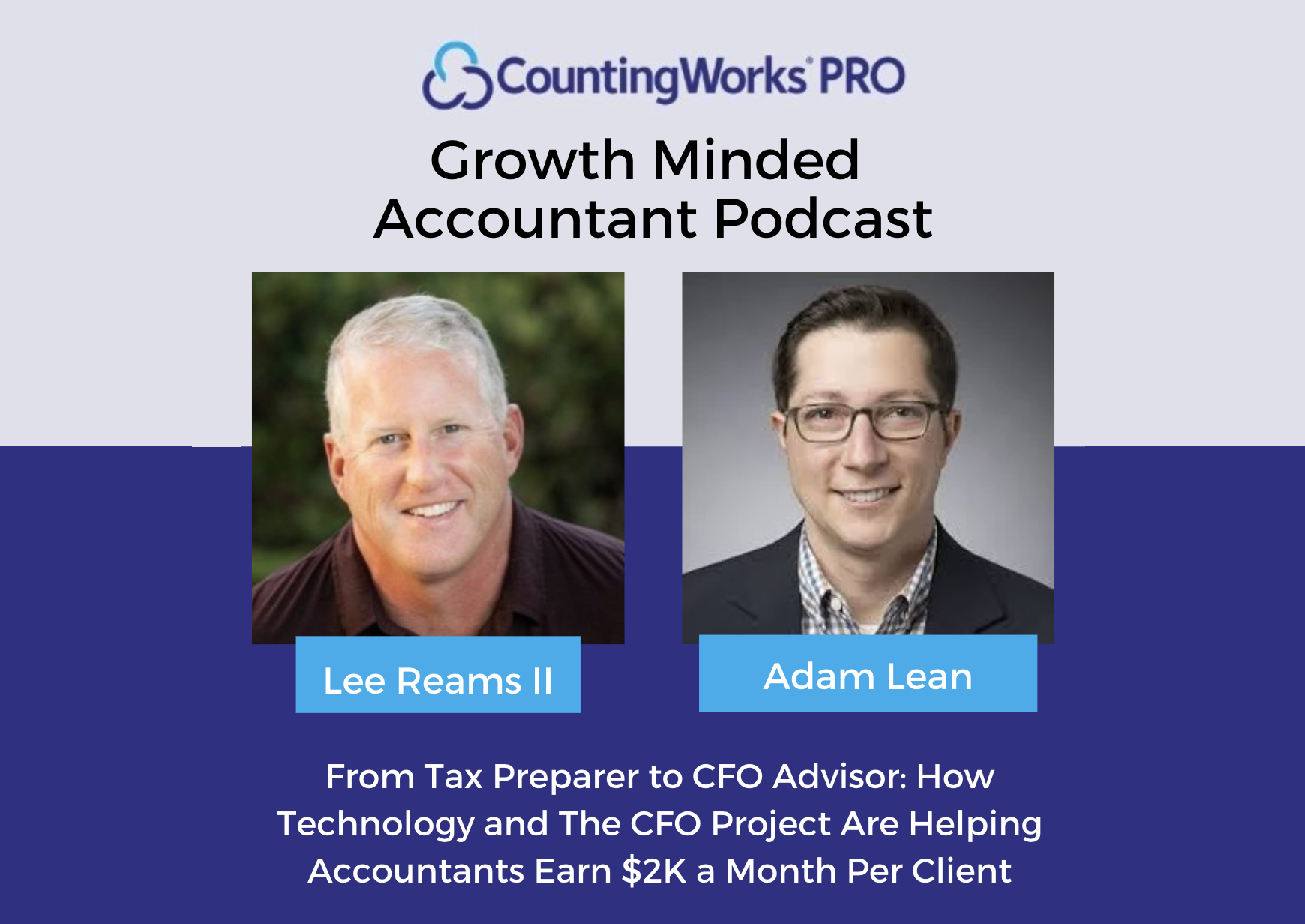
In this episode of the Growth Minded Accountant Podcast, Lee Reams II sits down with Adam Lean, CEO of The CFO Project, to discuss how tax professionals, CPAs, enrolled agents, and bookkeepers can transition from compliance work into scalable CFO advisory services.
Adam explains why most business owners don't actually want bookkeeping or tax preparation—they want someone they can trust to help them build a healthier, more profitable business. Together, Lee and Adam explore practical systems for packaging advisory services, pricing them confidently, improving client retention, and leveraging AI to create significantly more value without adding more staff.
Whether you're considering virtual CFO services, fractional CFO work, or simply looking for ways to increase recurring revenue, this conversation provides a practical roadmap for building a modern advisory practice.
Get Your Free Firm Growth Breakdown
We know that everyone digests information differently. That’s why we’re now sharing the full transcript of each episode of The Growth Minded Accountant right here on the CountingWorks PRO blog. Whether you’re short on time, like to scan and highlight, or simply prefer reading over listening, you can catch up on every conversation at your own pace.
Each week, we cover topics that matter most to tax and accounting professionals—from AI and automation to marketing strategies, firm growth, and client relationships. Scroll down to read the full episode, or subscribe to the podcast to listen on the go.
Welcome to the Growth Minded Accountant podcast where our experts will share
best practices on running your firm in the digital age. [music] This podcast is
brought to you by CountingWorks PRO. Let's get started.
Lee Reams II
Welcome back to another episode of The Growth Minded Accountant, the show for tax and accounting pros that want to
think bigger, work smarter, and build firms that grow even when they're not in the room. So, I am your host Lee Reams II the
second. I'm the founder and CEO of CountingWorks and our sister sister company taxbuzz.com. And today we're
going to talk about something that the industry uh kind of the influencers have been really hitting up whether you call
it virtual CFO services, fractional CFO services, on-demand CFO services. Uh our guest is going to break it down for us and kind of define how he sees it. So our guest today is Adam Lean. is the CEO
of The CFO Project which trains and equips accountants and bookkeepers to step confidently into this high value
advisory work. So we'll unpack why so many firms may hesitate to get into this advisory stuff specifically CFO
services. What makes a great virtual or fractional CFO and how to create systems
and processes that enable you to scale this revenue stream without adding staff. I think that is the great thing
about AI and some of the processes that Adam is going to share today is being able to scale without worried about where am I going to get my next hire. So
Adam, welcome to the growthminded accountant. Go ahead and say hello. Hey Lee, I'm really excited to be here.
Lee Reams II
That is awesome. So let's talk about this right now. Let's define, you know, I call it virtual CFO. the industry
calls it a bunch of things, but how do you look at, you know, when an accountant expands their services to
offer whether this is family office or business CFO services, how do you kind of define it yourself when with meeting
with accountants and kind of training them on how to do this? Yeah. So, we we coined a term called CFO
advisor. Now, let me let me back up and say it almost doesn't matter. It really
doesn't matter what you call yourself because your client, your prospective clients, business owners, they don't
know. They have no clue anyways what it is. They have no clue what a CFO is or virtual CFO or fractional CFO. When they
hear CFO, they either think expensive accountant or they think my small
business doesn't need a CFO. You know, Microsoft needs a CFO. So it doesn't matter what we necessarily use in terms
of a in terms of a title. However, we coined the term CFO advisor.
And we coined the term CFO advisor because what we believe is that business owners need somebody that they can trust
to just tell them what to do to have a successful business. That's it. So, in
order to have help a business owner have a successful business, we've got to
clarify a couple things. What does successful mean? Well, in our view and and really the in all of our view, a
successful business needs to be a business that is generating positive cash flow. If a business can do that,
then the likelihood of it being a success has dramatically gone up. It'll if they're producing cash flow, they
won't fail. they'll be able to reinvest in their business, be able to hire more people, do more marketing, etc. So, the
north star from from our standpoint, from a CFO advisor standpoint, is to get their
clients to generate positive cash flow on a on a regular basis. So, that's a successful business. And that is what a
CFO does regardless if you're the CFO for a for Microsoft or the CFO for the corner food truck. That's what a CFO
does. A CFO is not the head accountant. Accounting is a department that falls
under CFOs for a large business, but that's not what we do, especially for small businesses. Our job is to make
sure the business is successful. However, you cannot you as a CFO adviser
for a small business will not be successful if all you possess are CFO
type skills. You've got to also possess advisory skills. And a good adviser,
like a good, you know, a good teacher or a good athletic coach is somebody that can get the person that they're coaching
or their student to take action. And we've got to do that for our clients
because if if we take on, let's say, 10 CFO advisory clients, we we may have all
the, you know, the best CFO skills in the world, but if we can't get our 10 clients to take action on the advice we
give them, then we will fail, which means our clients will struggle. What's the point? So, we've got to get good at
being both a CFO, somebody that understands the hard tactical skills of a CFO. And we can get to that later if
you want. And then also the soft skills of an advisor. So we have to get good at
both which is why we coined the term CFO advisor. And and we don't use virtual CFO because you could do this in person
in your town. Like I when I I had 17 CFO advisory clients at one point, half of
them I would drive to their offices. But now all of my clients are virtual. They're they're remote. But you could go
to your their office. They could come to your office. It doesn't have to be virtual. And and and by the way, we also don't
like the term fractional CFO because a pushing all the buttons right now.
[laughter] A fractional C and and let me clarify, there's nothing wrong with being a
fractional CFO. We just don't advise you to be one. Why? Because a fractional CFO's job is to literally be the CFO,
fill a position in the business, albeit on a part-time or fractional basis. So,
if you have five fractional clients, you are in what we call the accountant trap where you're trading time for money.
You only work, you only get paid if you work, if you show up because you literally have a part-time job. At the
same time, you have, if you have five clients, you have five part-time jobs, which is very unsustainable and stressful. At the same time, let's say
you you handle client A on Monday, client B on Tuesdays, and so forth. Well, let's say it's Wednesday and
you're handling client C, but client A has a major problem in their business
and they need you. They don't care that you have four other clients. They need you now. And so it's it gets to be very
stressful. What we recommend is instead of offering fractional CFO work, we
suggest you offer what we call productized CFO advisory services. Meaning you get
the best of both worlds. You get the best of it being a service because you could charge more for a service,
especially one that gets results, helps the clients become successful. At the same time, you're delivering it like a
product. I mean, think about it. Like, I have my iPhone here. Apple created the iPhone once and they just manufacture it
millions of times a year. It's scalable. They're delivering it like a product. Every time somebody buys an iPhone, they
don't have to reinvent the wheel and think, "Oh, what do I need to do to come up with an iPhone?" It's duplicatable.
And that's exactly how we need to think about CFO services. We need to provide the same service, the same system with
every client. So when you take on a new client, you don't have to reinvent the wheel. You don't have to think, what do I do for this client? Every client,
you're doing the same thing as productize. All right. So I know I that was a long way. So the good news is we're actually
talking in the same language just in a different way. So I agree with you 100%.
Um, you know, anyone who's still billing by the hour or looking themselves as a labor component are obviously missing
out. uh the beauty of AI and technology is that now it can help you do a lot of tasks that you couldn't do at scale and
you can create processes and products now and what I was saying even fractional CFO I come back I'm a
Adam Lean
marketing person obviously so this is a good discussion Adam so uh from a marketing standpoint as a business owner
I look at it as like okay I can't afford a CFO right I'm too small my revenue is
two or three million I'm a growing business I need CFO level guidance but I
can't afford to go hire someone at 200 300 whatever thousand a year. So when I say fractional that is the mindset from
a marketing standpoint but yeah let's go let's build that out before we get into kind of what you think the the CFO
advisor is doing. But from a product size let's talk about this. Do you suggest uh do you create different
levels like a you know a gold, silver, platinum kind of thing or is this something per niche that maybe uh if
you're working with restaurants you might have different um types of products and pricing? You know, how do
you mix and match? Do you make it so you transparently show the pricing on your website or to the public via proposal
tools or kind of explain how you create that product in order to a get the
client in the beginning and then we'll talk about what the actual service should entail? Yeah. So, it's a great
question and this is a question the premise of this question trips up a ton of accountants
because they try to and and inevitably and this is anybody they complicate
things way too much. We as accountants, if we're going to offer any type of advisory service, we have to look at it
from the lens of a typical business owner. Period. Hard stop. We cannot look at it
through the lens of an accountant. And here's what I mean by that. Think of the average business you 99% of all
businesses according to the US Bureau of Labor Statistics. 99% are small businesses. And the most businesses on
Earth are ran by craft practitioners. People that are experts in a craft. So think like a somebody that that owns a
plumbing company is probably an expert plumber. A restaurant owner is a probably a a a chef or expert in the
restaurant. A hair stylist owns a hair salon. A dentist starts a dental practice. Most businesses are owned by
people ex that are experts at a craft, not business. So they don't wake up
thinking in terms of numbers and accounting and financials. They're not like some seasoned business owner
pouring over, you know, at a boardroom table each day pouring over spreadsheets and whatnot. They're not.
They're in a truck going and selling a new plumbing job. They're at the dental chair in their office working in
somebody's mouth. That is what most business owners are doing. And they love
doing their craft. What they don't love is all the complexity that comes with running a business, having to make
payroll and figure out who do I hire? Can I raise my prices? Should I bought that truck that I bought yesterday? I I
have no idea what's going on with with, you know, why why my accountant says that we made, you know, 10 grand in
profit last month, but my bank account only shows 200 bucks. like it none of it makes sense to the business owner. So
from their standpoint, all they want at the end of the day is to be a success. That's it.
And for so long, accountants have go gone to those business owners and said,
"Well, I can do your bookkeeping better, faster, cheaper. I can be do your taxes better, faster, and cheaper. Let's spend
an hour a quarter going through your tax return or going through your P&L and balance sheet." Business owners don't
care about any of that. They just want to be a success, meaning they want to make more money and and and have a work
life balance and enjoy their business and and and feel proud of theirelves as a business business owner. So, if we're
going to provide any type of service, we have to position it in a way that the typical business owner
will will will resonate with. And what and and the reason why I started off
this conversation by saying that it doesn't matter what you call yourself because you cannot go to a business
owner and say I offer CFO services regardless if it's virtual, fractional, part-time product, you know, what we
call CFO advisor. You can't say any of that because that does not there's no context
in the minds of a business owner as to what that means. It's confusing. So instead, we suggest you make it very
simple. Go to the business owner and say because at this if you go to a business
owner, they know enough about you ideally that they they know you're a financial professional, right? They know you're an accountant or an enrolled
agent or CPA or bookkeeper. They know that you're a financial professional already. They may not know what you do,
but they know that you're somebody that they can trust at least. So you go to them and you simply say, "Would you like
me to look at your numbers and your business on your behalf every month?"
And then I will meet with you once a month and tell you exactly what to do so
that you make more money. Sounds like a good proposition to me,
right? Who's going to say no to that? At least who at the very least they'll say,
"Well, what do you mean?" Or, "Tell me more." or they'll just say, "Okay, yes, I want
that." But who would say no to that? Because you think about it, business owners, their business is literally the
thing that puts food on their family's table. It has to work. And all of a sudden, a financial professional comes along and says, "Look, I will understand
all the complexity with the numbers and the accounting and financials for you." And then just tell you simply what to do
each month so that you make more money, which is what they want. Period.
So, let's talk this. Yeah, let's break this down a little bit more. So, I totally understand how your how your
game plan is. So, I'm a CPA firm. I have five partners. We're going after small and medium-sized
business. We're doing mo Let's say we're going after a niche. Um or we're doing local. Either way, it doesn't really matter. Um am I going in there to offer
a full service where I am going to do the bookkeeping and do this monthly virtual I'm going to show you how to
actually make money and give you the proactive stuff. Is it a two-tier service? Because I've seen that, you
know, a lot of the kind of the internet startups have gone that direction. Um, is that the business model? Are you
saying, "Hey, we want to position you above the kind of bookkeeping side. Let them work with their own bookkeeping
firm or smaller accountant, whatever, who doesn't have the capabilities I do as a virtual, fractional, whatever CFO
adviser does." Uh, explain to me how you see that and and how that works. That's a great question. And there's
three routes you could take. And there and all three are perfectly fine. There's nothing wrong with any of the
three, but you do need to pick a route. The first route is if you already offer some sort of bookkeeping or tax service
already, the easiest thing to do, the lowest hanging fruit is to upsell your existing book of clients to a CFO
service because they already trust you and they want you to help them. So, if you do that, then the route you could
take is being that one-stop shop. You could be the the bookkeeper and CFO adviser. You could be the tax person and
CFO adviser. You could do all three and be that one-stop shop. It it almost doesn't matter. U the the most important
part is that you already have a relationship with these people because they're already your clients. So, you
might as well upsell them to CFO services because they want that anyways. When you take on the ser the CFO
service, we do recommend though that you have essentially two different meetings with your client where one meeting where
you're wearing the tax or bookkeeping hat and then a different meeting where you're wearing just the CFO advisor hat.
Two different meetings. Um because the last thing we want is to conflate the two and because inevitably because we've
worked with a lot of accountants inevitably they'll go back they'll they'll lead the client back to where
the accountant's more comfortable and the accountant's more comfortable looking at the past right and and diving into is this account in
the right spot none of that really matters [laughter] the day it doesn't and so especially to the client so we've
got to keep the client engage engagement separate but you can still build them under one roof basically. Now, so so the
route number one is essentially being that one-stop shop for your clients. Route number two is going out and if if
you already have a marketing engine set up where you're getting bookkeeping or tax clients in the door, then route
number two is is when you get a bookkeeping or tax client,
only sign them as a bookkeeping or tax client if they're also buying your CFO
advisory service. Because the last thing that you want because if you own a tax practice or
bookkeeping practice, you are a business owner. And regardless of the type of business, why would you why would you
sell a a product or a service where your effective hourly rate is a lot lower
than another service, right? Like if you're if you own an ice cream store and you have two versions of ice cream, why
would you sell the version of ice cream which you're you're making a lot less? You wouldn't want to volume,
right? Well, you're right. Yeah. Well, that's hard with service based because volume is a
joke. It was a joke. It was a joke. Okay. Yeah. Because you're constrained by your time, right? Um but with with a bookkeeping service,
you're making, you know, let's say between $5 and $1,000 a month per for
your service. Tax returns, you're making, you know, anywhere from 500 to what, 2,000 a year for your service.
Whereas CFO advisory service, you're making the the average person that we train in our program is making $1,978 a
month. So $2,000 a month, $24 grand a year for a CFO advisory service. So we
suggest every time you take, this is route number two, every time you take on a new bookkeeping or tax client, only
take them on if they're also agreeing to your CFO service. And then route number three is to essentially get rid of your
tax and bookkeeping service by either outsourcing it to another company there. You know, there's a term called
co-firming where you could essentially work with another firm. They take on that client or you hire staff and
delegate it to your staff or you you just simply say you sell off your tax
practice or whatnot and only focus on being a CFO adviser. So, you have three
routes. There's there's there's pros and cons for each one, but but none of the three are inherently bad or or slash
better than the other. It's just really what you want. Um so you could be the one-stop shop or you can just say,
"Look, I want to be the the go-to CFO adviser and and only do CFO advisory
work." Okay. I have one last question about the packaging side and then I want to understand what makes a great CFO
advisor. How do you train them? Can a tax person you know all of a sudden transform themselves into these methods
Lee Reams II
and processes? So let's talk about the packaging here. So I think let's say you
bundle let's say let's go with the hybrid where you bundle the bookkeeping the accounting side obviously technology
is automating a lot of this is a lot easier to do bank reconcil everything's easier to do and then you have that in
let's say a couple different layers price levels depending maybe on the size of the business the amount of
transactions I would say um would you then range would you provide it that way
would you show your pricing transparently and say hey this is my starter level. This is for my
established 1 to three million business. This is my 5 million plus revenue business. And start off the conversation
that way. Or do you make each proposal customized to that client based on maybe
market conditions, where they're located? Someone in San Francisco probably is used to paying more than someone in Tulsa, Oklahoma. Kind of
explain how you approach that. And then I want to get into let's now take a a CPA or an enrolled agent who has a tax
practice bookkeeping and how do we now put them into a a CFO adviser. Okay. So in terms of pricing just CFO
services. So so putting aside bookkeeping or tax services just for a moment pricing CFO advisory services we
suggest that you keep it incredibly simple for your client because they don't know
much about this world. They're they're not price shopping you with another CFO advisor. They just don't they probably
don't even know another CFO advisor and they don't know if what you charge what you're what you charge is good or bad.
There's there's just no context. So, we've got to keep it incredibly simple for the client. And we suggest that you
val what we call value price. Uh you know where in you show your value before
you even present present the price. you show your value and get your client,
your prospective client to really understand what you do and where you could take
them. Then when you reveal the price, it totally makes sense. And so we suggest
that the the that you charge just one flat fee. No pricing ranges or tiers or
whatever because that's confusing. One flat fee and and the the minimum that we
suggest you charge is $1,500 a month. Again, the average that the person we train charges $2,000 a month, but one
flat fee per month. Now that the prospective client has context as to what you do and how you can help them,
then all of a sudden $1,500 a month or $2,500 a month is a no-brainer. Think about think about somebody that owns a
$4 million construction company in Boise, Idaho. You present something that's $2,000 a
month to them. And after they have context that and understand that for this amount of money, you're going to
help them never fail. Ensure they have way more money in the bank account. Ensure that they can grow their
business, the owner can have a work life balance, they can sleep at night, and they'll have a successful business.
24 grand a year is a nobrainer to a $4 million company. especially when they're
likely paying lowkilled laborers way more than 24 grand to do work that's
less valuable than what you're talking about. Think about this, the peace of mind that you're giving them. Having a
go-to financial guide on, you know, walking with them every month because
remember the, you know, most business owners are overwhelmed and insecure of their ability to run a successful
business. They're scared. The construction owner is an expert in construction and all of a sudden you, a financial expert, is coming along to
make sure that they never fail. Think of the psychological benefit that you are
providing to them. Would you pay $2,000 a month if you own a $4 million
business? Absolutely. I pay $2,000 a month just the guarantee
to sleep. So that doesn't even have to go with the financial side. So I like where this is going.
The reason why we don't Yeah. The reason why we don't recommend the tei and all that is because now you're focusing on the price. You don't want to focus them
on you want them to focus on the benefits. You know what I mean? Yep.
Yeah. No, and it's and I we try to talk to our client base anytime we're creating a new website or a brand
position for them of speaking to the client and and putting yourself in their shoes. And a lot of problems I see with
the accounting industry, CPAs, they weren't they they're not marketing experts. They weren't trained in sales and marketing. They don't get the
psychology. Usually their way of doing a website is putting as many commas after their name with designations and talking
about, you know, all these great designations. And the business owner is like, I I don't even know what, you know, that means, you know, and it's and
you're right, it's simplicity, being able to communicate that value very quickly and that kind of that outcome,
that dreamscape, right? So, where can you take me? I think that's great. All right. So, um, I've got that part. I've
we're going through the process. I'm getting in the mindset of both the accountant and how they need to change the way they think and how they need to
deliver and communicate that to the the end user, the business owner they're trying to to onboard. So now, how do you
at CFO project help me become this CFO adviser? I, you know, I am I know the
tax code inside and out. I know how to balance book. I know how to do bank wreck. I know how to do bill pay. I knew
how know how to look back at historical. um maybe I've done some look at profit first and all these other concepts but
you know am I qualified to be a CFO you know in how does that work?
Yeah, great question. We we are very intentional about what we do and what we
what how we teach accountants and bookkeepers to be CFOs. And we've got to be intentional meaning we we will teach
you what works in the real world with real business owners. And so what this
means is that we've got to teach you skills that will that will accomplish three
things. We've got to teach you skills that will help you get leads from business owners who need this service.
Two, we've got to teach you skills on how to sell those leads at $2,000 a
month on or on average advisory service. Because like you mentioned earlier, accountants and bookkeepers aren't
thrilled about doing sales and marketing. But but none of this matters unless you can get clients, which means you have to
do some sort of sales and marketing. But the good news is that with CFO advisory service, it almost sells itself. You
just got to position it in a right in the right way and build the relationship. In other words, if you're
if if you go to somebody that's been in the desert for 100 days and they're thirsty with water, you really don't
have to have many sales skills to sell them the water, right? They want it. You just have to be there and build a
relationship and position it the right way. And then the third thing that we teach you is is how to deliver a CFO
advisory service that works. Meaning your client's going to get success,
but also it means that your client will stick with you for a long time. The worst thing that can happen, and we hear
this a lot, accountants will say, "Well, I offer some sort of advisory service, but they don't take my advice, and the
client struggles, or I have no idea what to say during these advisory services, the these advisory meetings that I have,
or I don't charge for advisory service because I really don't know what I'm doing." Or they'll say, "Well, I offer
advisory service, but they think advisory is reviewing the P&L and the balance sheet." Well, the the so the
thing is in order to keep a client engaged, we have to get good at two things. I
sort of mentioned them earlier. We've got to get good at at understanding how to get a client
to be successful. So, we've got to be able to look at their financial, look at their entire business, not just the
financials, the entire business. Because think about the re the P&L P&L starts with revenue, but what about all the
things that drive revenue? things like leads and retention rate and purchase frequency rate, average transaction value and conversion rate. They're not
in the accounting, they're not in the books. So, we got to look at the entire business and understand the root causes
as to why this business is not successful, meaning it's not making money. And then, we've got to come up
with the specific next steps we want the client to take. We can't give them a laundry list of 48 things, even though
there may be 48 things wrong with the business. We got to give them a list of the most important things that will move
the needle the most on cash flow. Then, and this is the biggest skill,
we've got to get good at advising. We've got to get good at taking that list of things that we came up with and putting
them in a way that the client understands them enough so they'll take action.
Because if they don't take action, none of this matters. the the client won't improve their business, which
means you as the CFO advisor will fail, which means the client will say, "Well, this service is is pointless. I'm going
to discontinue it." And that's that's the worst case scenario. Our client our
the people that we train have an 87% year-over-year retention rate with clients because they're helping them and
providing advice. So, let's go into how you then train me as an enrolled agent. Let's say I have
350 clients. Out of those, you know, 50 own businesses. The rest are
professionals, but I have 50 clients that could utilize um, you know, this this CFO advisory service. How do you
now train me? So, forget the the leads and I have a client base already. So, I already can, you know, use a service
like Counting Works. We up we do have playbooks that upsell organically and automatically to them, right? So,
getting them in front of you is easy. we kind of discuss like a discovery call conversation
um approach to versus like a salesy approach that is all value. You don't talk about money till the end. So I love
your approach. It's right on what we're we're saying as as well. But now how do you train me on these processes? What do
I need to look for? How do I now go from this? I'm looking at just at numbers and kind of going through your you know
you're saying now you're adding KPI dashboards. Am I doing other things that I can make that into a monthly
presentation? Is this techniques, processes, software? How how do you help uh someone like me deliver that?
Adam Lean
Yeah. So, we again keep it simple. We utilize we created what we call the one
clear path. So, it's it's essentially nine steps that you take every single
month with every client. It's the same nine steps for every client. The client has no idea that that you're following this this system, but you're following
the system. And that way, you could delegate parts of the nine steps to your team if you want or or whatnot. Or you
can do it all yourself. It takes about four hours a month per client for all nine steps. So which is not bad
considering you're earning 2,000 bucks a month. So five effect rate is 500 bucks an hour. So anyways, the
the nine steps and the bulk of the the nine steps if you think of them as is t
three tiers. So three steps then three steps and three steps. The first set of three steps is where you're
understanding what's going on over the past 30 days because you're doing this monthly.
What's going on with the business? What are the specific reasons root causes to why their business is not on track to
hit their targets that we set for the year? And we we like to use the analogy
that you know every m every business is like a machine. So, think about like if your washing machine broke, if it was if
it stopped doing the thing it's supposed to do, which is to make money to to wash clothes. Then you need to take the lid
off. Washing machines do make money. Yeah, that's true. Yeah. Yeah. But you need to take the lid off the washing machine and figure out the part of parts
that are the problem and then fix it and then so the machine can get back to doing what it's supposed to do, which is
wash clothes. Well, a business is the same way. A business, every business on earth is like a machine who has one that
has one function, which is to make money. In our world, it's called generating positive cash flow. But that's the goal. If the machines stop
doing what it's supposed to do or not doing it as well, then you just need to take the lid off and figure out what the part or parts. We call them drivers. And
every business has hundreds, if not thousands of drivers that drive
the the making money. So our job as the CFO advisor is to figure that out. So, we'll train you on how to figure that
out for every business regardless of the industry, regardless of the location, regardless of the size of the business.
We'll show you how to figure that out. Then, the second tier is that we'll help your client help you train you to to
help your client set numerical targets for the most important drivers
for this year. That way, the client has a north star. we know what we're the
most important things to focus on and we know if we focus if we're if we're on track because it's it's numerical.
Then the third tier is where you give your client two deliverables. One, and
this every month you do this one, you give your client a scoreboard. We call
it a scoreboard, which is a color-coded dashboard basically that lists all the
drivers that we're targeting for in red, yellow, and green. So every month they can see clearly here's the most
important drivers we're targeting, and these are in red, which means we've got to focus on them now. These are in
yellow, which means we need to pay attention, but they're not as a high priority. And then these are in green, which means they are on track. Then the
second deliverable we give them is an action plan. of the drivers in red that are on the scoreboard. The action plan
lists specific next steps to take so the client when they get off this call with
you every month, they know exactly what to next steps to take so that the driver
the the scoreboard will hopefully turn yellow or green the next month if they've taken the right next steps. And
that way you're giving your client a very very specific clear plan. And now
you've gotten the client away from thinking about numbers per se and more about the operations of their business,
which is what they love. And now you've gotten the client really engaged because the the bulk of this
hour meeting that you spend with the client, you're help you're you're leading them in discussions around their
business, an area that they know intimately well and love to talk about rather than, well, should this $400
expense be in office supplies or in, you know, equipment? You know, that's important.
Lee Reams II
We don't care. [laughter] Do what? I love it. No, so that that makes total sense to me. Um, and then you're just
basically going in, you guys have created processes, you got your nine-point plan. You're just teaching me as my enrolled agent or CPA. Okay, this
is how you do this inside your own ecosystem. This is how you communicate it. This is how you do the research.
This is how you write the reports. These are how you identify the KPIs. I totally get it. So, I'm going to give like a
realworld example here. Um what if you know so right now year end uh healthcare
cost renewals are coming up and everyone's getting sticker shock they're 10% plus coming up and then there's
other variables that happen in each year when you're doing this month-to-month thing. Is there an annual side to this
as well where you do like a a fullear forecast and then we go into what each
month could look like or how do you reset it for each year based on you know my labor costs have gone up my I have
tariffs now my you know I have extra costs um from inflation on my cost of
goods sold whatever I'm just giving examples how do you stay nimble and then that's my first question how do you deal
with that and then secondarily how do you keep the the client accountable like you're doing the dashboards and each
month you go, "Oh, but what if they get busy and life starts happening and they they they actually don't do anything?"
Yeah. In January of each year, we train the the the accountants and and enrolled agents and bookkeepers to set targets
for the full year with their client for the most important drivers that drive cash flow.
That is the north star. So that way the client can see at December 31st, I should have, you know, x amount in the
bank account. I should have x amount in revenue and I should have x amount in profit
that if and and we get the client to buy in on that. Do you want not only do you
want this, but will you get excited if we hit this number? And and assuming they say yes, if they don't say yes, you
got to increase the the targets to get them to say yes. And if they're excited
about it and that their goal is to hit that that at the end of the year, then every month when we give them the
scoreboard and the and the the action plan, all of that is geared towards
getting them to stay on track towards that yearly target. So that's what holds them accountable. If you give them an
let's say that there's just one item that's in red in in March and and you
give your client a list of the action plan action steps next steps to do and they don't do it then the next month in
April that same item will probably be in red and you can your your you ask your
client did you do these things and they said no I got busy. Well but I thought you wanted this cash flow number in the
bank and the revenue and profit number by the end of the year. is that not still true? And they were like, "Yes, I want it." Then why did you spend your
time doing all these things that didn't move the needle? And and
I would not suggest you being that that that speaking like that to a client, but for our purposes here, that's
essentially trying to communicate. I got the message. Yeah. essentially what you're trying to communicate 99% of the time and if not
100% of the time the client is is um
knows that they dropped the ball. So they you can you know they're still your
client. You still treat them with you kill them with kindness essentially. You have to sort of have a measurement a
measured toughness about you almost like a good you know athletic coach or good I was going to just I was going to put
it right into that example of a coach you know youth and high school and elite levels you know you got to get tough at
the same time you want people to be accountable and you got to understand this is what it takes if you want to reach your dreams so I think this is
wonderful I I buy into everything you're talking about so uh what if I am an
independent tax and accounting firm and I wanted to learn your system. What would be the steps? How do they contact
you? How long does it take? And then how long, you know, basically can I go from today, this sounds great. I want to be
offering this by January 1. Is that a possibility? How does that work? Yep. Yeah. So the very first step is to
go to our website thecfoproject.com and then you just learn learn more about what we do and and on the website we
have a couple of free trainings that you could take so you can really do a deep dive into what we do and why we do it
and then you can see if this is right for you and then from there we'll we'll get you to schedule a call with one of
our uh and what we call enrollment advisors and this is not a sales call. This is more of a right fit call. You
write for us or we write for you kind of thing. And this is a 30-minute call and we'll give on this call we'll give you a
behind thes scenes tour of the program. But I and then we'll assuming you're right fit then we'll extend an offer for
you to join. Once you join you should be able to get up and running as a CFO and
get your first client within 90 days. And in fact, we when you've joined, one
of the first things that we'll do is sit down with you in a uh in what we call an onboarding meeting with our community
manager who will help you set specific targets for your firm. Much like you're
going to do with your clients, we're going to help you set targets for your firm and we want you to get your first
client within 90 days. Some get it a lot lot faster, especially if you have an existing book of business. Um, so we we
want to get you in plugged in, start the training, start working with your mentor, and so you can get your first
clients soon. Awesome. Uh, is there anything that I have missed today in this discussion,
kind of talking over, you know, what you guys do, the benefits? I think the only thing I'd like to circle back to that we
didn't address and maybe this is what we missed is the accounting industry for whatever reason is very much an I do it
this way. I've been doing it this way for decades. It works for me. I've been
arguing specifically now with this AI disruption that the world as you know it
has changed dramatically in a good way. I'm selling I'm contrarian. You know the
mainstream media everyone's knowledge based businesses are dead. I actually disagree. I think this and technology is
going to enable the human experts um the people who you know actually intimately
know you know AI is predictive right it's not necessarily has intuition it does doesn't know everything that's
going on so you as a human can really guide a lot of your advice but kind of you know what was what is it that needs
to happen to get an accountant to kind of change their mindset to to perhaps they're so riskaverse they're scared to
make this move and to try something like this out yeah I think There's a that's a great great question and that could be a
podcast in of itself because I know we could be here for hours, Adam. I know we're trying to wrap this up, but I I just wanted to see what you thought
here. I I think AI I I agree with you. I think AI is is one of the greatest things I
think for the accounting profession for a couple reasons. one if if for for such a long time
accountants have been selling a commoditized service meaning the average person on earth doesn't know the
difference between a good accountant and a bad one. So therefore they're going to go to the accountant that Bob the next door neighbor recommended. You know what
I mean? So even though that account that accountant could be a and and so
because you're selling commoditized tax or bookkeeping services your price goes
down. That's that's because you offer a commoditized service. It's why most gas
stations have very similar prices and that are on the same street because you're offering a commoditized service.
So, in order for the accounting profession to make more money, you've got to decommoditize yourself. And in
order to do that, you got to sell something that people will pay more for. And what will people pay more for? Advice on having a successful business.
And guess who are the best people on earth to provide this? people that already understand numbers.
I firmly believe that an accountant, a bookkeeper, enrolled agent, CPA are way
better and and can be better equipped to help a business owner be successful more
than a business coach because the only definition of success
for a business is based on a number, positive cash flow.
So I think this is a great thing for the accounting industry. Yeah. No, 100%. And uh you know as uh we
at accounting works, we're all about communicating that narrative and understanding that your relationship you
layer actually becomes your moat with clients and being able to um communicate these values and help people understand,
you know, there is a better way to get, you know, there's a way to get to your dreams. And a lot of times, you're
right, in the accounting industry, if you go out there and Google or now ask Chat GPT, you got tens of thousands of
CPA, EAS all looking exactly the same. What I love about what we're doing is we
had uh someone launched their site yesterday was bookkeeping for misfits and it was all about the people who like
you're talking about the the plumber, the contractor who doesn't have time to run their books and has messy books. We
concentrate on you, but they complete they made a narrative. they were speaking to an audience. That type of
firm is going to be much more successful than those that are the commodities. So, I love everything that you're sharing,
Adam. I hope people will and we'll put The CFO Project up in the links. Uh we'll share that obviously on the
Adam Lean
descriptions of what we're doing. So, Adam, again, thank you very much for joining us. I think this has been really
uh enlightening for me and I think a lot of our audience will have a lot of benefit. Hopefully, they'll kind of get motivated and take this leap. We've seen
a lot of our clients just with that are doing these advisory services, doing the upsell campaigns through our playbooks
getting real revenue growth very quickly at $24,000, 10 new clients is a quart
million dollars. I mean, this is real business here, people. So, definitely. So, I hope everyone enjoyed this
conversation on the Growth Minded Accountant podcast. Uh we have a bunch of nice exciting topics as usual uh
coming up in the coming weeks. So, again, this is Lee Reams IIs. Thanks for listening and we'll see you here next time. And again, thank you, Adam.
What is a CFO advisor?
A CFO advisor helps business owners improve financial performance by providing strategic guidance, monitoring key business drivers, and creating actionable plans that improve cash flow and long-term profitability.
How is a CFO advisor different from a fractional CFO?
A fractional CFO typically fills a part-time executive role inside a business. A CFO advisor delivers standardized advisory services that are scalable across multiple clients through consistent systems and processes.
Can accountants transition into CFO advisory services?
Yes. Accounting professionals already possess much of the financial knowledge required. The transition primarily involves learning advisory frameworks, communication skills, pricing strategies, and structured client engagement processes.
Why is hourly billing limiting firm growth?
Hourly billing rewards time rather than expertise. Advisory pricing reflects outcomes and business value, allowing firms to improve profitability while creating better client experiences.
How does AI support advisory services?
AI automates many repetitive accounting tasks, generates reports more efficiently, and provides analytical support, allowing advisors to focus on strategic decision-making and client relationships.
What types of clients benefit most from CFO advisory?
Small and mid-sized businesses seeking improved cash flow, stronger financial decision-making, business growth, and ongoing strategic accountability benefit significantly from recurring CFO advisory relationships.