The tax and accounting industry doesn’t have an AI problem. It has a hiring problem.
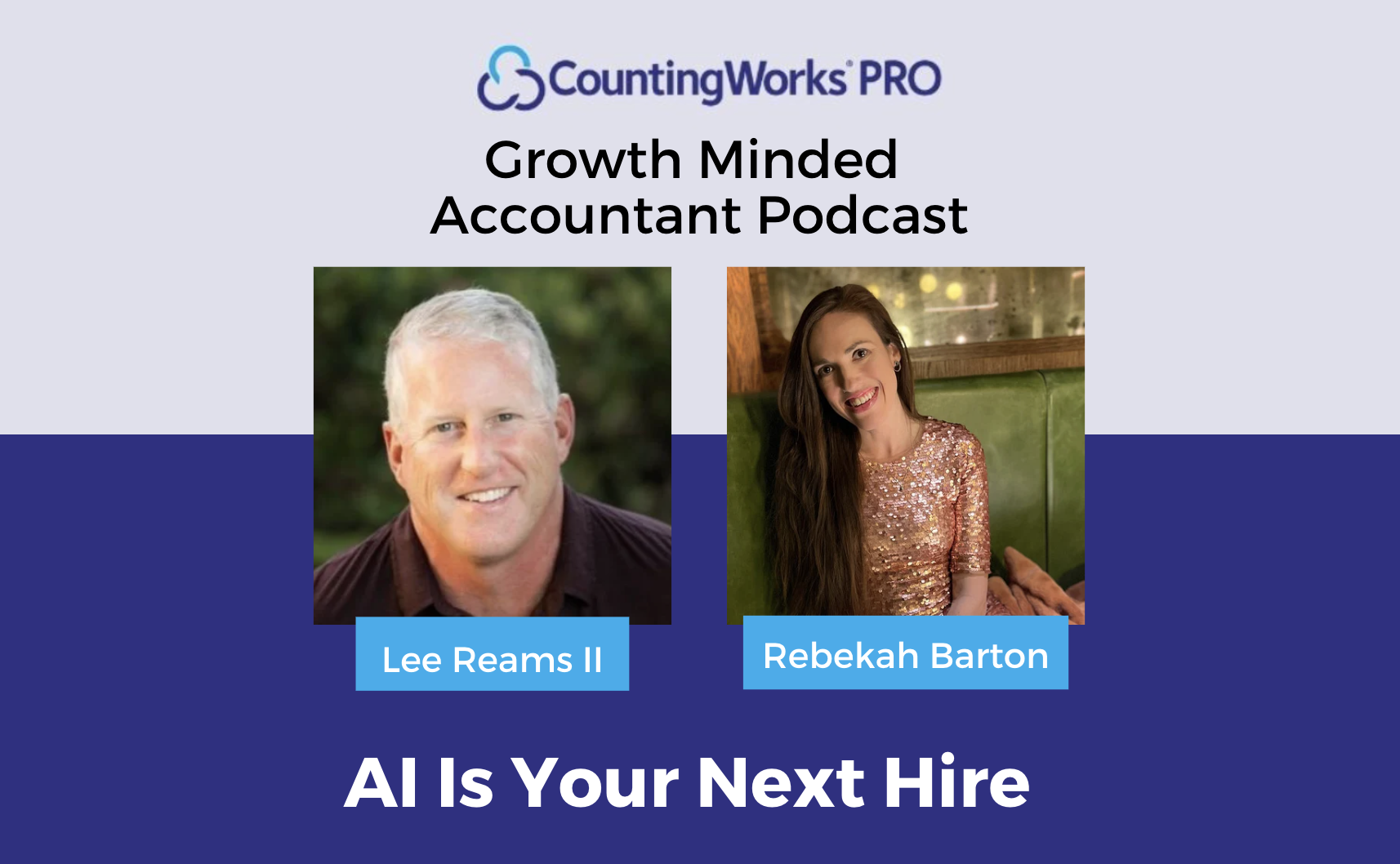
In this episode of The Growth Minded Accountant, Lee Reams II and Rebekah Barton unpack one of the biggest shifts happening in firms right now: AI isn’t just a tool—it’s a role.
With fewer accountants entering the profession and client demand continuing to rise, the traditional growth model—hire more people—just isn’t working anymore.
So what replaces it?
In this episode, you’ll learn:
This episode is a mindset shift.
Because the firms that win over the next few years won’t be the ones using the most tools… They’ll be the ones building the smartest systems—where work gets done before they even log in.
Final thought: Don’t ask, “What AI tool should I use?”
Ask: “What role do I need next in my firm… and can AI do it first?”
We know that everyone digests information differently. That’s why we’re now sharing the full transcript of each episode of The Growth Minded Accountant right here on the CountingWorks PRO blog. Whether you’re short on time, like to scan and highlight, or simply prefer reading over listening, you can catch up on every conversation at your own pace.
Each week, we cover topics that matter most to tax and accounting professionals—from AI and automation to marketing strategies, firm growth, and client relationships. Scroll down to read the full episode, or subscribe to the podcast to listen on the go.
Welcome to the Growthminded Accountant podcast where our experts will share best practices on running your firm in the digital age. [music] This podcast is brought to you by Counting Works Pro. Let's get started. Hello and welcome back to another episode of The Growthminded Accountant. My name is Lee Reams. I am the founder and CEO of Counting Works. And today's topic is uh honestly obviously probably the thing you've been hearing about everywhere and you're sick and tired of it. Uh but it is the biggest shift in our industry that we've seen in um a few decades and most firms really haven't wrapped their heads around it yet.
And uh and what we're going to talk about today is kind of my view of what AI really is. And the reason I'm bringing this up is I'm still seeing I just got an email solicitation this morning, for example, for an AI webinar, right? And it's talking about basically how to write prompts. It doesn't get into what AI really is doing. And it's really not giving you the direction, the profession, you know, kind of where things are going and what you should be doing. So my take and today's topic is AI isn't a tool, it's your next hire. And I want you to start looking at AI as a labor component. It's not just a taskmaster. It's not just sending you, you know, due dates.
It's not just rewriting a an email for a client. If used correctly, it is actually doing a ton of the heavy lifting when you're actually running your practice. So whether that be on a marketing side and we'll talk about that, how to use this agent and labor as a way to scale and grow your business all the way to onboarding to actually finding signals within your current database that clients that need advisory work for example. So while everyone is talking about AI, I don't think they're talking about it the right way.
A lot of times too, I had a Reddit post about this exact topic and someone came in and said, "Hey, the the people that are most successful right now are using offshore and AI to get things done faster." And my first thought on that is that's to get compliance done faster. That's not really talking about where the industry is going and where you should be going with your client base. And that's more into the advisory side. So, as usual, Rebekah Barton, our chief visibility officer, is joining me today. So, Rebekah, say hello.
Hey, everybody. you looking forward to this one? So, let's start with the beginning here. There's a shortage of accounting help, tax help. Uh the AICPA latest trend reports show that fewer accounting graduates are coming into the pipeline. Obviously, we have this hu huge boomer uh retirement wave. So, fewer people are even sitting for the CPA exam. There are states like Kentucky are making it easier to qualify to become a CPA or be involved. So, there's some movement there. Uh but this is not a temporary problem.
Uh NASBA, a bunch of other uh thought leaders have come out and said, "Hey, you know, demand from clients isn't slowing down." Even though the doomers are telling you, "You're all out of business." That's not true at all. You obviously saw it in the last tax season. So what firms are stuck in is a cycle of we need more people to grow or I need to start firing clients. We've talked about that in other podcasts. Um but the people aren't there to hire, right? So then they offshore and then they realize, oh my god, offshoring isn't as easy as I had hoped or if they're hiring domestically, it's like the price tag that comes on. Uh they're hugely expensive or quite honestly they don't stay.
So the real question becomes what if growth doesn't come from hiring anymore and what if it comes from building a firm that doesn't need as many people. That is what my view on the future is and that is where AI comes in. but not necessarily just as a tool but as something very different.
And uh what I've even in our own product development teams like yesterday we're working on some new tools and one of the comments I said is we don't want to give the accountant the tax pro more work like meaning we've created a new let's say a proposal tool and it writes a customized onetoone proposal that is awesome but if you don't have enough time to do that in the first place you know all you're thinking about is oh I got another tool to take more of my time or an engagement letter for example well I just don't have time to do an engagement letter.
So systems and where it's not just a tool um are actually doing all this work for you and all you're doing and coming in and saying, "Hey, this is correct. I approve. Send andor I'm tweaking it a little bit." I go from there. So that I think is what the shift is and I think that's where firms are getting a lot of this wrong. So, Rebekah, kind of give an idea of how you see taxpayers and accountants using AI tools like they think it's just a a new Google.
Yeah. And it's not. Um, Google and Chat GPT and all the other AI systems, Perplexity, Gemini, whatever your preferred system is, they work very differently. And if you're using it as another form of Google, it's not going to scale and it's not going to do all of the things that AI can do for you. I know McKenzie did some research on AI adoption across industries, not just with tax and accounting, but within pretty much everything. And many, many companies are still kind of stuck in experimentation mode. They're just playing with it. They're trying to see what it can do. They're don't have systems in place. It's all just kind of oneoff haphazard prompting.
Then they'll get something really great, be excited about it, but they don't know how to scale it. They don't know how to implement it on a larger scale to create true systems. So, I think they're starting over every time. There's nothing ongoing. There aren't these things in place that are helping them actually automate or use AI as a labor tool, which is what we're really going to get into today.
So, what you've got to do is create structure, consistency, and that's where you're going to start seeing the leverage that AI can really give you within the tax and accounting industry and how it can help you elevate yourself above your competitors without losing a personal touch, without losing the relationships that you've really built. Because I think that's another fear people have is that they're just going to become this AI company. And that's not the case at all. What this is going to do is allow you to automate and to have better systems within your office so that you can continue delivering even better services to your clients on the front end of things.
Yeah. No, it's 100% human in the loop. And Rebekah, as power users like ourselves, we understand that very easily. Um, you can see at times when AI technology can only go so far if you don't have the proper guardrails in, if you don't have the proper security in, which is even a bigger issue. I see people trying to build, you know, a standalone agent or they're trying to build what they call labor agents because they saw it on a YouTube video and then they're not even thinking about where is my client data going, who has access to that client data, am I even breaking my own rules and and and engagement, right?
Um there's a lot of different things and then they also see if they don't have proper guard rails where you don't have consistency in the results. So you need to set these up um where you can control the outcomes in a consistent manner. So when I talk about not using AI just as a tool occasionally I'm talking about and and and then this is what people think. Well, I'm writing prompts. I'm asking questions and I'm getting answers. I that's not the way I want you to think about AI right now. And and maybe the word it shouldn't be AI.
If we used it as a software tool, if we just said this is an automation tool, I think people would maybe disarm their like push back to it and realize, okay, so let's step back. What job uh needs to get done every single week, right? So I would feel a a growthminded firm would be marketing, onboarding, ongoing client communication, advisory support.
Uh and then my question is well how can AI step into those roles and maybe not perfectly but enough to remove a huge amount of the work and let's start with the marketing side and I'm going to kind of hybrid this with onboarding and some things that we are doing and we've talked about this before but on the marketing side we have utilized AI as a full-on copywriter website designer I would say um an IT person to deliver marketing material via social media whether whether that be via email. So in the old days, let's think about it. You might have had a small team of people just to do the marketing um side of your practice, right?
But if now I have 15 or 20 accurate, trusted, targeted blog articles written for me at scale, automatically publishing, automatically being added to my client newsletter, automatically being shared on social media, that is a huge labor component. So whether you would have hired that person or not, AI now enables me to think of AI as labor. I can turn it on. I can put guard rails in. I can teach it. So let's talk about that real quick, Rebekah, on how to get kind of the consistent results. How do you you add guardrails to say my firm tone is X. I like to write like, you know, Z and then kind of give it uh guardrails.
I want to target this type of messaging or I want to create clusters around this type of topic. How do you train it or how do you give advice to it to make AI act as a trusted labor component?
Yeah. So, these LLM systems are smart. That's the first thing to remember. It is going to understand as you train it. And really, the best way to train your AI is to use it. Use it as a true assistant. I use mine. I know Lee, you use yours and hours a day. There are probably days that I'm in AI doing some kind of task for 10 hours, letting it help me, you know, do various things for work. Um, so I think the biggest thing that you can do is literally speak to it like you would an assistant. If you want things done a certain way, say you want it done a certain way. If you want things to be written in a specific tone, tell it that. Upload samples of your writing.
Upload samples of emails you've written. Upload samples of blog posts you've written. Upload samples of any interviews you've done. All these kinds of things will help it understand who you are, help it understand your tone, the kinds of words you use, the syntax you use. The more you train it, the more back information you give your AI, the more it's going to understand about you. Just like when you get to know a new person or you hire a human assistant, it's going to take them some time to dive into everything that you've done before and really understand who the firm is, who you are as a firm owner. Do the exact same thing with your AI system. And also give it positive feedback.
I found that when I tell mine things like, you know, that was great. Repeat that in the future. It really does. And it it remembers those those pieces of praise and exactly the types of things you want. So, I think that's something a lot of people skip is they just move on to the next task and they don't actually tell the system, hey, do this again next time or keep this format next time. That's how I build a lot of repeatable processes within my workflows is just consistently telling it what I like and what I don't and where to make these changes and then it does make those changes moving forward.
Yeah, I'm going to continue on with some more labor examples of again not just a tool but actually doing things. So, uh we have a prospecting agent for example. So, I can tell the prospecting agent, hey, I want to target restaurant owners in San Francisco that have revenue between $500,000 and $10 million. Uh, and I want to offer uh CFO advisory full turnkey services to these restaurants. Our prospecting agent will go out, find the target audience. It will scrape the web and basically enrich the data and actually create almost a narrative about that person so that when it starts outbound cadence to this uh prospect, it's actually speaking exactly personalizing every single email.
So instead of sending 400 emails of the exact same thing, every email will be personalized to that specific firm. It will then write blog articles about it. It will write FAQ articles about it. These are things that will help you rank better in search. It will help you rank better inside these inside chat GPT. When someone is looking for uh you know I'm looking for a CFO for my restaurant business. This will now surface your practice inside that is a labor agent. The old days you had that was a you know a sales development person. You had you know like a HubSpot person. You're talking tens of thousands of dollars.
We've created it now where it's a hundred a couple hundred dollar a month or $100 a month, whatever it is, right? So that is labor on the onboarding side and this is kind of a cross between marketing and onboarding. Um we have now surfaced uh an agent that sits inside your blog articles and this something we haven't released yet but it's coming. But basically it will say hey do you have more questions about this topic? The old days it's a static blog that you know what maybe they reached out to you maybe they asked a question maybe you had some call to action. This time now it takes the conversation and actually evolves it.
And the whole idea with every tool that we build is to have the human in the loop be a part of the conversation. So it teaches it shares knowledge. It doesn't do a DIY type of uh advice giving I would say it's more of hey okay here's some more answers here some more questions about it. And all this information then is loaded inside of your portal for as a lead. And now that lead you have all this documentation exactly what they're looking for. This is like onetoone advisory, you know, surfacing onetoone advisories. So these are the ways that I'm talking about in onboarding. It's super simple.
If you can figure out a way that every client gets almost a custom task, you know, based on what you are, because we know, so we've enriched the client data, we're scraping all the client data from your tax returns, the financial statements, and now we're able to surface, hey, this client needs this to-do list. these are the documents that you should upload and automatically request them. By the time you're logging in, you're just logging into a dashboard that says, "Hey Lee, here's six clients ready to go to step two. Please review where they are. Uh these clients are forget, you know, or or or lagging or whatever." And then you can create game plans for it.
So, that's another form of labor.
Another option is in a dashboard, for example. You log in every day. It tells you exactly what's going on in your entire client database. Here's your six appointments. Here's the 10 clients that have inquired about a question. Your AI, your labor already wrote the responses. It knows the tax research. It knows the tax code. It already speaks in your tone. They're just ready for you to review. So that's what I mean by labor and setting up certain roles. So if you start breaking down your practice, you almost can be where you're an admin or maybe your admin is an admin of all these AI labors. So it's not necessarily perfect. Um, there is human in the loop. We've already said that.
But I would say, does it double you, triple you, quadruple you? Does it mean you don't have to hire as many admin people? Maybe not as much seasonality, maybe you don't need people off season. 100%. Um, so one of the things that I am seeing though is a I'm going to call it a tool stacking problem. So this is where firms get in trouble. They they go out and they sign up or they create their own little agents. I've seen quite a few DIYers lately that have built absolute just disgusting websites. They've built like the workflows that barely operate. They're like rubber banded together, but they saw online or a media and influencer saying you can do this this and that.
And the reality is they're all disconnected. I don't know what the security is. They don't perform well because AI is not able yet to be like people all talk about vibe coding. Yeah, I can create incredible comps. I have a really hard time creating a code base overnight talking to it. Okay. Is it possible? Maybe. But you have IT people spending a ton of time and they're developers and programmers. So what you end up having is you have one tool that you use for your blog, another one for your email. So I there's a new tool out that I've seen that will write uh responses for your Gmail. Well, first of all, if you're an accountant and you're using and they're targeting accountants.
I'm like, what accountant is responding to clients via email when they're asking personal financial questions? So then the first problem you got to your question is what kind of vendor doesn't even understand my business, right? But the point of my point is that you have multiple tools. None of them talk together and I think that becomes even a bigger cluster than you already had. So uh they might generate ideas, they may generate drafts, but they don't actually execute. Uh and there's a a stat from Gartner that says knowledge workers are already overwhelmed by the number of tools and notifications they deal with daily.
And one of the things even we found when we were developing our software is I felt we were overwhelming even the words urgent ASAP and we're sourcing all this new information but it felt like to an accountant's point of view I was like oh my god AI is making my life even worse not necessarily better. So you don't want 10 AI tools sending you notifications. You want one system that actually works together and is doing and delivering work. So Rebekah, why is that such a big difference?
Well, most tools are going to create more decisions for you, right? Do I like this? Should I change this? Do I need to rewrite this? Do I need to prompt this again? So instead of actually saving time and building systems, you're just managing outputs all day, which isn't actually saving you time, right? It's just changing how you're filling your time, but you're still wasting the same amount of time on busy work and repeatable tasks that could be automated. So, the goal should be to have the AI system draft the email, build the proposal, prep the response for you, and have it sitting there for you when you walk into your office in the morning.
You sit down at your computer, everything is set to go. All you have to do is review and then divide and conquer like you were just talking about, Lee, right? Whether that's sending the emails that are already prepped or delivering things to your admin so that they can handle it. Everything's done for you on the back end. And that's the big difference. You sitting in an AI module all day long tweaking prompts, tweaking outputs is not really resolving the problem of you wasting your time doing repeatable tasks, right? So, you need to find a system that works together, that works cohesively.
I've actually talked to some clients recently who are like, "Well, we're going to still use this for our CRM and we're going to have it bridged with this tool." And it's just like, "No, no, no, no, no.
You need one thing um one system." So I think it is a big problem because it's something that I've been seeing and you know people just don't understand how a single system can just do things for them in a cohesive fashion as opposed to peacemealing this kind of gigantic AI tech stack that is going to become a huge problem within a week and you're going to just be so confused by all the different things you have going on that it is like you just said going to make things worse instead of better which is absolutely not the goal here.
Yeah. the so let's just keep it on the same theme about AI as labor. So the example of what Rebekah talked about, you know, let's say it's busy tax season. Overnight you get or let's say over the weekend you get 10 or 15 client inquiries. They go through your secure client CRM. Hopefully, they're not sending it to your your Gmail. And an AI labor tool should be able to do all the research, write that response, and then all you're doing is when you come in in the morning and log in on Monday, your your dashboard should say, "Hey, review uh the 10 responses to your client hub." And then three of those responses were they wanted to change their appointments.
And the AI automatically found them a new appointment. Right? That is true labor. Um, and I think that's really important. So, that's just another example. Perhaps it's surfacing advisory opportunities for you because it knows the background of each client. All you're doing then is saying, "Hey, do I want to send that proposal for advisory?" Because it says, "This person just hired eight people. They are prime example of someone who should be doing CFO advisory services. Here's the proposal already written for you. Do you want to change the pricing? Do you want to change the services? Do I want to send it at all?" So that's the way it really starts working as a labor site.
So we had mentioned security and I think that's something that does not get talked about enough and we see it too often where pros are very loose with their security. Two-factor authentication. It's too too cumbersome for me. There's a reason you're you're dealing with their most you know they have you have your social security numbers, you have their financials, you have their you know you have your tax returns. uh that really concerns me. And you if you're putting your client data in public AI tools, tax info, financial, social security numbers, personal details. Um that's a big that's a big issue and it's not secure.
And then that's what I've also seen is, you know, like openclaw and these tools, you're putting all these different tools together. I don't even know if you're actually, you know, breaking the rules of each software product. probably their service agreements, but the reality is now you're sharing data all over the place. I think that is a big issue on a profession built on trust. So I just want to tell people be careful before you jump in to it's kind of like the wild west. But if AI isn't built in a secure system, it's not just inefficient, it's it becomes a liability and most firms don't even realize where the data is going.
They're not even following, you know, I they're not even thinking about it. Um but I think it's a big issue.
So let's go into a area that we're into at the growthminded accountant talks about a lot and that's going to be uh AI marketing tools and more importantly utilizing what the chat chbetes the perplexities the clouds are doing right now what Gemini is doing and what's changing right now um Rebekah in that side and what are you seeing happen I think search is becoming AI driven but kind of explain that and then we'll kind of get into if you and go into again a few more things of how labor AI can do these tasks that they couldn't before.
Yeah. So, search is definitely changing and it's definitely becoming AIdriven. This is probably what's changing the fastest actually because you have all of these search algorithms that have completely shifted within the past 12 to 24 months really. Um I like to say now I relearn my job a couple times a year as the algorithms change and as AI becomes more and more important. And I love that. Like that's I am a nerd about this stuff and I enjoy it so much. But I think with search becoming AIdriven, it's really changed how people need to view what they're putting out into the internet. No longer is keyword stuffing a thing.
It doesn't matter um if your website says, you know, five times tax preparation in Las Vegas or whatever the situation may be. What matters is the story you're telling and naturally geollocating yourself and telling a cohesive narrative across the internet. And this is something we've talked about a lot, but I think firms are really beginning to realize that just having a website isn't enough anymore. In my field, we call it having a web footprint. Building a full web footprint. You don't just want a website. You don't just want a Facebook page. You don't just want an Instagram.
You want to be feeding all of these different platforms because that's what's going to help build authority for you around the web. Blogging is going to help build authority for you around the web. writing articles on thirdparty websites like Taxbuzz, um, Medium, these different kinds of places. You can put different content on different websites, but as long as it's cohesive, that's what's really going to matter. Niching yourself down. Um, Google has even said themselves in search central that they are prioritizing helpful content that is people first, people driven. What are the questions people are actually asking? Answer those in your content. You can use AI to help you research this.
Having FAQ pages is huge. Now, each of these points I'm making could really be its own podcast. So, I feel like we're kind of flying through it for the sake of time, but this is a really important part of the puzzle here as far as ranking within AI and also with using AI as labor. So, on the back end of things, you're probably thinking, how am I going to have time to build out all of this content, right? Like maybe you know it's important but actually getting from the ideology of it's important to having physical deliverables that you can put out onto the internet feels overwhelming. That's where AI as labor can really help you.
And I think this is the thing we don't talk about as much here is how to utilize that. So you can build out systems that will help you create social media posts for a month that will help you use something you've written, say a long form blog post, and break it down into pieces of media that you can just automatically post for every different platform. You know, you can turn points you've made in a blog into social media captions. You can turn them into reals, into scripts for YouTube.
So, there's kind of this way to use AI that I like to talk to people about where you can take a single piece of content and have AI break it down for you into something that may last you two weeks, 3 weeks, a month, and then you have this cohesive content that's already built for you. Graphics can be built for you. Your entire social media marketing system can really be automated with an AI. And the same goes for blogging. You can build content clusters and then you can take those and break them down.
So, I think using AI as kind of a marketing assistant is something that is very possible and maybe feels a little bit like a pipe dream to people, but if you can dedicate maybe 30 to 60 minutes a month honestly to just really being in your AI system, you can get all of the deliverables you need from a marketing perspective for an entire month. And then email would be another area um where it can write out email campaigns. It can create niched down campaigns for different segments of your clientele. All of that is going to be able to be automated or at least heavily automated if not fully within your AI system, right?
And we're talking about labor and we obviously have our playbooks that are doing exactly what you're talking about. And let's just talk what is the labor that would have gone into that before. You have probably a marketing and advertising type firm or mind. You have then a copywriter, probably a specialized copywriter, especially if you're talking about the tax code. Then you have someone who's going to select the images, create the graphics. Then you have another person who's going to then publish the article and the blog articles. So AI tools, things that we have built that we have, we've had this tool out for a year. Um could do this at scale. Personalize it. That's the thing.
The personalization at scale is the the beauty. So it's not just generic. You went in and wrote a prompt to say, "Write me an article about a 529 plan." No, it's going to go much deeper into the area that you serve, the geography, perhaps some landmarks that it will mention. Um, it will talk about the personality of your firm. You know, there there's so many things that it can add.
And if it's doing onetoone emails, so meaning if you're sending emails to your current client base, maybe it's trying to upsell them uh to uh tax advisory from just being a compliance client, it is smart enough to use all the information and context it has about that particular client and then craft an email that is particular to that individual client one to one, right? And that is huge. So you know what what would that have cost in the old days? You know, we used to say, uh, you know, if you hired everyone as contractors, you're talking 30, 40, $50,000 a year, easy. Um, so this is one of the things though that accountants probably weren't doing that in the past.
Only the more successful firms were. And this is the great equalizer and this is why I I think this topic is so important is firms of all sizes now have access to these tools. We're selling them in small subscription, you know, monthly subscriptions. So it's like if you start thinking okay I can now supercharge my firm my capabilities by a small investment um versus what I was paying in labor I mean it's night and day. So once you start thinking that way once you start doing the shift I mean you already seen it in the code writing they're thinking in tokens.
So one developer now has a developer cost and then they have a token cost but guess what that one developer is doing five times what they were doing 10 times what they were doing previously. So I mean the net net cost output is hugely amplified. More importantly the cost is is way down. So which circles back to what I think everyone cares about and that's time. And AI saves time. But that's not necessarily the goal. If AI gives you back 10 hours a week, that's not just efficiency. That is capacity for people that want to grow. Capacity to actually do higher value work and really getting into the advisory side of things.
And some of the tools that we're doing now will not only find advisory opportunities within your current client database, but also then craft the upsell campaigns to those clients and then actually basically serve up what that compliance u from compliance I mean to advisory what that advisory report for example or that advice the strategies actually looks like. So AI doesn't make you just more efficient. It makes you more valuable to your client base, right? You're delivering better financial outcomes if you use it right. Um and that's I think a big deal. So let's go into u the idea that uh your first AI hire, you know, you know, okay, well that makes sense. You know, where do I start?
Uh, and I would say keep it simple and map your practice out into these these areas that I've been talking about. So, marketing, what do I need assistance in? What can I use AI labor to amplify? Maybe there's an area that you never thought you could afford to do before, but you can now. A small monthly fee could give you what that may have cost you $100,000 a year before. onboarding everything from collecting data even scheduling appointments, rescheduling appointments, uh reminding clients who are still missing information, proddding them automatically. The system works in the background. So then it tells you, okay, this client is ready now for the human in the loop review.
Okay, client communication. Um, what is that? That's not just like a newsletter. That's not just social media. client communication where you have an AI assistant write those initial drafts of of responses, right? Um there's a number, you know, even just having some sort of response back to the client when they send something in saying, "Hey, setting expectations. It's busy season. Hey Lee, you know, and it's not just a normal um response. This is a personalized. It feels very human." Okay. And then more importantly, delivery. How do we make the delivery of our product a more professional?
Perhaps easier for the client to go through and review and be a part of it, easier for them to pay you, maybe easier for them to approve, easier for you to to to get the the data back to say, okay, now it's time to uh file a tax return. So, you know, what I'm thinking is where am I spending time that doesn't require my expertise. Think about that. So, those are the the the medial tedious tasks. You know, that's your first AI hire. You know, not everything at once, just one role, one function, and see how it works, right? And once you get it, once you start this thing, you're you're going to feel, I think, almost less frantic. You feel more powerful.
I I feel for sure, you know, let's just talk about, you know, some of the things that I've been doing. Um, I used to have a a huge marketing department and we can do I'm going to say 20 30 times the output that we could do when we had five or six people running this before. It's incredible and the quality is much better. Um, and it makes us much more efficient, but more importantly, it creates the expertise like, and how do you explain this, Rebekah? Where you have a vision, let's say, as a firm owner or you have a definite point of view of what you want to talk about. you're an expert, but then you assign it to another person who then has another person helping them out.
They don't have the expertise perhaps in creating that type of content and it gets washed down. By the end of the day, you as the expert are are doing all the work. So, and I I see that all the time.
Yeah. I think that happens all the time when you're working with with anyone, right? Because you are the one who ultimately has to come back in and do things. And I think that's where a lot of firm owners get burned out. And it's actually somewhere AI can help a lot because if you train it properly and you train it on your expertise, then it becomes effectively an extension of you. And I know Lee, you and I both use our AIs that way. We have taught them very well what we know about our specific industries and knowledge bases.
And now the outputs are such that we're not having to do perhaps as much cleanup work as we necessarily would even with using like human assistants or a whole staff of marketing agents. It kind of eliminates that bottleneck and that middleman of having, hey, I've got a huge team to do this. Now you've just got one AI labor agent that you are training on your own expertise. And I think it just makes things a lot cleaner, a lot more efficient. Um, and it's something that far too few tax and accounting professionals are taking advantage of, which is kind of the whole point of this podcast is that you can use AI this way and you can really help it.
It can assist you in creating those systems that maybe you've been lacking or that you found in the past to be inefficient or clunky.
Yeah. And I'm going to give one last example and I'll kind of wrap this up. But uh so one thing we've seen as well is the idea of using a tool again as labor to do kind of the interview process but start making it I'm not talking about the intake but start making it dynamic.
So meaning the old days everyone a certain group of clients you all got the same template same type of questions in the AI world the client's intake experience the questions being asked the data being collected you used to have to have a human sit down who's smart enough to go I asked this question based on this I do this um on a system the old way of a process it's set you don't get that it's the same intake form the same questionnaire for every client we've developed tools that dynamically will change the questions that it's going to source from your clients that is almost like a pre-in process and this will helps again help you create the the offer the best strategies the best ways to deal with this and more importantly educate your clients on new opportunities for advisory that is a labor component.
So, if I now can have my AI tools having these conversations with my clients in a very professional, polished way, when the the data finally gets to me for when I'm starting to do my work, I probably cut out an hour, an hour and a half, or more important, I wasn't doing it well enough. Um, I'm going to do a better job because I have more insight about my client, more personalized insight than I ever did.
So, you know, the way I look at this, the firms that win over the next few years aren't the ones that adopt the most tools. uh they're they're the ones that are going to build the smartest systems. I think there's a lot of catchup out there right now. Um the good news is unlike the the webinar that I was sent yesterday that felt or actually this morning that felt like it was built for two years ago AI discussions, there are firms like BDO that are BDO that are talking about, hey, there's AI powered firms. They were AI first firms and this is what they look like. And I think if you start thinking that way, you're basically building AI powered teams.
So humans and then you have your agents doing the work, you are basically managing the outputs, managing the decision trees. That is where a lot of the work that you a would not have done. You wouldn't have gone through all this data. You would not have been able to have this much input into creating strategies than you ever did before. Okay? And what happens is the work, most of this work is done for you while you're sleeping. You know, I I gave you that example of I had 10 inbound client uh questions into my hub. The AI or Max, our tool would have written, researched, responded. You could set it up. We're not setting it up yet to it just sends.
We still have please review, but at some point I think you're going to trust it to send. Um but I think that is huge savings, right?
uh if you were doing that the in the old days or the I guess I guess call it the old days you know you might have a tax researcher that has to analyze things they have to then articulate and write the answers they have to reference it this would take hours per response and that's why pros get bogged down in the busy work right uh so I think it's really important to start looking at this in a different way and again don't ask what tool I should use it's what role I need in my firm that AI can do it first and even probably better so that wraps wraps up this edition of the Growthminded Accountant podcast. Um, hopefully we've driven in AI is labor. AI is labor.
Don't think of it as purely a chatbot, okay? Think of it as actually doing things that you do today more efficiently. Maybe they're doing 85 90% of it. I'm not saying it's delivering things on its own. We that's not my mindset at all.
I think is just a tool to do most of the research and think of it as just if you had an army of assistants and now for each thing that you think about okay what can AI do first that I'm not currently doing that's how you start developing your tech stack so uh thanks again for being a listener to the growthminded account podcast we will continue talking about best practices ways to survive and to uh be very successful in the AIH so until next time um have a I'm sure you're all still I've heard a lot of people on six week I heard a six week Disney cruise. That was one of our subscribers. I'm like, six weeks on a Disney cruise? That's crazy.
But hopefully you're all enjoying your time off and kind of getting refreshed and getting ready for next season. So again, thank you.
Q: What does it mean to think of AI as a “hire” instead of a tool?
A: The episode argues that AI should be viewed like a team member with a specific job function. Instead of using it only to answer questions or write content, firms can assign it roles such as marketing support, onboarding assistance, client communication, research, or advisory opportunity identification.
Q: Why aren't AI prompts alone enough to improve a firm's operations?
A: Individual prompts can produce useful outputs, but they don't create systems. Firms often end up repeating the same work over and over, while integrated AI workflows can continuously handle tasks, surface opportunities, and prepare deliverables without requiring constant manual input.
Q: How can AI help a firm grow if there aren't enough accountants to hire?
A: AI can take over many of the repetitive tasks that consume staff time, such as drafting communications, managing onboarding workflows, monitoring client activity, and creating marketing content. This allows firms to serve more clients and expand services without relying solely on additional hiring.
Q: What's wrong with using multiple AI tools for different tasks?
A: The problem is that disconnected tools often create more complexity and more decisions for staff. Instead of reducing workload, they can force users to manage multiple dashboards, notifications, and outputs. A unified system is more likely to create efficiency because the tools work together.
Q: How does AI create new advisory opportunities inside an existing client base?
A: By analyzing client data, activity, and communication patterns, AI can identify situations where a client may benefit from tax planning, CFO services, entity restructuring, or other advisory work. Rather than waiting for the client to ask, the firm can proactively present recommendations and solutions.
Q: What is the biggest mistake firms make when implementing AI?
A: Many firms focus on saving a few minutes on individual tasks rather than redesigning how work gets done. The episode emphasizes that the goal isn't efficiency for efficiency's sake—it's creating more capacity, delivering higher-value services, and building systems that continue working even when staff are offline.
Listen to other podcast episodes or read other related blog articles with relevant information and insights.