



Growth is not the same thing as getting more clients.
That is where a lot of tax and accounting firms get the conversation wrong.
Some firms need more demand. Others have plenty of demand but need better clients. Established firms may have their biggest growth opportunity sitting inside their existing client base, while overloaded firms may need more capacity before they should even think about adding more work.
So when an accountant says, “I don’t need marketing,” the better question is:
What kind of growth does your firm need next?
Because nearly every firm has a growth opportunity. It just may not look like more tax returns.
Marketing Is Not the Goal. Growth Is.
The word “marketing” creates resistance for a lot of accountants. It can sound like advertising, cold outreach, social media, or trying to convince someone to buy something they do not need.
That is not the point.
Growth can mean more demand, but it can also mean better-fit clients, higher-value services, more revenue from existing relationships, better retention, greater capacity, less dependence on the owner, or a stronger position within a specific niche.
A website, reviews, content, AI visibility, client intelligence, automation, and advisory are not unrelated marketing projects. They are different growth levers.
The real question is which one matters most for your firm right now.
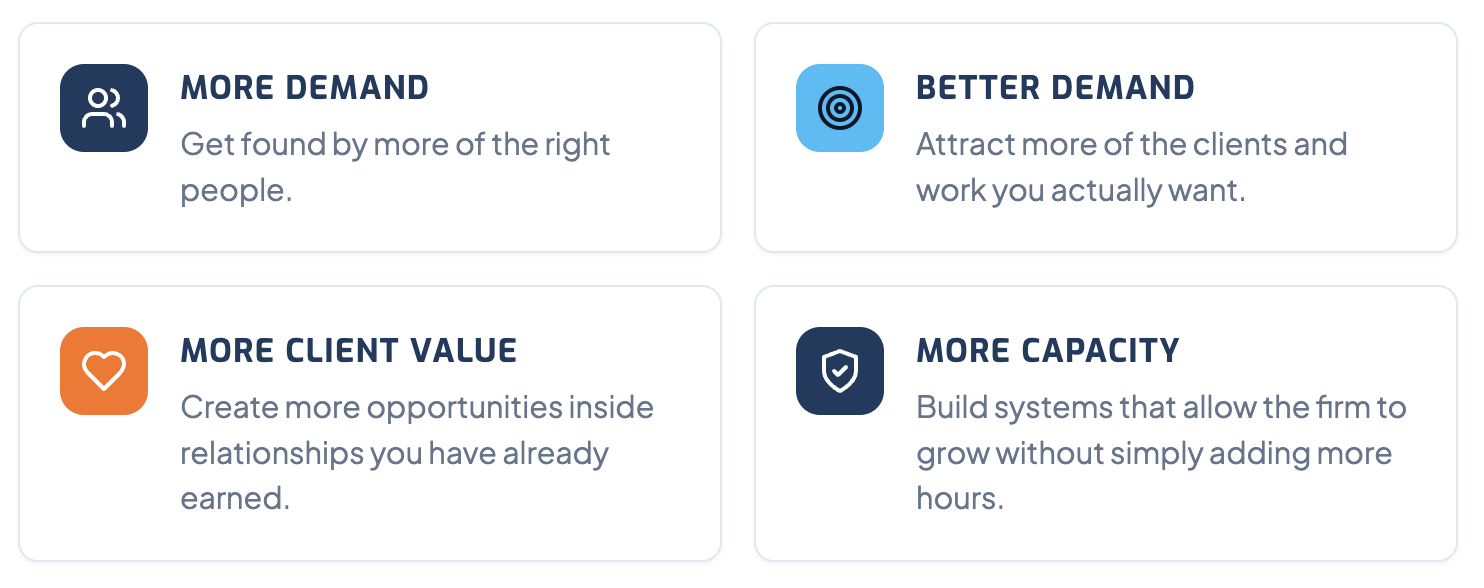
MORE DEMAND
Get found by more of the right people.
BETTER DEMAND
Attract more of the clients and work you actually want.
MORE CLIENT VALUE
Create more opportunities inside relationships you have already earned.
MORE CAPACITY
Build systems that allow the firm to grow without simply adding more hours.
“I Don’t Need Marketing.”
Maybe you don’t.
If your firm has all the clients you want, at the prices you want, doing the work you want, with strong retention, enough capacity, a healthy pipeline, and no concern about what happens if referrals slow down, then generating more demand probably should not be your priority.
But that is rarely what firms actually mean.
“Most of our clients come from referrals.” That is great, but referrals are not the same as having control over your growth.
“We’re already too busy.” Then your opportunity may be better-fit clients, better pricing, more capacity, or replacing lower-value work.
“We don’t want more tax returns.” Good. Growth does not have to mean more tax returns. It could mean more planning and advisory work, better relationships, or more revenue from clients you already serve.
“Marketing has never worked for us.” Maybe the problem was not marketing. Maybe the firm was promoting generic services instead of clearly showing who it helps, why it is different, and what problems it solves.
And if the concern is “we don’t want to be salesy,” your clients probably do not want that either. A good growth strategy should make it easier for the right people to understand your value and choose you. It should not turn accountants into salespeople.
These are not really arguments against marketing. They are questions about what kind of growth makes sense for your firm.
Growth Looks Different at Every Stage
There is no single growth playbook that works for every tax and accounting firm.
A firm trying to establish itself has a very different problem from a successful practice with hundreds of clients and an owner working 70 hours a week. As the firm changes, the growth constraint changes with it.
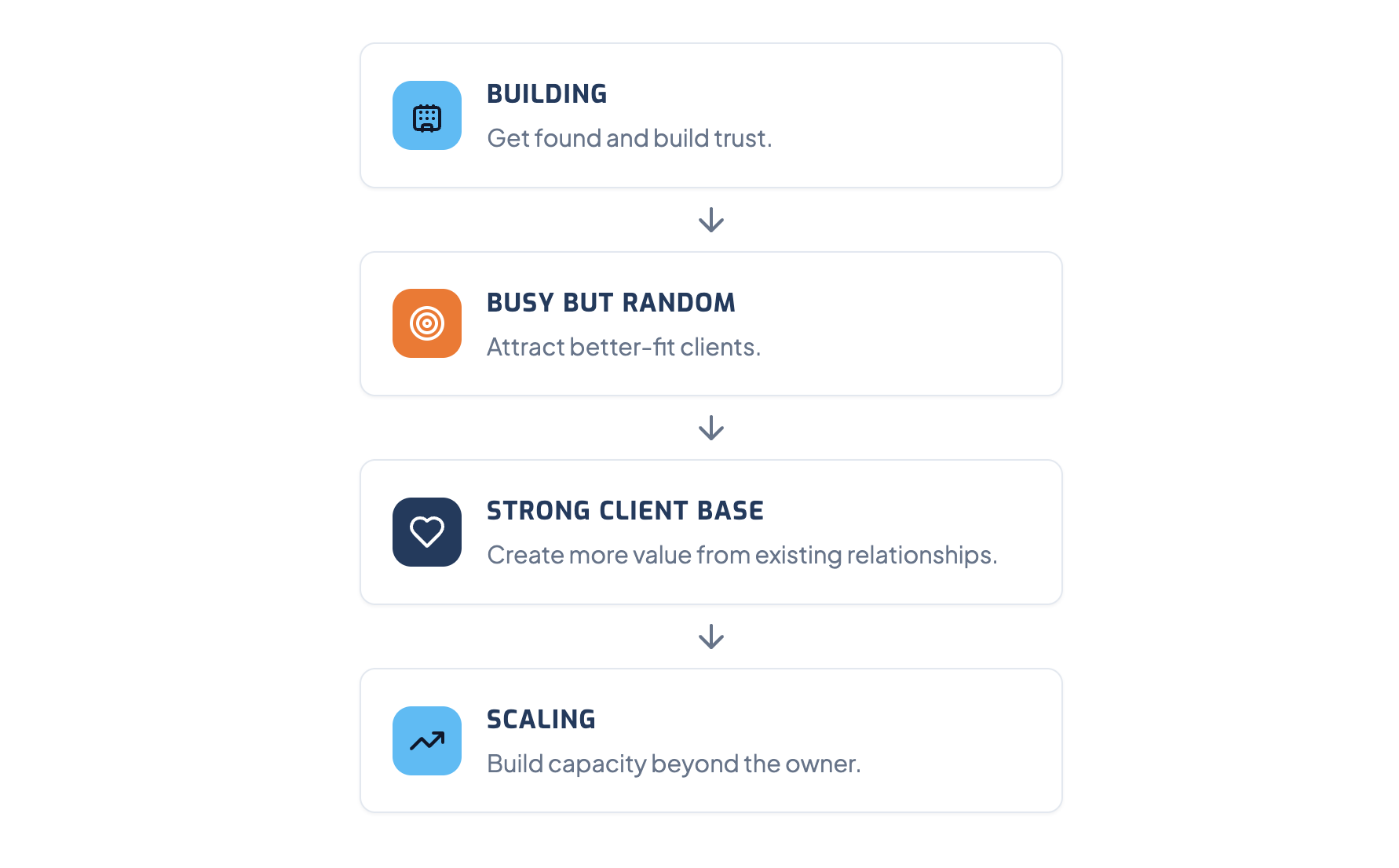
Understanding where you are makes it much easier to decide what deserves your attention next.
Stage 1: You’re Building the Firm
For a newer or growing firm, the challenge is usually straightforward: not enough of the right people know you exist.
At this stage, growth is primarily about visibility and trust. Prospective clients need to find you, quickly understand what you do, believe you can help them, and feel comfortable taking the next step.
Be Clear About Who You Help
A firm that says it serves “individuals and businesses with all of their tax and accounting needs” sounds like almost every other firm.
Specificity creates relevance.
Maybe you work particularly well with real estate investors, construction companies, dentists, professional service firms, business owners preparing for retirement, or families with complex tax situations.
You do not necessarily have to become a one-niche firm, but prospective clients should be able to see themselves and their problems in your website and messaging.
If you want more construction clients, for example, do not make prospects hunt for evidence that you understand construction. Create a page that talks about job costing, cash flow, payroll, entity structure, and tax planning for contractors. Ask existing construction clients for detailed reviews. Publish useful content around the questions contractors actually ask.
That is how demand becomes intentional.
Build Trust Before the First Conversation
People are forming an opinion about your firm long before they call you. They are looking at your website, reading reviews, checking your credentials, and comparing you with other options.
Increasingly, they may also be asking ChatGPT or another AI platform questions about their situation and who might be able to help.
Your digital presence should make the case that your firm is credible, relevant, and worth contacting before the first conversation ever happens.
At this stage, growth means getting into the consideration set and giving people a reason to choose you.
Stage 2: You’re Busy, But Growth Is Random
This may be the most common position in the profession. The firm is successful, the phones ring, referrals come in, and everyone is busy. Yet there is often very little control over what kind of client walks through the door next.
That is not a lack of demand. It is a lack of intentional growth.
At this stage, the opportunity shifts from generating more leads to creating better demand.
Decide What You Want More Of
Start with the clients you already have.
Which relationships are most profitable? Which clients value your advice? Which industries or situations does your team understand particularly well? Which engagements would you happily duplicate?
Those answers should shape your positioning, website, content, reviews, and overall story.
If a firm has 40 great restaurant clients and a deep understanding of restaurant payroll, cash flow, sales tax, and margins, that should be visible. If a firm has become particularly strong with physicians or real estate investors, that expertise should not remain hidden inside the client list.
Growth does not have to mean adding 100 clients. Replacing 20 poor-fit relationships with 10 much better ones could improve revenue, capacity, team satisfaction, and the quality of the work at the same time.
Marketing becomes less about volume and more about attracting and filtering for the right opportunities.
Give Better Clients a Reason to Choose You
Referrals still matter enormously, but even referred prospects do their homework.
If someone receives the names of three firms, they are likely to visit the websites, read reviews, compare expertise, search the firms, and increasingly use AI to help evaluate their options.
Your digital presence should answer one simple question:
Why this firm?
Maybe the answer is your niche expertise. It could be your proactive approach, client experience, specialized services, responsiveness, or how well you understand a particular type of business owner.
Whatever makes the relationship different, do not make the prospect figure it out.
Stage 3: You Have a Strong Client Base
At some point, your biggest growth opportunity may no longer be outside the firm.
It may already be sitting in your client database.
A client buys a rental property. A business starts hiring rapidly. An owner begins thinking about retirement. Someone sells an asset, starts another business, changes entity structure, or begins preparing for a future sale.
Those events create opportunities for planning and advice, but clients do not always know when they should call their accountant.
And professionals cannot personally remember every potential opportunity across hundreds of relationships.
That is where client intelligence and technology can become growth tools.
Surface Opportunities Instead of Waiting for Clients to Ask
The better organized your client information is, the easier it becomes to recognize needs and opportunities.
Technology can help surface patterns and client attributes across your database:
Who owns rental property?
Who is approaching retirement?
Which businesses are growing?
Who has multiple entities?
Who may be preparing for a business sale?
Who could benefit from a tax planning conversation?
Who has never used advisory services despite having a more complex financial situation?
The point is not to have software “sell” clients additional services.
The point is to help the professional recognize opportunities that would otherwise remain buried in tax returns, documents, emails, and memory.
Then the accountant can decide what deserves a conversation.
Give Clients a Reason to Talk to You
Once an opportunity is identified, communication can be highly relevant instead of generic.
Imagine identifying 40 business owners in your client base who are between ages 55 and 65. Rather than sending your entire database another generic newsletter, you could send those clients an educational piece about preparing a business for sale several years in advance.
Or identify clients who own rental property and send them timely content around depreciation, cost segregation, or a tax law change affecting real estate.
A targeted article, email, webinar, planning reminder, or personal outreach can help a client recognize an issue they did not know they should be thinking about.
That is how advisory grows naturally.
The firm is not forcing another service onto the client. It is surfacing something relevant and creating a reason to have a valuable conversation.
At this stage, growth comes from creating more value inside relationships you have already earned.
Stage 4: You’re Trying to Scale Beyond the Owner
There is another version of growth that firms do not talk about enough: what happens when the firm becomes too dependent on one person?
The owner brings in the clients, remembers the relationships, answers the questions, reviews the work, and knows what needs to happen next. Eventually, growth becomes constrained by the owner’s time.
At this stage, growth is not primarily a marketing problem.
It is a capacity problem.
Make the Firm’s Value Repeatable
The firm’s story should not exist only in the owner’s head, and neither should the client experience.
The way prospects are handled, clients are onboarded, information is organized, opportunities are identified, communication happens, and follow-up gets completed should increasingly become part of how the firm operates.
Clients also need to develop relationships with the firm, not exclusively with one partner. Better systems and shared client information make it easier for other professionals on the team to step in with the context they need.
That allows the firm to grow without every decision eventually landing back on one person’s desk.
Use Technology to Return Capacity
Technology, automation, and AI can make work faster, but speed is not the ultimate goal.
Capacity is.
Look at the repetitive work consuming professional time today.
Document requests. Scheduling. Follow-up. Client onboarding. Research. Data organization. Routine communications. Identifying missing information. Tracking deadlines.
Every process that can be simplified or automated creates capacity for something more valuable.
That might be planning, advisory, client conversations, business development, or simply completing the firm’s existing work with less stress.
Technology should not just help you do more work.
It should help your professionals spend more time on the work that creates the most value.
So, How Do You Actually Create More Growth?
Start by identifying the biggest constraint.
Not all four growth levers.
One.
If You Need More Demand
Start by improving how the right prospects find you.
Pick one or two client types you want more of and make sure your website clearly shows that expertise. Build stronger reviews. Publish useful content around the questions those prospects are asking. Improve your visibility in Google and AI-powered search.
Do not try to be visible for everything.
Become more visible for the work you actually want.
If You Need Better Demand
Look at your best clients and reverse engineer why they are good clients.
Then sharpen your positioning around them.
Change generic service copy. Build niche or specialty pages. Feature relevant reviews. Explain the client experience. Show how your approach differs.
Your goal is not simply to generate more inquiries.
It is to make the right prospect think:
“This firm understands someone like me.”
If You Need More Value From Existing Clients
Start with your database.
Use the information you already have, and technology where available, to segment clients and surface potential opportunities.
Then choose one issue worth talking about.
Maybe it is retirement planning. Business succession. Real estate. Entity structure. Estimated taxes. A new tax law. Cash flow. Advisory.
Identify the clients for whom that issue is relevant and give them a reason to have a conversation with you.
That is a much better growth strategy than sending every client the same generic message.
If You Need More Capacity
Identify the work your professionals are doing that does not require their highest level of expertise.
Then improve one process at a time.
Automate follow-up. Simplify onboarding. Improve document collection. Centralize client information. Use AI to assist research and organization. Delegate routine work more effectively.
The objective is simple:
Return professional time to the firm.
Because a firm with no capacity cannot capitalize on growth even when the opportunity is sitting directly in front of it.

Growth Is a System, Not a Campaign
This is where many firms get stuck.
They think growth means launching a new website, running an ad campaign, asking for more reviews, or sending a few emails.
Those things can help, but none of them is the strategy by itself.
Sustainable growth comes from connecting the pieces.
Get found by the right prospects.
Give them a reason to choose you.
Deliver a better client experience once they do.
Understand those clients well enough to recognize new opportunities.
Create the capacity to serve them without overwhelming the firm.
When those pieces work together, growth becomes far less dependent on luck.
From Accidental Growth to Intentional Growth
A tax and accounting firm can grow for years on reputation and referrals alone. Many great firms have.
But there is a difference between receiving growth and building for growth.
Intentional growth means deciding who you want to serve, what work you want more of, why someone should choose you, where the best opportunities already exist, and what is preventing the firm from getting where it wants to go.
Those questions lead to very different decisions than simply asking:
“How do we get more leads?”
Sometimes the answer is more visibility.
Sometimes it is better positioning.
Sometimes it is finding an opportunity inside an existing client relationship.
Sometimes it is creating more capacity.
Sometimes it is simply saying no to the wrong clients so you have room for the right ones.
Marketing Is Not the Goal. Growth Is.
The firms that get this right will not necessarily be the ones doing the most marketing.
They will be the firms that understand what kind of growth they need and intentionally build around it.
Get found by the right people and give them a reason to choose you. Create more value once they become clients. Build an experience that keeps them. Use better information to recognize opportunities sooner. And create enough capacity to continue delivering great work as the firm grows.
That is not marketing for marketing’s sake.
That is building a better tax and accounting firm.
Where Is Your Firm’s Next Growth Opportunity?
CountingWorks PRO is built around one goal: helping tax and accounting firms grow more intentionally.
Whether your biggest opportunity is attracting better clients, improving your visibility, strengthening your client experience, surfacing more opportunities from your existing relationships, or building greater capacity, the first step is understanding what is holding your firm back today.
Start with a Firm Growth Breakdown and identify where your next growth opportunity may be.
Get Your Firm Growth Breakdown